
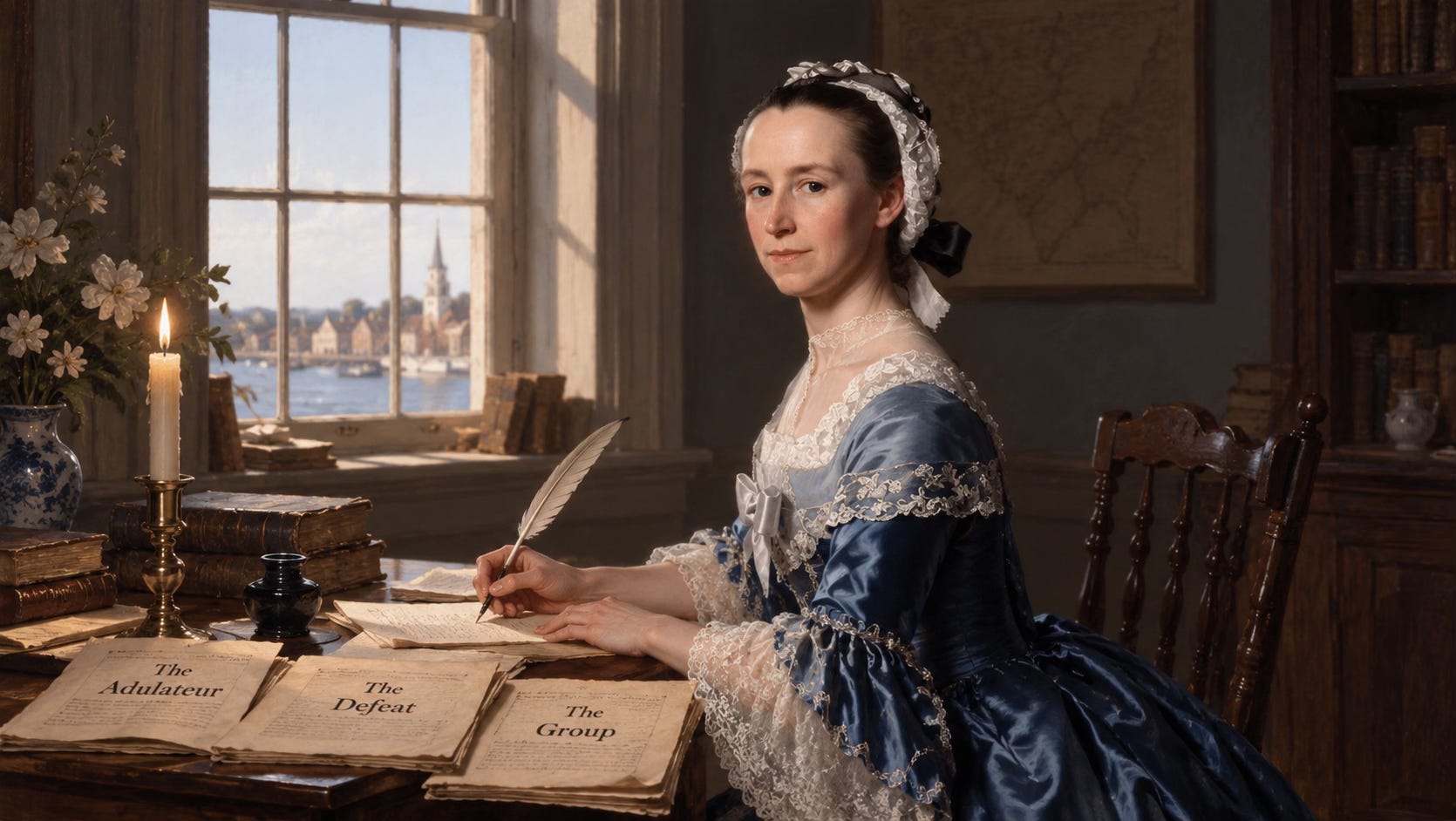
She was James Otis’s sister, and she had the same mind and none of his opportunities.
Mercy Otis was born in 1728 in Barnstable, on Cape Cod. Girls in that time and place were not educated. She sat in on her brothers’ lessons with their uncle, a minister preparing them for Harvard, and read what they read — history, Shakespeare, Milton, Raleigh’s History of the World.
Her brothers went to Harvard. She did not because no woman could.
She married James Warren, a Plymouth merchant and farmer who became a significant political figure in Massachusetts. Their house became a place where the leadership of the resistance argued things out. John and Abigail Adams were friends and correspondents. Samuel Adams, John Hancock, and Elbridge Gerry came through.
And in 1772, Mercy Otis Warren picked up a weapon that was available to her.
She started writing plays.
They were not meant to be staged — theater in Puritan Massachusetts was outlawed until 1806. So they were printed in newspapers and as pamphlets. The Adulateur appeared in 1772, set in a fictional country called Servia, featuring a rapacious governor named Rapatio who is unmistakably Thomas Hutchinson, the royal governor of Massachusetts. The Defeat followed. Then, in 1775, The Group, which savaged the Loyalists appointed to the new mandamus council as a pack of grasping men trading their country for office.
Her satire was sharp, personal, and extremely effective. It made the Crown’s officials ridiculous, which is frequently more damaging than making them villainous, and it did so in a form that people passed around and read aloud.
All of it was published anonymously. Her authorship was known to a small circle and to nobody else. Then the war was won, and she did something that gets her filed in an awkward place in American memory.
She came out against the Constitution.
In 1788 a pamphlet appeared titled Observations on the New Constitution, and on the Federal and State Conventions, signed by A Columbian Patriot. It is one of the most substantial Anti-Federalist arguments produced anywhere, and for more than a century it was generally attributed to Elbridge Gerry. Twentieth-century scholarship established that it was in fact Mercy Otis Warren who wrote it.
Her objections were specific and, on the historical record, mostly vindicated.
There was no bill of rights. There was no guarantee of freedom of the press or of conscience. There was no protection against unreasonable search — her brother’s issue, in her hand, twenty-seven years later. There were no clear limits on standing armies. The federal judiciary was too powerful and too remote. The Executive and the Senate were entangled in a way that would breed intrigue. And the document had been drafted in secret by men meeting behind closed doors.
Her deeper claim was the classical one: that republics depend on the virtue and vigilance of the people, that liberty is lost gradually and by consent rather than seized at once, and that free peoples are usually talked out of their rights rather than robbed of them.
She lost. The Constitution was ratified.
And then she won, which is the part that matters and the part that Americans consistently miss about the Anti-Federalists.
The Bill of Rights exists because people like Warren refused to ratify quietly. Several states approved the Constitution only with recommended amendments attached. Madison, who had argued that a Bill of Rights was unnecessary, went to the First Congress and drafted one anyway, because the political price of not doing so had become too high.
The first ten amendments are the losing side’s terms of surrender, and they are the part of the document most Americans can actually name.
In 1805, at seventy-seven, Warren published a three-volume History of the Rise, Progress and Termination of the American Revolution — under her own name at last. She had known most of the principals personally and had been in the room for a great deal of it.
It cost her John Adams’s friendship. He thought her portrait of him was unjust, and he wrote her a series of letters that were, even by his standards, intemperate. They did not speak for years. Elbridge Gerry patched it up in 1812, two years before she died.
Warren spent her life making arguments that were published without her name, opposing a document that was ratified over her objection, and writing a history that lost her a friend. The search-and-seizure protection her brother argued for in 1761, the free press and free exercise clauses, the limits she demanded in 1788 — they are all in the Constitution now, in the amendments, because she and people like her would not let it pass without them.