
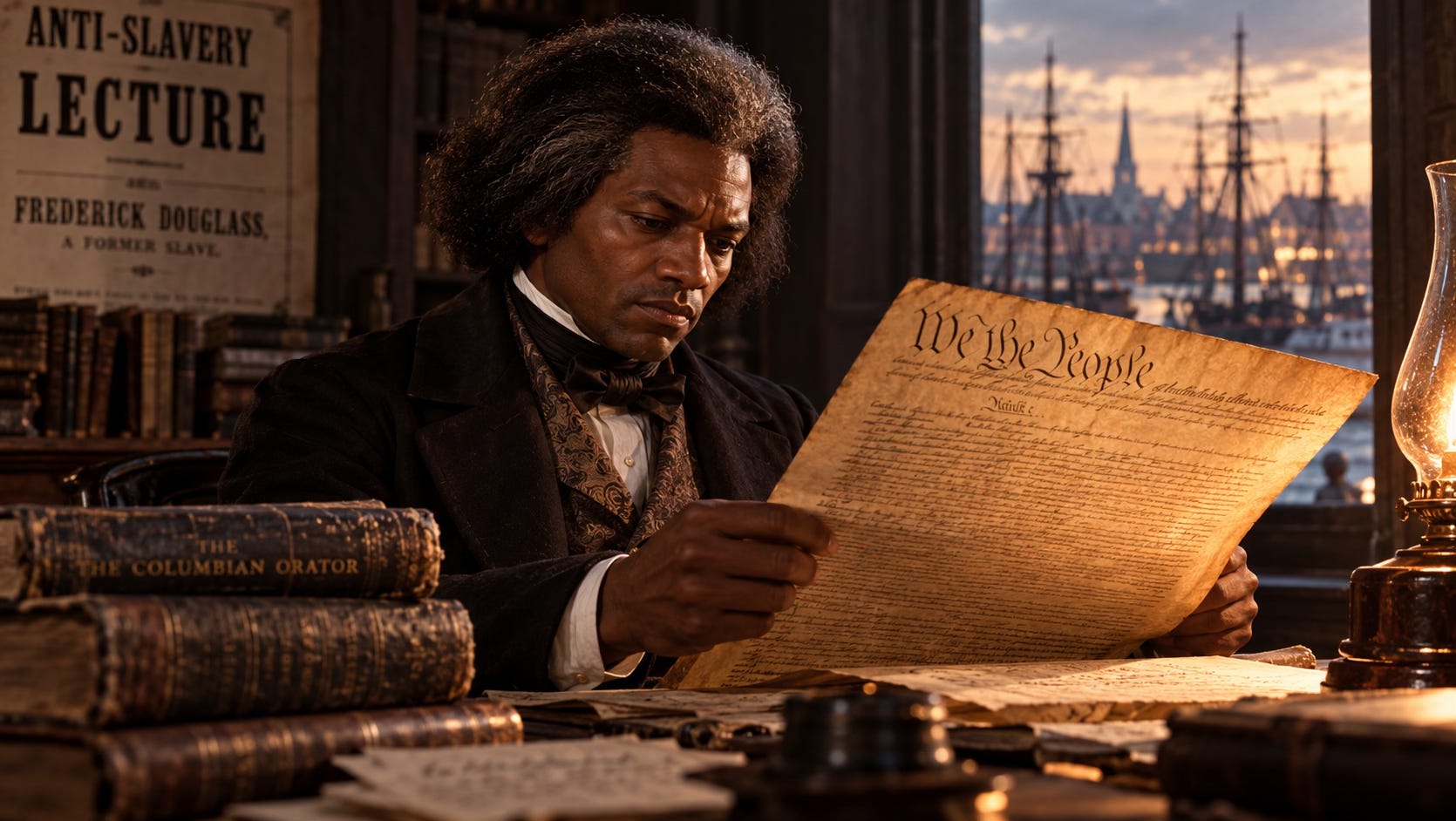
He taught himself to read out of a schoolbook of speeches.
Frederick Bailey was born into slavery in Talbot County, Maryland, around 1818. Sent to Baltimore as a boy, he was started on the alphabet by his owner’s wife until her husband stopped it, on the grounds — which the child overheard — that learning would make a slave unmanageable and unfit to be a slave.
Douglass wrote later that this was the first clear explanation anyone had given him of the mechanism by which he was held, and that from that moment he understood the pathway from slavery to freedom ran through reading.
He finished the job by trading bread to poor white boys in the street for lessons, and by buying, at about twelve, a copy of The Columbian Orator — a popular schoolbook of speeches and dialogues. It contained a dialogue between a master and a slave in which the slave argues his own case and wins, and it contained speeches on liberty from the parliamentary tradition.
Let that sink in: one of the greatest orators of nineteenth-century America learned rhetoric from a textbook while enslaved.
In September of 1838 he escaped by train and steamboat to New York, in something under twenty-four hours, wearing a sailor’s clothes and carrying seaman’s protection papers borrowed from a free Black sailor whose description did not particularly match his own. He changed his surname to Douglass and went to New Bedford.
Three years later he spoke at an antislavery meeting on Nantucket and William Lloyd Garrison heard him.
What followed is the part of the Douglass story most Americans know: the lecture circuit, the 1845 Narrative that was so well written critics claimed no former slave could have produced it, the flight to Britain to avoid recapture after the book identified him, and the return with his freedom purchased by British supporters.
The part that belongs in a publication about American constitutionalism is what happened next, and it cost him nearly everyone he knew.
Garrison’s abolitionism held that the Constitution was a proslavery document — “a covenant with death,” in his phrase — and that the North should therefore dissolve the Union rather than be complicit in it. Garrison burned a copy of the Constitution in public. Douglass, as a Garrisonian, argued this position for years.
Then he changed his mind, and he changed it by reading the text for himself.
His argument, worked out through the late 1840s and stated fully afterward, ran roughly like this: Look at the document itself, not at what the framers privately intended or what the Supreme Court had lately said about it. The word slave does not appear in it. The word slavery does not appear in it. The compromises that protected the institution are written in evasions — persons held to service, other persons — because the men who wrote them were ashamed to name the thing in the charter of a free government.
A document that refuses to name slavery cannot be said to guarantee it. And read plainly, its preamble, its guarantees of due process, its ban on bills of attainder, its provisions for habeas corpus and jury trial and a republican form of government in every state, are all hostile to human bondage.
Douglass concluded that the Constitution, interpreted as it stands, is a glorious liberty document, and that abolitionists who conceded it to the slaveholders had surrendered the strongest ground they had.
Garrison never forgave him. The friendship ended. The movement split.
But Douglass was right about the practical question, which is why this matters beyond the intramural history of abolitionism. His position — that the founding documents belong to everyone and can be used against the injustices they compromised on — became the argumentative foundation of the antislavery constitutionalism that Lincoln practiced, of the Reconstruction amendments, and eventually of the civil rights movement a century later.
None of which made him soft about the country.
On July 5, 1852, in Rochester, invited to give an Independence Day address, he gave the speech that is now called What to the Slave Is the Fourth of July?
He spent the first half praising the founders sincerely and at length — their courage, their reasoning, the risk they ran. Then he turned, and asked what the Fourth of July meant to an American slave, and answered his own question: a day that revealed to him, more than any other in the year, the gross injustice and cruelty to which he was a constant victim.
He told an audience of sympathetic white reformers that the celebration was, to the enslaved, an offense, and that there was no nation on earth guilty of practices more shocking and bloody than the people of the United States at that hour.
And then, having said that, he told them he did not despair, because the arguments the founders had put into circulation, that all men were created equal, could not be confined to the men who first made them.
That is the whole Douglass method, and it is worth naming precisely because both American factions tend to want half of it.
He held that the country was guilty and yet, more importantly, that the country’s founding principles were true; the second fact was the reason the first one could be indicted. He did not have to choose, and he thought anyone who insisted he choose was making a mistake — the Garrisonians by throwing away the charter, and the slaveholders by pretending it was theirs.
Loved this article!