
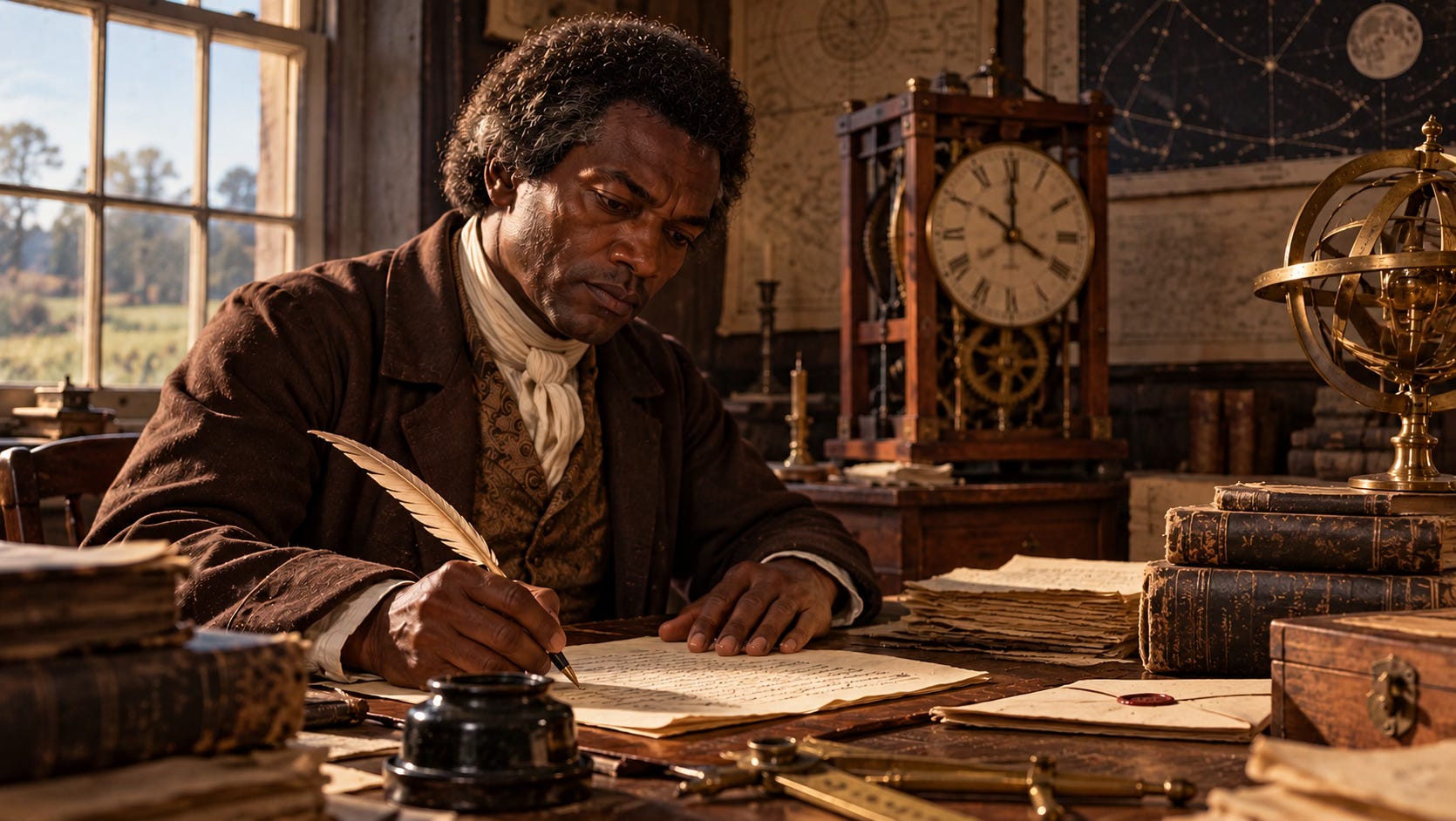
Benjamin Banneker built a clock out of wood.
He was a free Black farmer in Baltimore County, Maryland, born in 1731. Sometime in his early twenties he borrowed a pocket watch, took it apart, studied the gears, and carved a larger version of it out of wood, all by hand. It struck the hours. By most accounts it kept time for decades.
He had almost no formal schooling. His grandmother, an Englishwoman who had come to Maryland as an indentured servant and married a freed African, is traditionally credited with teaching him to read. The rest he taught himself.
In middle age he took up astronomy, working from books and instruments lent by his neighbors, the Ellicott family, who were building mills along the Patapsco River. He taught himself enough mathematics to calculate the positions of the sun, moon, and planets and to predict eclipses. That is the hard arithmetic behind an almanac, and in many early American farmhouses the almanac was the only book on the shelf besides the Bible.
In early 1791, at fifty-nine, he joined Andrew Ellicott’s survey of the boundaries of the new federal district on the Potomac. He kept the astronomical clock and made the nightly observations that fixed the survey’s position. After a few months he went home to his farm.
You may have heard that Banneker later reconstructed the entire plan of Washington from memory after Pierre L’Enfant quit and took his drawings with him. It is a good story. The record does not support it. What he actually did is more interesting.
That August he wrote to the Secretary of State.
Thomas Jefferson had published, a few years earlier in his Notes on the State of Virginia, a passage speculating that Black people were inferior to whites in reason and imagination. He offered it as a suspicion only. It was widely read.
Banneker enclosed a manuscript copy of his almanac, every calculation done by his own hand, and let it answer the suspicion for him. But the letter went further.
He reminded Jefferson of a time, not long past, when the colonists had considered themselves enslaved by the British Crown. And he quoted Jefferson’s own words back to him: that all men are created equal, and endowed by their Creator with certain unalienable rights.
Then he drew the conclusion Jefferson would not. “How pitiable it was,” Banneker wrote, “that a man so convinced of the benevolence of the Father of Mankind should at the same time detain so many of his brethren under groaning captivity and cruel oppression, and be found guilty of the very act he had so loudly condemned in others.”
He did not ask Jefferson for anything. He simply held up a mirror.
Jefferson answered eleven days later, on August 30, 1791. Nobody, he wrote, wished more than he did to see such proofs as Banneker exhibited that nature had given Black Americans talents equal to those of other men. He told Banneker he was sending the almanac to the Marquis de Condorcet, secretary of the Academy of Sciences in Paris.
It was a gracious reply. It was not a change of conduct. Jefferson held people in slavery until he died, and years later, in a private letter, he wondered aloud whether one of the Ellicotts had helped Banneker with the math.
Banneker had the whole exchange printed. His almanacs ran every year from 1792 through 1797 and sold across the mid-Atlantic, carrying the name of a man the Secretary of State had privately doubted.
He died in October 1806. By most accounts, his house caught fire during his funeral and burned with nearly everything in it, including the wooden clock.
But here is what the letter teaches.
Banneker did not argue against the founding. He argued from it. He took the Declaration more seriously than its author did, and he used it as a standard Jefferson could not escape because Jefferson had written it.
That is the power of a written principle. It outlives the convenience of the men who wrote it. It can be quoted back to them.
And it is why the founders insisted on writing things down: rights in declarations, powers in constitutions, limits in plain language. A government bound by text can be held to the text. A government run on discretion or a series of suggestions answers to no one, because there is nothing to quote back.
Banneker had no vote, no office, and no army. He had the author’s own words and he mailed them home.
If you enjoyed this article, you’ll love the documentary.
Thread of Liberty follows the entire thread of the American experiment — from ancient Rome and the Puritans, through the Revolution and the Constitution, to Tocqueville, Lincoln, Calvin Coolidge, and the modern Administrative State.
Watch the full feature documentary at ThreadofLiberty.com