
The first casualty list of the American Revolution was printed as a broadside and circulated through the colonies within days.
Under the heading for the wounded of Lexington, among the names of farmers and tradesmen, is an entry that reads, in the spelling of the day, Prince Easterbrooks — a Negro man.
He was about thirty-five years old. He had been born around 1740, most likely in Lexington, probably the son of an enslaved man named Tony. He was the property of Benjamin Estabrook, from whom he took his surname, and he had been the property of that family his entire life.
Massachusetts provincial law barred what it called Indians and Negroes from training in the militia.
It also required them to turn out armed in an emergency.
Sit with that pair of rules for a moment, because they describe the entire American contradiction in two clauses of colonial statute. You may not be a soldier but if needed you must fight.
Prince Estabrook was on the muster rolls of the Lexington militia anyway. Local practice on this question was looser than the statute, and by all accounts the men of Captain John Parker’s company knew him and stood with him.
On the night of April 18, 1775, the alarm came that British regulars were marching out of Boston.
The Lexington company assembled on the green in the dark, waited, and was dismissed to Buckman Tavern across the road when the regulars did not appear. Around dawn, word came that they were close, and the drum beat again. Roughly seventy-seven men formed up on the common as several hundred British light infantry came down the road.
Parker’s instruction to his men, as tradition has it, was that they should not fire unless fired upon — but if they meant to have a war, let it begin here.
Somebody fired. Nobody has ever established who.
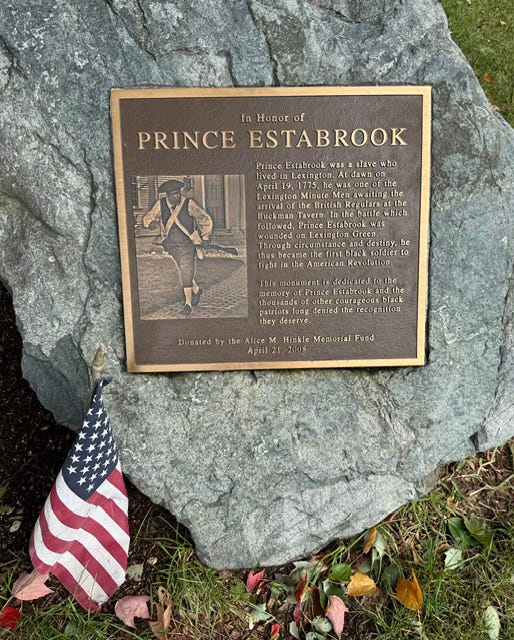
In the volleys that followed, eight Lexington men were killed and nine wounded before the British officers regained control of their troops. Prince Estabrook took a musket ball in the left shoulder.
He was carried to the Estabrook house — the house of the man who owned him — and treated there by Dr. Joseph Fiske along with the other wounded.
He was the first Black casualty of the Revolutionary War.
He recovered in about two months and went back. That is the part that changes the story from an anecdote into a life.
His service record runs, in pieces, across nearly the whole war. Captain Parker’s company in 1775. Colonel Jonathan Reed’s regiment. Colonel Eleazer Brooks’s regiment. The Continental Army in 1780 and 1781, in the 3rd Massachusetts. Colonel John Greaton’s regiment in 1782. Colonel Michael Jackson’s in 1783.
Eight years, on and off, from the first shots to the last.
Historians note honestly that we cannot always tell whether he enlisted on his own initiative or was serving as a substitute for a white man — a common arrangement, and one in which an enslaved man’s service was somebody else’s asset. The record does not say.
What the record does say is that he was eventually freed, and that the mechanism was almost certainly the war itself. Massachusetts abolished slavery in the 1780s through a series of court decisions built on the state constitution’s declaration that all men are born free and equal, and military service was a common route to emancipation before that.
He moved to Ashby, a small town to the west, and lived there with Nathan Estabrook, the son of his former owner. He died around 1830, close to ninety years old, and is buried in the old burial ground there. A headstone placed in 1930 identifies him by unit.
Nothing else about his private life survives. No wife or children are recorded. No account in his own words exists.
There is a temptation to tell this story as an uncomplicated one about patriotism, and an opposite temptation to tell it as an indictment. Neither is honest.
The accurate version is harder. Roughly five thousand Black men served in the Revolution on the American side. Many were enslaved. Some were freed for it and some were not. They fought for a country that had just declared all men created equal and was not prepared to mean it. But they fought anyway and their presence at the founding is a fact and not a footnote.
James Otis had written, eleven years before Lexington, that the colonists were entitled to their rights as men, and that this was as true of Black men as white ones, and that nothing was clearer than that all men are by nature free.
In April of 1775 a man who was not free bled on the common at Lexington to make Otis’s argument stick. When the Lexington monument went up in 1949 listing the minutemen who stood there, it named him with the rest and said nothing about the rest of it. A separate marker went up in 2008 to say the rest of it.