
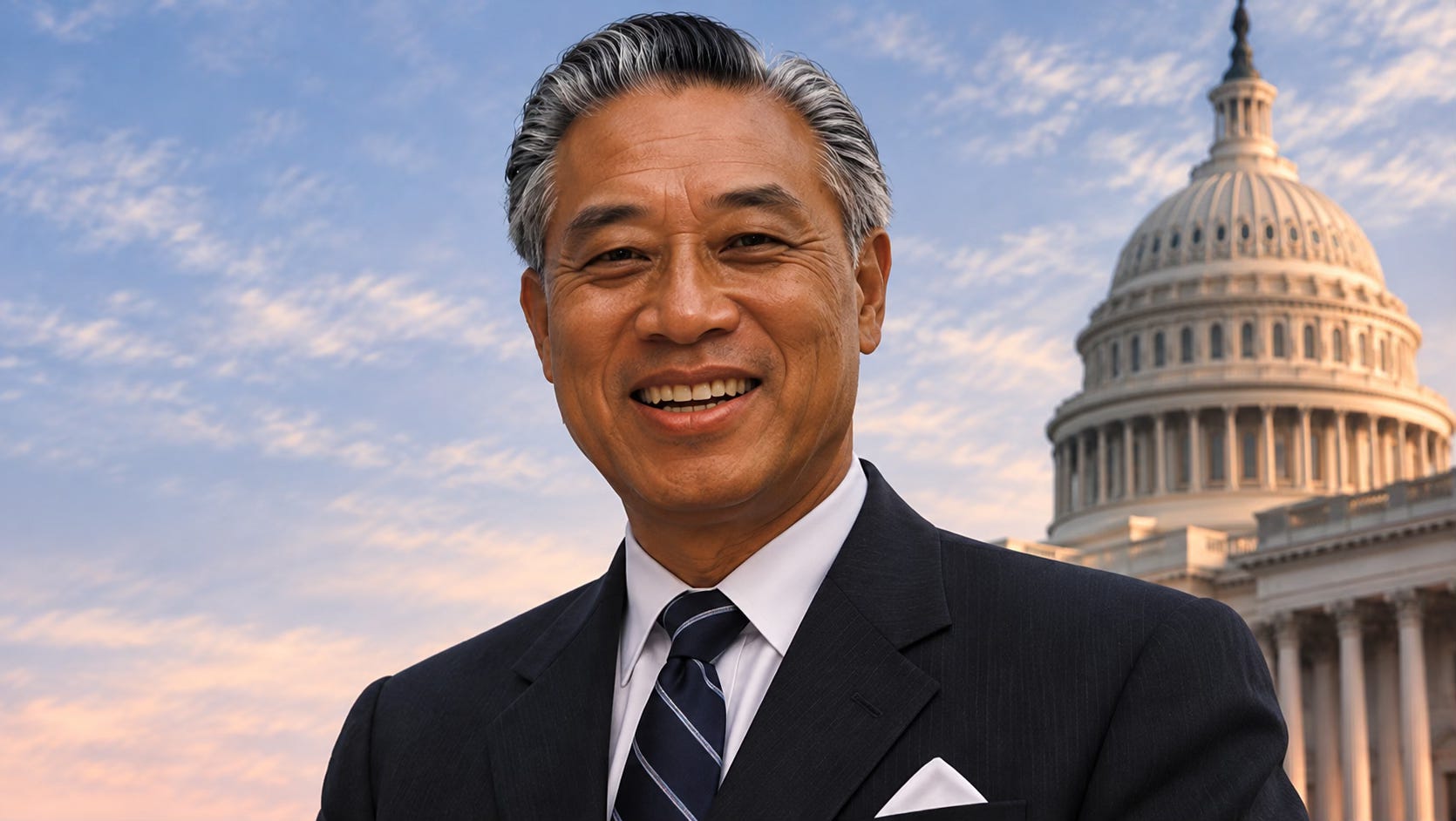
He was born Yau Leong Fong in Honolulu in 1906, the seventh of eleven children, in a Chinese immigrant neighborhood where his father worked on a sugar plantation.
Both parents had come from Guangdong as contract laborers. Neither could read or write English. The family was poor in the specific way that plantation labor made people poor and the children worked from the time they were able.
Fong shined shoes. He sold newspapers. He caught fish and picked beans and sold them. He worked in the plantation fields during school vacations and later for the Pearl Harbor naval shipyard.
It took him four years after high school to save enough to enter the University of Hawaii. He finished in three, worked his way through, and then went to Harvard Law School and earned his law degree.
Now set that biography against the law of the country he was a citizen of.
The Chinese Exclusion Act of 1882 barred Chinese laborers from immigrating to the United States and made Chinese immigrants permanently ineligible for naturalization. It was the first federal law in American history to exclude an entire nationality by name. It was extended to Hawaii after annexation. It was renewed, made permanent, and not repealed until 1943, when wartime alliance with China made it embarrassing — and the replacement quota permitted roughly a hundred Chinese immigrants per year.
Hiram Fong was an American citizen because he was born on American soil. His parents could not have become citizens no matter how long they lived or what they contributed.
He practiced law, co-founded one of the first multiracial law firms in the territory, went into business, and served in the Territorial House of Representatives from 1938, becoming Speaker in 1948. He served in the Army Air Force as a major during the Second World War.
Fong was one of the leading advocates for Hawaiian statehood, which is worth pausing on because the objection to statehood was rarely stated in constitutional terms.
Hawaii’s population was majority Asian and Pacific Islander. That was the problem for a bloc in Congress and a great deal of the resistance to admitting the territory for decades came down to an unwillingness to seat senators elected by such a population.
Despite the pushback, Hawaii was admitted in August of 1959. Fong won one of the two new Senate seats, defeating Frank Fasi, and was sworn in that month.
He was the first Asian American and the first Chinese American to serve in the United States Senate, and the first person of Chinese ancestry elected to Congress. He served three terms, until January of 1977. He remains the only Republican ever elected to the Senate from Hawaii.
What he did there is the point.
He voted for the Civil Rights Acts of 1960, 1964, and 1968. He supported the Twenty-fourth Amendment abolishing the poll tax and the Voting Rights Act. He pushed an amendment providing for federal observers at polling places to protect minority voting.
And he worked on the Immigration and Nationality Act of 1965.
That statute abolished the national-origins quota system that had governed American immigration since the 1920s — a system explicitly designed to preserve the country’s existing ethnic composition, and the legislative descendant of the exclusion regime that had kept his own parents permanently foreign.
A man whose mother and father could never have been naturalized sat in the Senate and voted to end the machinery that had barred them.
He also became, in 1964, the first Asian American to receive votes for President of the United States at a major party convention.
He said, around the time of his election, that he expected to lose money in the Senate and was willing to, and that he was more than pleased with blessings he could not have imagined and would never have attained but for the opportunities a democracy had given him.
He died in 2004 at ninety-seven.
This series began with a lawyer arguing in a Boston courtroom in 1761 that a man’s house is his castle and that a statute contrary to natural equity is void, and that this was true of every man because all men are by nature free.
That argument was made by and for a particular set of English colonists. It did not stay with them, and it was never going to, because arguments of that shape cannot be kept in a box.
A wounded man on Lexington Green who was somebody’s property claimed it. A thirteen-year-old girl sewing a flag in Baltimore had a claim on it that nobody acknowledged. Frederick Douglass picked it up and turned it on the men who thought they owned it. Robert Smalls used it to buy a house at auction and to fight, and lose, in a room full of men writing his people out of the franchise. Ansel Adams put four words of it on the cover of a book about Americans behind wire.
And a plantation worker’s son from Honolulu, whose parents the law had defined as permanently ineligible to belong, took the oath in the Senate chamber and then voted to repeal the law. The American argument is dangerous to whoever tries to hold it exclusively. That is the best thing about it.
If you enjoyed this article, you’ll love the documentary.
Thread of Liberty follows the entire thread of the American experiment — from ancient Rome and the Puritans, through the Revolution and the Constitution, to Tocqueville, Lincoln, Calvin Coolidge, and the modern Administrative State.
Watch the full feature documentary at ThreadofLiberty.com
As always, wonderful.