
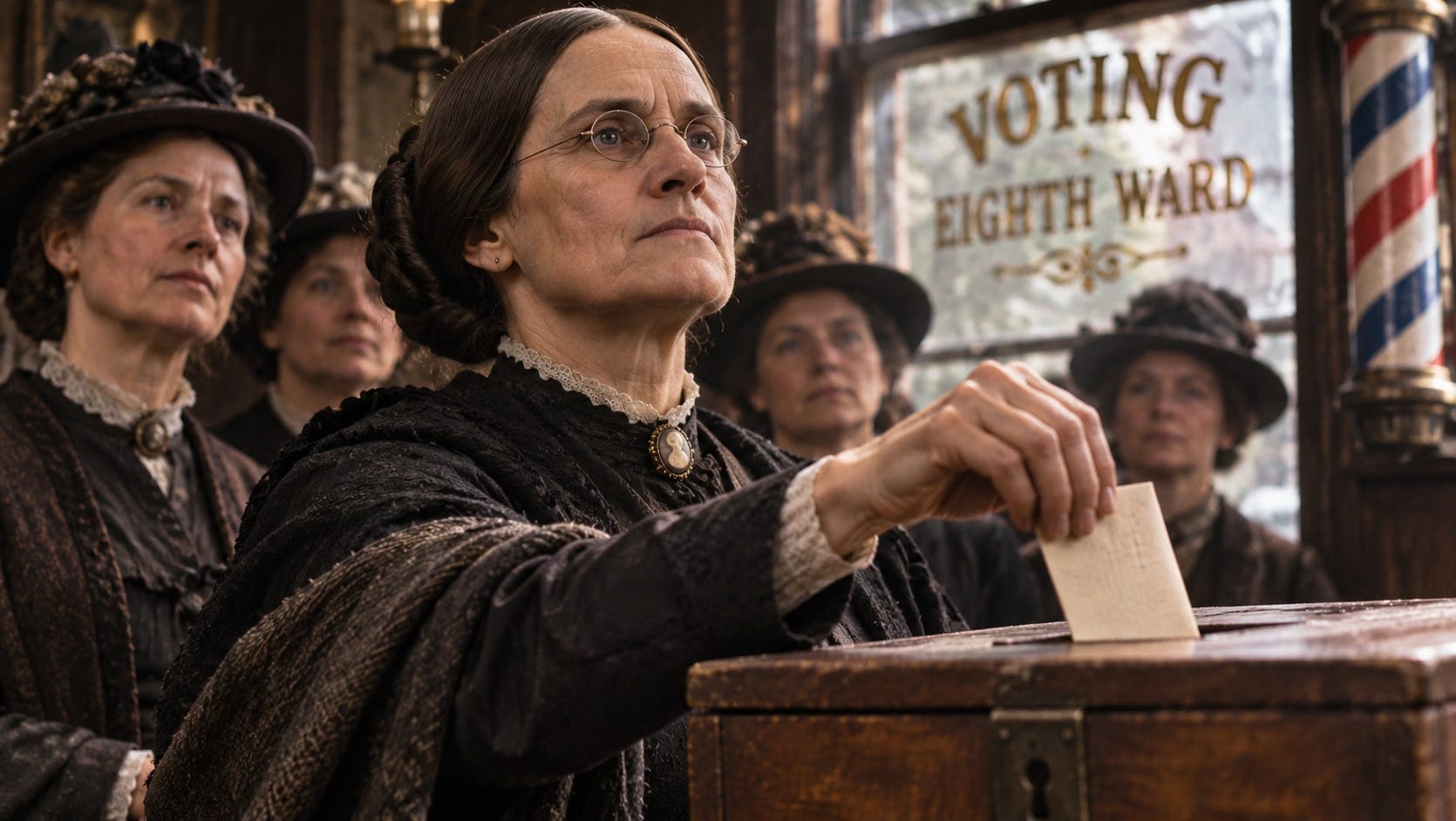
On November 1, 1872, Susan B. Anthony walked into a barbershop in Rochester, New York, where voters in the Eighth Ward were being registered and asked to be put on the rolls.
The inspectors said no.
Anthony then read them the Fourteenth Amendment: all persons born or naturalized in the United States are citizens, and no state shall abridge the privileges or immunities of citizens. Voting, she argued, was one of those privileges. She told them that if they refused, she would personally sue them.
They registered her. Four days later she voted, along with fourteen other Rochester women. That evening she wrote to a friend, delighted, that she had gone and done it and added that she’d voted a straight Republican ticket.
Two weeks later a deputy United States marshal came to her house and arrested her for voting illegally under a federal law written to protect elections in the Reconstruction South.
She was fifty-two and had spent two decades arguing for women’s rights. Now she had something better than an argument. She had a case.
While she waited for trial she gave the same speech in town after town across Monroe County. Its title was a question: “Is it a crime for a citizen of the United States to vote?”
The speech was a reading of the Constitution. She began with the Preamble. “It was we, the people; not we, the white male citizens; nor yet we, the male citizens; but we, the whole people, who formed the Union.” The government was formed to secure the blessings of liberty to the whole people. Not half of them. And not as a favor.
The prosecutor complained that she had prejudiced every possible juror in the county and had the trial moved to neighboring Ontario County. She spoke in every town there too.
The trial opened in Canandaigua on June 17, 1873. The judge was Ward Hunt, a justice of the United States Supreme Court, who in those days also sat on the federal circuit courts.
Hunt ruled that Anthony was not competent to testify in her own defense. When the evidence was in, he did something a judge is not supposed to do in a criminal case. He read an opinion he had written before the trial began, and then directed the jury to return a verdict of guilty.
Her lawyer protested that only a jury could convict. Hunt discharged the jurors without letting them deliberate or be polled.
Then he asked whether the defendant had anything to say.
She did.
She told him he had trampled underfoot every vital principle of the government. She had been denied, she said, the most basic right of the accused, a trial by a jury of her peers, and convicted by men who were all her political superiors under a law she had no voice in making. Hunt tried to stop her several times. She kept going.
He fined her one hundred dollars plus costs. She told him she would never pay a dollar of it and she never did.
Hunt did not order her held until the fine was paid. Had he done so, she could have taken the case to the Supreme Court. He made sure she couldn’t.
The question was settled the other way soon enough. In 1875 the Supreme Court held unanimously in Minor v. Happersett that citizenship did not carry the right to vote. If women wanted the ballot, they would have to amend the Constitution.
So they did.
The amendment that would come to bear her name was first introduced in the Senate in 1878. It took forty-two years. Anthony died in 1906. The Nineteenth Amendment was ratified in 1920.
Here is why her story belongs in this series.
Look at what Anthony did and did not do. She did not ask an agency for a waiver, or a court to invent a right from nothing. She read the text, acted on it in public, and accepted the consequences. When the courts said no, she went to the one place the Constitution says the fundamental law can be changed: the people, through their representatives and their states and the amendment process. It took four decades. It worked and it has never been undone because it was done the right way.
And look at what was done to her. A judge took the verdict away from the jury. Twelve citizens sat through the trial and were not permitted to decide it. That is precisely the power the founders tried to wall off: the decision belongs to ordinary citizens, not to the official in the robe.
Anthony lost the case and won the argument. She did it the way every argument in a republic is finally won. She voted.
If you enjoyed this article, you’ll love the documentary.
Thread of Liberty follows the entire thread of the American experiment — from ancient Rome and the Puritans, through the Revolution and the Constitution, to Tocqueville, Lincoln, Calvin Coolidge, and the modern Administrative State.
Watch the full feature documentary at ThreadofLiberty.com