
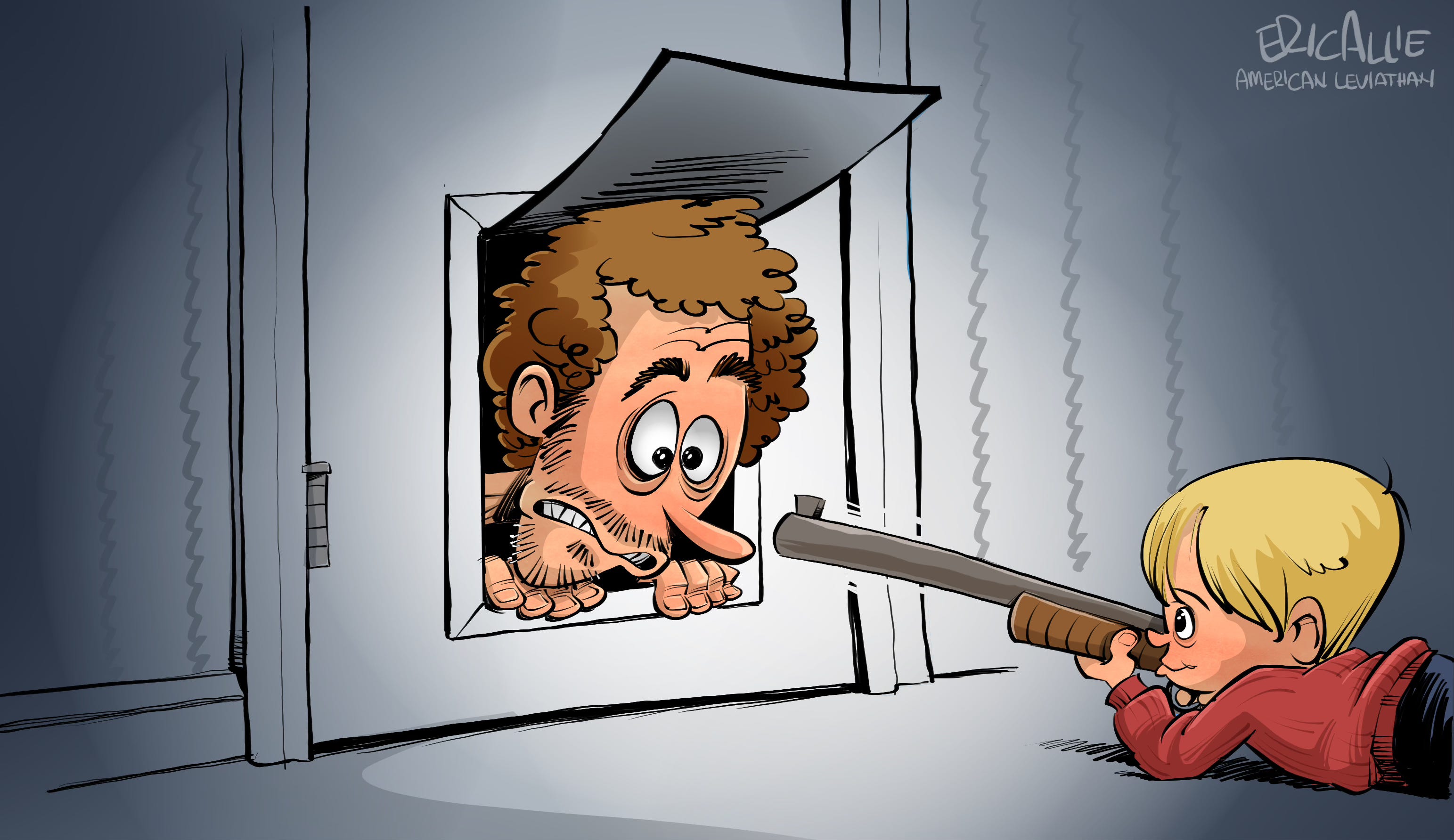
Home Alone isn’t really a comedy.
It’s the most successful self-defense movie in American history.
Every year, millions laugh while watching an 8-year-old do what the state refuses to:
defend his home.
Kevin McCallister isn’t a mischievous kid.
He’s a case study in the oldest political truth there is:
When Leviathan fails, self-defense becomes non-negotiable.
And in Home Alone, the administrative state fails at every layer.
The System Makes Promises It Can’t Keep
Kevin’s home is attacked repeatedly.
He calls for help.
He does everything the “system” tells you to do.
And what does he get?
A dispatcher reading from a script
A patrolman who knocks once and leaves
A department that never follows up
A bureaucracy that sees a crisis as paperwork, not urgency
This is Leviathan in a nutshell: the more it grows, the less it protects.
The state claims a monopoly on force, but refuses a monopoly on responsibility.
So the burden shifts back to the citizen.
Kevin Doesn’t Want to Defend Himself — He Has No Choice
Self-defense in Home Alone isn’t vigilantism.
It’s realism.
The Wet Bandits aren’t criminal masterminds.
They’re opportunists exploiting an absent state.
They assume no one will stop them because no one ever has.
Kevin tries the compliant route: call the police, wait, trust “the system.”
It fails.
So he does what every sane person does when the distance between danger and response becomes too large:
He rejects dependence.
He asserts agency.
He defends the home.
Not because he’s brave.
But because he’s alone.
Leviathan’s Nightmare: An Empowered Citizen
If there’s one thing the administrative state fears, it’s this: the individual who realizes no one is coming.
That realization is political dynamite.
Kevin stops being passive.
He stops outsourcing his safety.
He stops waiting for institutions that don’t work.
He becomes the exact kind of citizen Leviathan hates:
resourceful
decisive
unafraid
self-governing
He takes responsibility because the system abdicates it.
And when individuals reclaim responsibility, the myth of Leviathan’s necessity begins to crumble.
The Booby Traps Aren’t Gags — They’re a Philosophy
People remember the paint cans and blowtorches as humor.
But beneath the slapstick is clarity:
When you can’t rely on institutions, you build your own defenses.
Kevin fortifies entry points.
He controls choke points.
He uses terrain.
He outthinks adversaries.
He prepares for escalation.
Everything he does is rooted in the oldest human right: the right to secure what is yours when no one else will.
This is the scene Leviathan wants memory-holed.
Because it proves a simple point: citizens are far more capable than the managerial class imagines.
The Police Don’t Save Kevin — They Arrest the Men He Already Defeated
The most revealing moment comes at the end.
After Kevin fights, bleeds, struggles, and survives, the police finally arrive.
And what do they do?
They arrest two men who are already tied up, beaten, and incapacitated.
The state didn’t stop the crime.
It processed it.
This is the fundamental flaw of Leviathan:
It claims the authority of a guardian but performs the role of a clerk.
The Real Lesson of Home Alone
The movie is not a child’s fantasy.
It’s a constitutional lecture disguised as slapstick.
It teaches what every civilization eventually relearns:
Public safety is a mirage without local competence.
Bureaucracy cannot replace vigilance.
A distant state cannot substitute for neighborhood strength.
And no government, no matter how large, can arrive fast enough to replace individual responsibility.
Kevin’s survival isn’t accidental.
It’s ideological.
He lives because he refuses to outsource the defense of what matters most.
That is the moral truth Leviathan despises.
The Warning Hidden in the Laughter
If you watch the movie not as a comedy but as a political parable, the message becomes blunt:
A society that relies on Leviathan for protection will one day find itself home alone.
And on that day, the people who survive won’t be the ones who believed in the system.
It’ll be the ones who believed in themselves.