
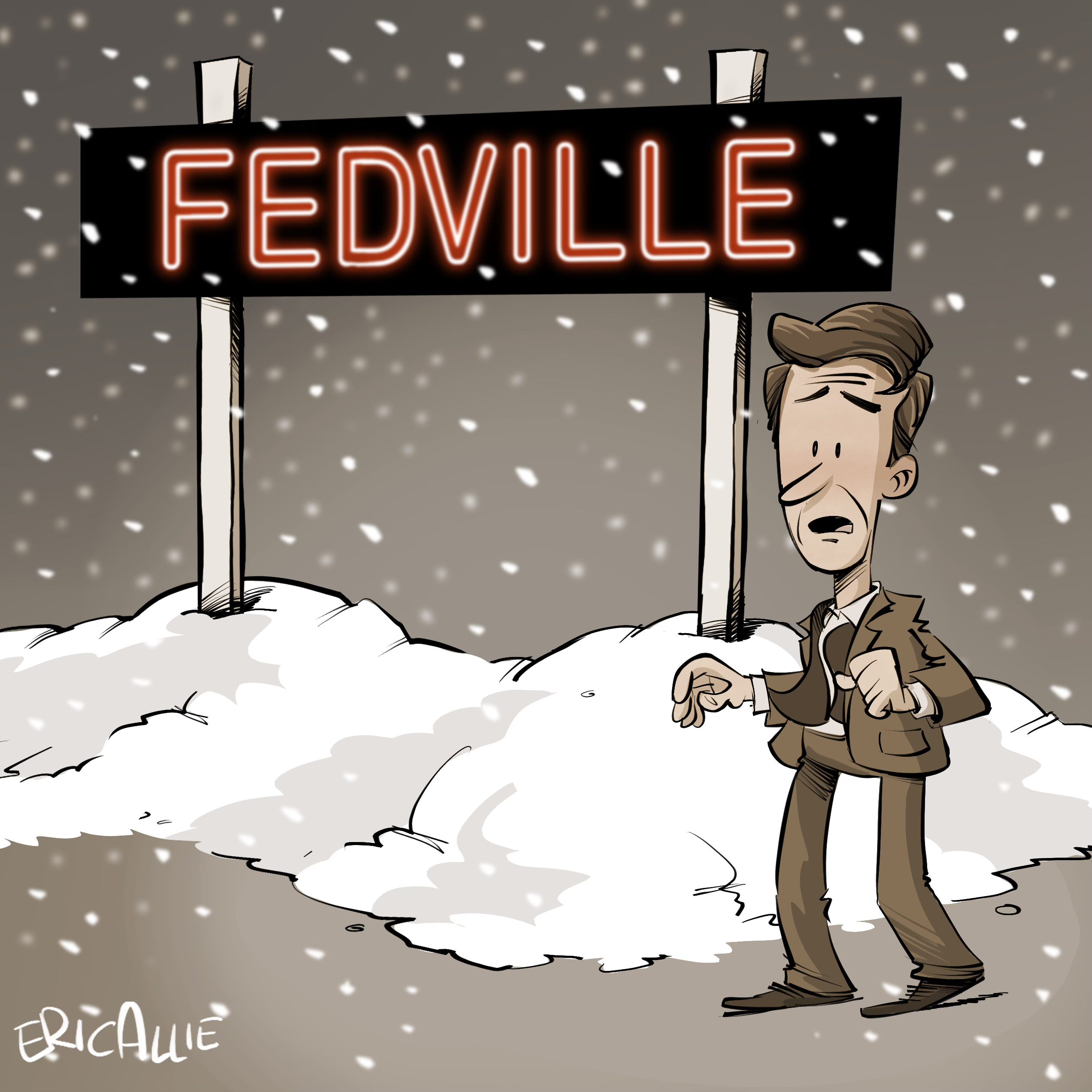
In It’s a Wonderful Life, the crisis is simple: ordinary people trying to build ordinary lives are threatened by a financial power structure too concentrated, too arbitrary, and too insulated from the consequences of its own decisions.
Frank Capra filmed it as a local morality play—George Bailey versus Mr. Potter.
Today, the story is national, and Mr. Potter has a new name:
The Federal Reserve.
Bedford Falls Had One Mr. Potter. We Have an Entire Institution.
The whole tension in the film is that George Bailey wants a world where local people have control over their own futures—where decisions are made close to home, where risk is human, and where community matters.
Potter wants the opposite: centralized control, managed outcomes, and dependence on the banker who pulls every lever.
That’s today’s Federal Reserve.
The Fed doesn’t merely influence the economy.
It manages it, distorts it, and decides winners and losers with the same cold detachment Potter used when he tried to buy out the town during the bank panic.
One man tried to own Bedford Falls.
The Fed tries to own the entire price of money.
George Bailey Believed in Skin in the Game. The Fed Believes in None.
In the movie, the Bailey Building & Loan exists because real people commit real savings into real projects.
The institution is humble, fragile, and rooted in community.
The Fed is the opposite:
No skin in the game
No accountability
No proximity to the people affected
No limits on intervention
No feedback from reality—only from models
When George Bailey makes a mistake, the town suffers and so does he.
When the Fed makes a mistake, the town suffers and the Fed does a multi-billion dollar renovation on its offices and holds a press conference.
The Film’s Pivotal Scene Is the One America Ignored
When the bank run hits, Bailey speaks the truth:
“You’re thinking of this place all wrong. As if I had the money back in a safe. Your money’s in Joe’s house… and the Kennedy house… and a hundred others.”
He’s explaining real finance—savings turned into productive investment.
If you updated that line for the Federal Reserve, it would sound more like this:
“Your money isn’t in Joe’s house.
It’s in liquidity operations, asset purchases, facility expansions, and a spreadsheet no one voted for.”
The Fed took the logic of Potter—centralize, abstract, control—and scaled it into a national architecture.
America used to have thousands of George Baileys.
Now we have one Potter with 12 regional branches.
What Happens When Mr. Potter Sets the Interest Rate
The fundamental power in It’s a Wonderful Life is interest.
Potter uses rate-setting as a weapon.
Bailey uses it to give people a path to ownership.
Today the Fed plays Potter’s role:
Artificially cheap money → inflates assets
Sudden tightening → crushes borrowers
Backstopped bailouts → reward the biggest
Zero accountability → isolate power from consequences
Potter tried to own Bedford Falls by manipulating rates. The Fed shapes the entire country the same way.
George Bailey made mortgages possible. The Fed made houses unaffordable. George steadied the town. The Fed destabilized the nation.
What the Movie Actually Teaches Us
People misremember It’s a Wonderful Life as sentimental.
It’s not entirely. Maybe we should look at it as a warning.
The film ends with a community choosing George Bailey over Potter—not because George is perfect, but because local agency beats centralized power every time.
The moral isn’t that we should hope Potter has a change of heart.
He won’t.
They never do.
The moral is that a free society depends on systems where risk, responsibility, and accountability stay close to home.
That’s the very thing America traded away when it built a monetary Leviathan capable of steering the entire economy from a conference room.
The Wonderful Life We Lost — and the One We Need Back
Bedford Falls thrived when money served people and communities—not the other way around.
Today we’ve reversed the equation.
When the Fed sets the price of everything, it sets the terms of everything.
And what it demands in return is exactly what Mr. Potter demanded:
Control. Dependence. And a town too small to push back.
But here’s the quiet truth Capra slipped into the final scene:
George didn’t defeat Potter with force. He defeated him by making Potter irrelevant. Communities built around shared responsibility beat centralized power every time.
They did in the movie.
They could again.
If we decide we want that life back.