
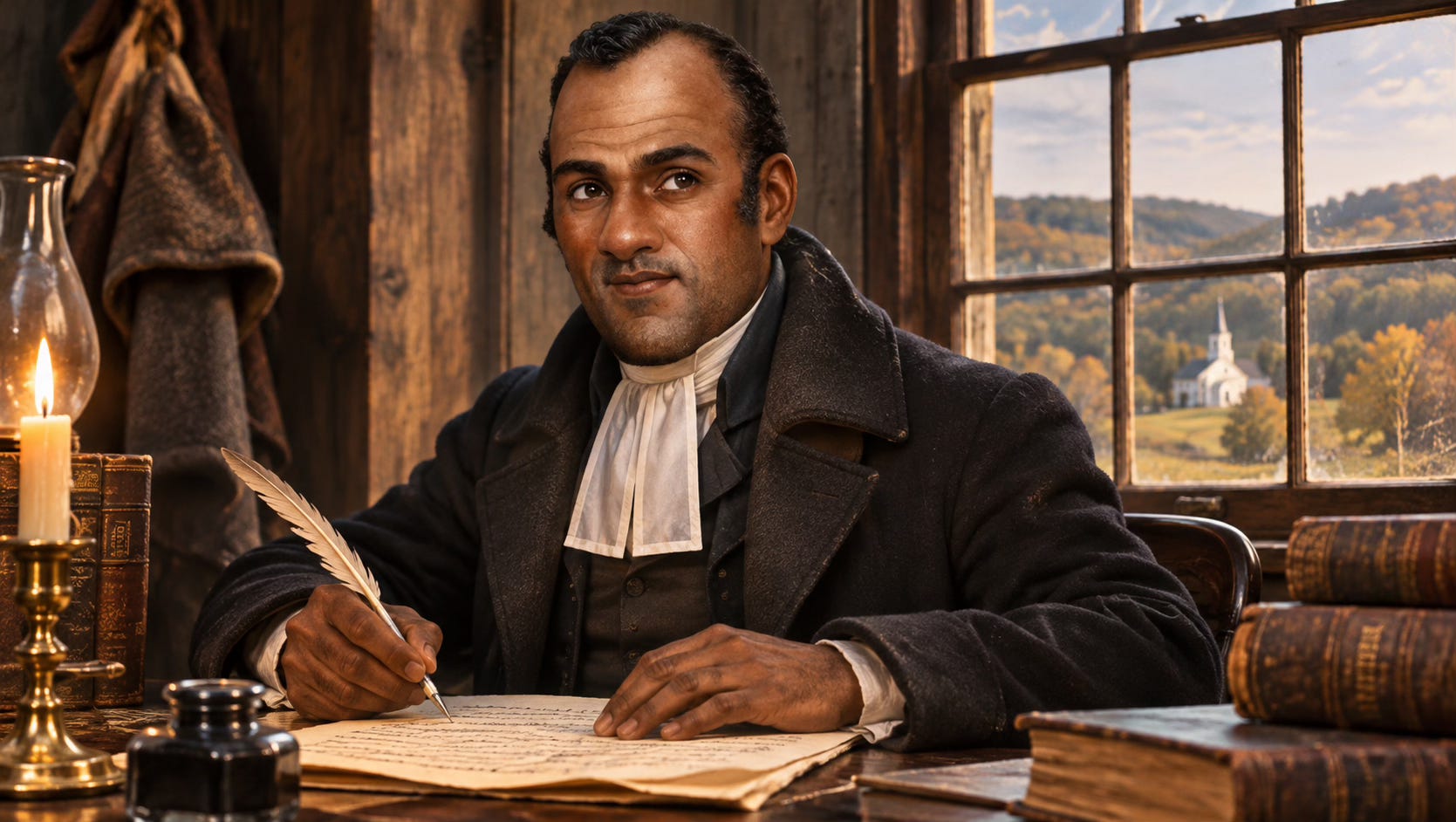
In the spring of 1775, when word of Lexington and Concord reached western Massachusetts, a minuteman from Granville marched east with his company toward Boston.
His name was Lemuel Haynes. His father was African. His mother was white. He had been given away as an infant and raised as an indentured servant on a farm, bound by contract until he turned twenty-one.
He had been free for less than a year.
Haynes was born in West Hartford, Connecticut, in 1753. The family he was bound to, the Roses of Middle Granville, were devout Congregationalists and the household ran on Scripture and the sermons of the Great Awakening. He worked the farm by day and read at night, by the light of the fire, whatever he could get his hands on; mostly theology.
When his indenture ended in 1774 he signed up to be a minuteman. After Lexington he served with the army around Boston, and in 1776 he went north with the garrison at Fort Ticonderoga.
Sometime in those years, most likely 1776, he sat down and wrote an essay. At the top he copied a sentence that had just appeared in the newspapers: “We hold these truths to be self-evident, that all men are created equal.”
He titled his essay Liberty Further Extended.
The argument is simple and relentless. Liberty, Haynes wrote, is a jewel handed down to man from heaven, not a privilege granted by other men. If the colonists were right that no Parliament could take their liberty without consent, then no master could take a man’s liberty either. The logic did not stop at the color line, because the logic never mentioned a color line.
“Liberty is equally as precious to a black man as it is to a white one,” he wrote, “and bondage equally as intolerable to the one as it is to the other.”
He took the colonists’ grievances against the Crown and turned them around. The same men who complained that taxes on tea reduced them to slavery held other men in actual slavery. If the first was tyranny, what was the second?
And then he didn’t publish it.
We don’t know why. The manuscript stayed among his papers until a historian found it in a Harvard library and published it in 1983. For two centuries one of the earliest Black commentaries on the Declaration of Independence existed in a single handwritten copy.
However, Haynes did not need the essay to make a name for himself. He made it in the pulpit.
In 1785 he was ordained a Congregational minister, among the first Black men ordained by a mainstream American denomination. In 1788 he was called to the West Parish of Rutland, Vermont, a white congregation, and he stayed for thirty years. In 1804 Middlebury College gave him an honorary master’s degree, generally recorded as the first advanced degree awarded to a Black American.
His preaching was learned, sharp, and hard to argue with. When a popular Universalist preacher came through Rutland teaching that every soul would be saved regardless of conduct, Haynes answered him with a short sermon comparing the visitor’s message to the serpent’s promise in Eden: you shall not surely die. It was reprinted for decades.
He was also, to the surprise of modern readers, a fierce Federalist. He admired Washington, distrusted Jefferson, and preached that liberty without virtue becomes license, and license becomes tyranny.
In 1818 his congregation turned him out, partly over politics and very likely partly over race. He moved on to other pulpits and died in Granville, New York, in 1833.
Here is why he belongs in this series.
Haynes did not argue that the Declaration was a lie. He argued that it was true and that its truth was larger than the men who signed it were prepared to admit. Rights come from God, not from the colonial assembly, not from Parliament, and not from the man who holds your indenture.
That is the same principle the founders used against the Crown. It is the same principle every life in this series rests on.
A right that comes from the state can be handed out selectively. A right that comes from God belongs to everyone the state would prefer to leave out.
Haynes understood that in his early twenties, with a musket, in a country that had not decided whether he was a citizen. He wrote it down. It just took two hundred years for anyone to read it.
If you enjoyed this article, you’ll love the documentary.
Thread of Liberty follows the entire thread of the American experiment — from ancient Rome and the Puritans, through the Revolution and the Constitution, to Tocqueville, Lincoln, Calvin Coolidge, and the modern Administrative State.
Watch the full feature documentary at ThreadofLiberty.com
What a wonderful story about an exceptional man. Thanks for writing about him.