
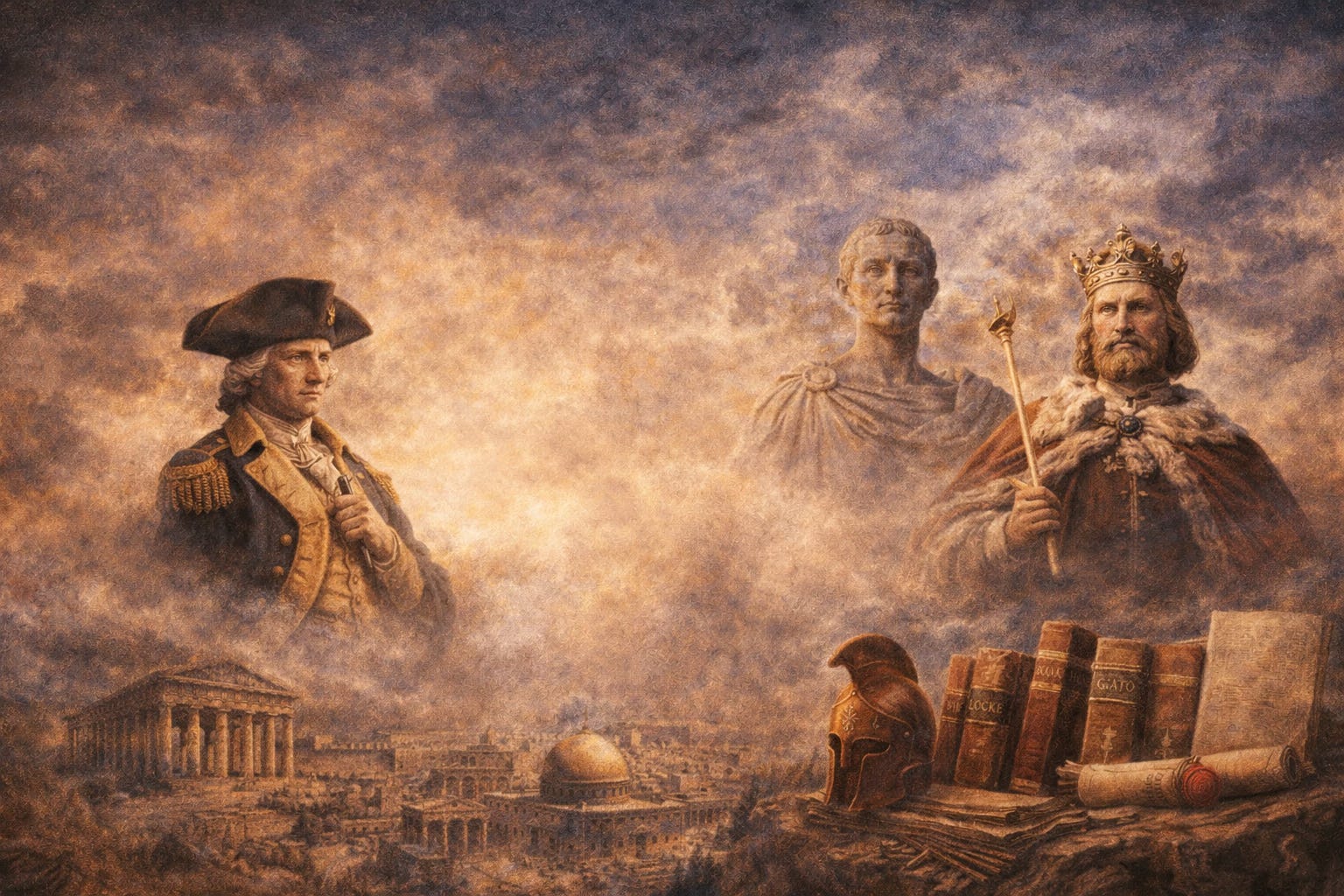
There’s a popular modern myth that America is “an idea.”
That’s true, but it’s also misleading in the way fortune-cookie wisdom is misleading.
America is not just an idea. It’s an idea with a genealogy—a bloodline of arguments about law, power, human nature, and God. It’s about a people with a very unique Constitution, borders and customs built up over the course of centuries.
And if you trace that bloodline, you run straight into a paradox:
The intellectual foundation for American liberty is heavily British.
Yes, Britain—the empire we rebelled against.
The Americans who lit the fuse in 1776 were not trying to become something entirely new. In a very real sense, they believed they were fighting for something very old:
The rights of Englishmen.
But behind those rights was an even older inheritance—Sparta, Athens, Rome, Jerusalem—civilizations that argued, each in their own way, about virtue, order, law, and the limits of power.
America did not come from nowhere yet in many ways, is still deeply unique.
It is a braid of strands pulled from history and weaved into a new national fabric.
From Sparta, a severe devotion to civic duty and the idea that a people must be capable of self-rule—or someone else will rule them.
From Athens, a cautionary tale: democracy without restraint becomes mob passion dressed up as justice.
From Rome, the architecture of a republic—mixed government, checks, offices, law—and also the warning of what happens when a republic becomes an empire because citizens trade liberty for bread and entertainment.
From Jerusalem, the radical moral claim that the human person is not a tool of the state—that there is a law above the law, a Judge above the judges.
Then comes London, where the English tradition of local self-government, common law, and resistance to tyranny sharpens into a political philosophy that the Founders devoured.
This is what we call the Whig inheritance.
Not “Whig” as a dusty party label. Whig as a worldview:
Power is dangerous.
Human nature is flawed.
Liberty requires structure.
Law must bind rulers, not just the ruled.
Property matters because independence matters.
Resistance to tyranny is not just permissible—it can be a duty.
The Founders didn’t pull these ideas from the air. They read them. Quoted them. Copied them. Fought over them.
John Locke’s natural rights and social contract theory.
Algernon Sidney’s resistance theory.
James Harrington’s republican thinking.
Cato’s Letters (Trenchard & Gordon), which were basically the colonial version of “these people are trying to rule you, don’t let them.”
The American Revolution wasn’t a consumer dispute over taxes.
It was an argument over whether rights come from the state—or whether rights come from God (or nature) and the state exists to secure them.
That distinction is everything.
Because if rights come from the state, then the state can unmake them whenever it has a reason. Crisis. Safety. Emergency. Experts.
But if rights come from something higher than the state, then the state is not your creator.
It’s your employee.
And that worldview is what built America.
Tocqueville later noticed something fascinating: Americans had inherited English local self-government so deeply that they practiced freedom like a habit—not a performance.
Which leads to a question we can’t dodge:
If the inheritance was British… why did it explode here?
Because the colonies became laboratories.
Which is next.
Well said......exceept there are no degrees of unique. Unique is.........unique.
What about what was adopted from the Haudensaunee? Everything except the part where the women are in charge. If that had been also adopted by the founding fathers, the US would not have become the imperialist war mongering country of today.