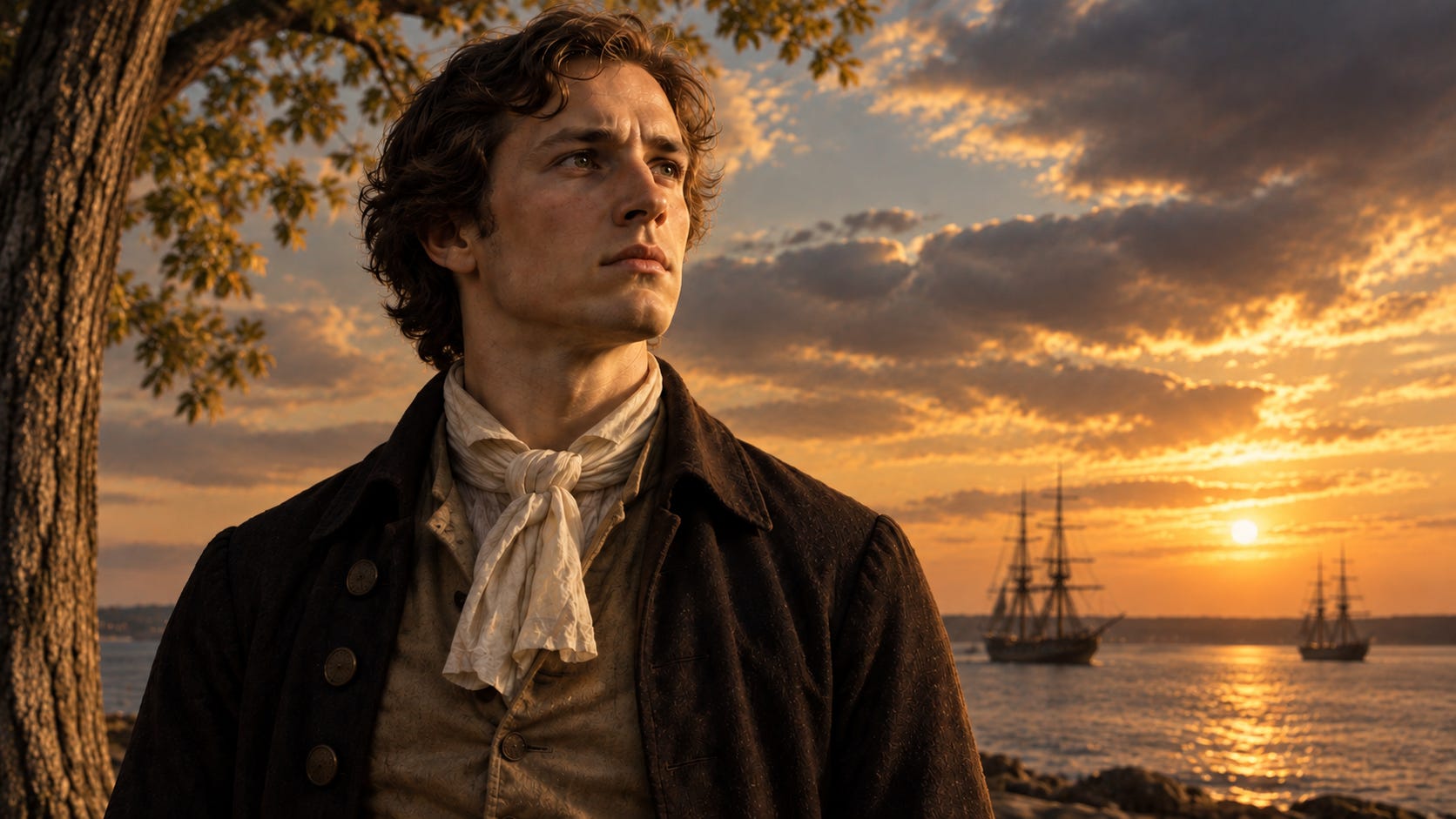
Nathan Hale was a schoolteacher.
That is the detail everyone skips past, and it is the whole point of the story.
He graduated from Yale in 1773 at eighteen, with honors, alongside a classmate named Benjamin Tallmadge. He taught school in East Haddam and then in New London, Connecticut. By the accounts of people who knew him he was athletic, well-liked, conspicuously handsome, and serious about his students — he reportedly taught a class for young women in the early morning hours, before the boys arrived, which was not a common practice.
He was not a soldier by temperament or training. He was a young man with a Latin education and a good reputation in a small town.
Then Lexington happened, and he enlisted. He became an officer in Knowlton’s Rangers.
By September 1776 the situation in New York was desperate in a specific and unglamorous way: Washington did not know where the British army was going next.
Long Island had been lost. The army had escaped across the East River. Howe held Brooklyn and would soon hold Manhattan, and Washington needed to know his intentions — troop dispositions, movements, where the next landing would come.
He asked Lieutenant Colonel Thomas Knowlton to find a volunteer from his Rangers to go behind the lines.
Nobody volunteered. This is not a slight on the men present. Espionage in the eighteenth century was regarded as dishonorable work, unbecoming a gentleman, and the penalty for it was not a prisoner exchange. It was a rope, without a trial.
Nathan Hale volunteered.
His friends tried to talk him out of it. William Hull, who had known him at Yale, argued with him directly and later wrote down Hale’s reply — that every kind of service necessary to the public good becomes honorable by being necessary, and that he owed his country the accomplishment of an object so important.
He crossed to Long Island around the middle of September, dressed as a Dutch schoolmaster looking for work. It was not a bad cover. It happened to be true.
But Hale was, by every professional standard, an absolutely terrible spy.
He carried no cipher. He made his notes in plain Latin and hid them in his shoes. He seems to have told at least one person who he actually was. He had no contacts, no exfiltration plan, and no training whatsoever, because there was no such thing as training. Because of his lack of subtlety, he quickly came on to Robert Rogers’ radar.
Rogers, who’d formed and led Roger’s Ranger during the French and Indian War, was very much a mercenary. He’d tried to play the Americans and British against each other to see who would give him the most money and highest commission. Washington, unamused, had personally interrogated Rogers and then promptly had him arrested.
But Rogers escaped in September and made his way to Long Island. Within days of Hale’s landing on the island, Rogers was on his trail, eventually persuading Hale that he too was a patriot spy. Hale confessed his mission to Roberts. The next night, Roberts invited Hale to dinner at a local tavern while having the establishment surrounded by former Rangers loyal to Roberts.
Hale was taken that night of September 21. The notes in his shoes removed all doubt: Hale was absolutely a patriot spy. He was brought before General William Howe at the Beekman Mansion in Manhattan. There was no court-martial. Under the laws of war then in force, a man taken out of uniform behind enemy lines had no defense and was entitled to no proceeding.
After a few abrupt questions, Howe ordered him hanged the next morning.
Nathan Hale was executed on the morning of September 22, 1776, near what is now midtown Manhattan. He was twenty-one years old.
What we know about his conduct comes largely from the enemy. Two British officers, Lieutenant Frederick MacKenzie and Captain John Montresor. Montresor, a British engineer officer, eventually came across the lines under a flag of truce and described the execution to American officers, including William Hull, who wrote it down.
Montresor reported that Hale asked for a Bible and was refused. That he was permitted writing materials and wrote letters — to his brother, and to an officer he had served under — and that those letters were destroyed on the spot, one account holding that the provost marshal did it so the rebels would not know that one of their men could die with that much composure.
And Montresor reported the speech at the gallows.
The line as it comes down to us is: “I only regret that I have but one life to lose for my country.”
It is very likely not exactly what he said, and it is almost certainly not original.
Joseph Addison’s tragedy Cato was the most popular play of the age among American patriots — Washington had it performed for the army at Valley Forge — and it contains that exact lament that we can die but once to serve our country. Every educated man in that generation knew the play the way we know movie dialogue.
So Hale, standing under a tree with a rope around his neck at twenty-one, reached for a line from a play about a Roman republican who chose death over submission to a tyrant.
That does not diminish it. That is the thread of this entire series in a single act.
A young man with a classical education, formed by a republic that did not yet exist, quoting a play about Roman liberty to British officers who were about to hang him — and doing it well enough that the enemy carried the story back across the lines because they could not stop talking about it.
There is a coda.
Four years later, Benjamin Tallmadge — Hale’s Yale classmate — became Washington’s spy master and was running the Culper Ring in New York City, the most effective intelligence network of the war. Tallmadge would later be the officer who took custody of Major John André after Benedict Arnold’s treason was exposed.
André was a British officer caught out of uniform behind American lines. The exact offense. The exact penalty.
Tallmadge, by his own later account, told André plainly that he had a friend once who was in his situation and that the friend was hanged. He and André had become genuinely friendly during the man’s confinement. Tallmadge testified against him anyway, and André was hanged at Tappan, NJ on October 2, 1780.
The laws of war applied both ways. That was, in a sense, the whole American argument: the rule does not bend for the man you like.
Hale accomplished nothing militarily. He gathered no intelligence, delivered no report, and changed no British movement. Judged as an operation it was a total failure that cost a promising young man his life.
But judged as an argument about what free men owe to their country that didn’t even it’s an extraordinary argument that’s been running for two hundred and fifty years and has not stopped.
If you enjoyed this article, you’ll love the documentary.
Thread of Liberty follows the entire thread of the American experiment — from ancient Rome and the Puritans, through the Revolution and the Constitution, to Tocqueville, Lincoln, Calvin Coolidge, and the modern Administrative State.
Watch the full feature documentary at ThreadofLiberty.com


Why did you disable scanning for AI text? Did you use AI in writing this piece?