
The Articles of Confederation were a noble failure.
They were built out of fear—fear of centralized power, fear of monarchy, fear of becoming what they just fought.
But by the mid-1780s, reality was doing what it always does:
It was punching the theory in the face.
Debt.
Disorder.
Weak enforcement.
No coherent national authority.
A government that could request, but not compel.
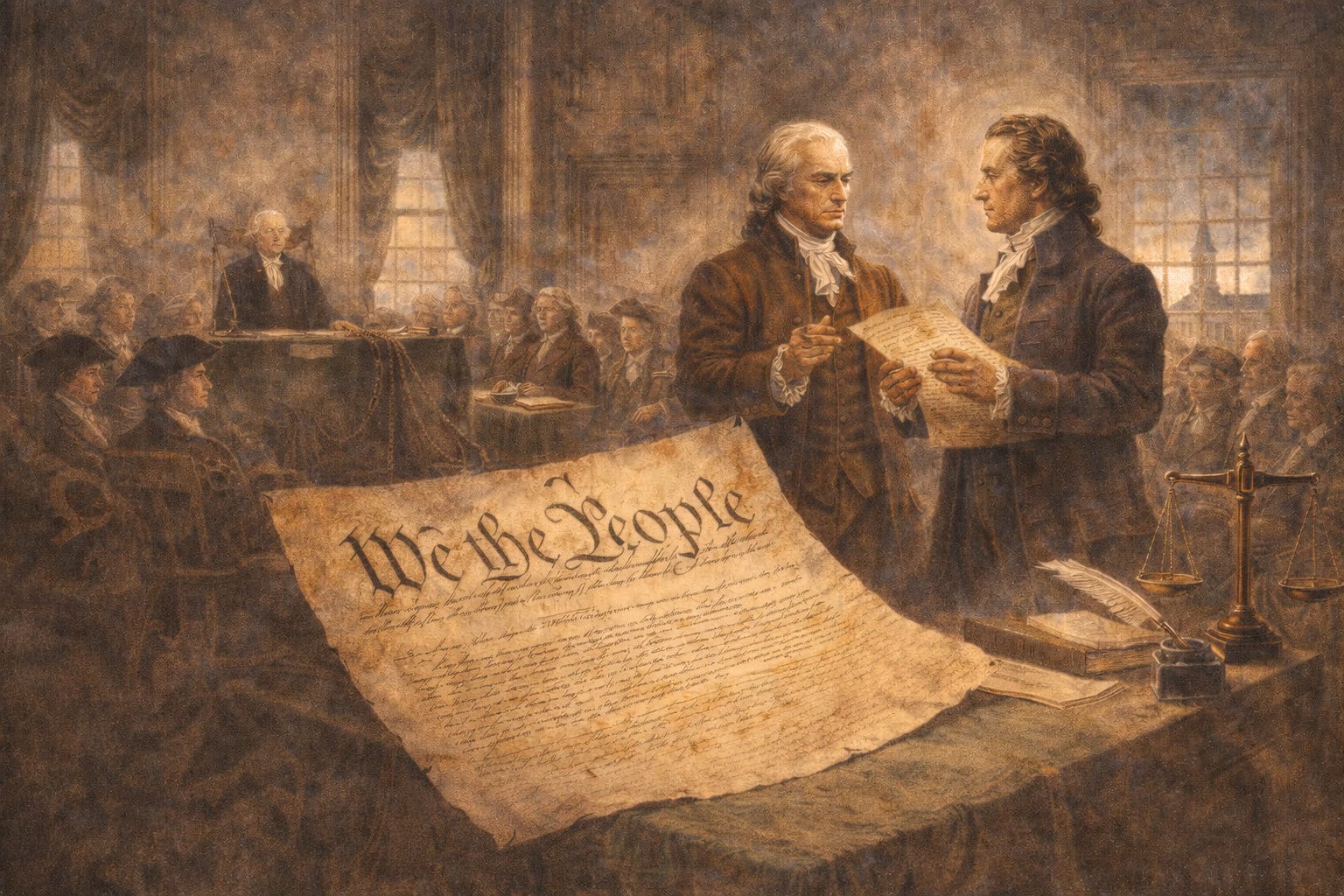
So the founders convened in Philadelphia to do something radical:
Take Whig political theory and turn it into machinery.
This is where the Declaration, Constitution, and Bill of Rights become a three-part chord:
The Declaration lays the philosophical foundation: rights, consent, legitimate government, right of resistance.
The Constitution builds the structure: separation of powers, federalism, enumerated powers, checks and balances.
The Bill of Rights makes explicit what the structure exists to protect.
And the through-line is the Founders’ central tension:
A government strong enough to govern, but constrained enough not to devour liberty.
This is where the Madison/Hamilton/Mason triangle matters.
Mason: no Bill of Rights, no signature.
Hamilton: list the rights and people will assume anything not listed isn’t a right.
Madison: structure matters—diffuse power and weaken faction and you protect liberty because no single hand can choke it.
This is also where the Founders’ pessimism about human nature is not an embarrassment.
It’s wisdom.
They did not assume angels.
And they did not assume citizens would always be virtuous.
So they designed a system that works even when people are selfish. When human nature behaves like it always has throughout time: capable of great good, incapable of sustained good and often doing what it can, not what it should.
That’s not cynicism. That’s realism.
Which also explains why progressive consolidation of power into an administrative apparatus—rule by unelected managers—creates a structural threat. Not because every bureaucrat is evil, but because concentrated power eventually gets used. And abused.
That’s why the Constitution is a restraint system.
It does not guarantee good outcomes.
It makes tyranny harder.
That’s its genius.
And then a new problem appears—the problem of scale.
A republic can work in a small society. But what happens as it grows? As democracy becomes less local and more national? As passions travel faster than deliberation?
That question is the doorway Tocqueville walks through.
Superb!
Well stated.