
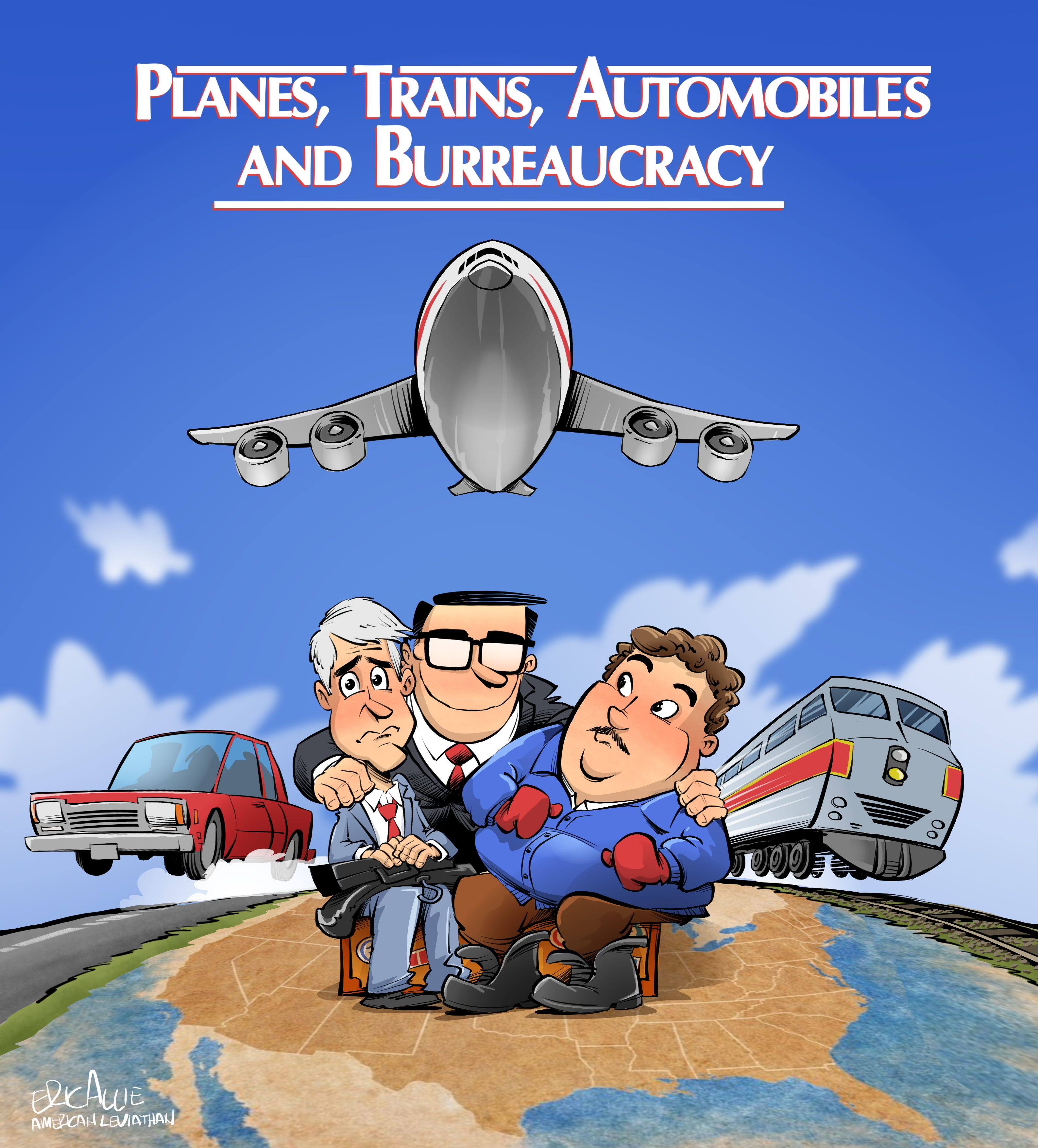
Planes, Trains & Automobiles is supposed to be a comedy.
A stressed-out professional just wants to get home, and every system designed to help him ends up failing him.
The joke is that Neal Page’s nightmare journey is exaggerated.
The reality is that today it isn’t exaggerated at all.
It’s the American transportation system — held together by outdated rules, sclerotic agencies, and a bureaucracy that treats travel as a privilege to ration, not a challenge to innovate.
If that movie were made now, it wouldn’t be a comedy.
It would be a documentary about the FAA, Amtrak, and the Department of Transportation.
Planes: The FAA’s Antiques Roadshow
Neal Page’s flight is delayed, diverted, and then stranded.
Classic movie setup.
Today, the FAA produces the same outcomes without the humor. The agency still relies on technology from the late 1990s. Its air-traffic control modernization program is two decades behind schedule. Pilot certification rules are a political minefield.
Drone integration, next-gen aircraft, and autonomous systems are stuck in an approval loop so slow it might as well be a freeze frame.
The FAA’s message to innovation is simple:
Not yet. Maybe never. Come back with another binder.
If Neal tried to get home today, he’d never leave O’Hare.
Trains: Amtrak’s Monopoly of Mediocrity
John Candy’s iconic train scene works because the train is already off schedule and falling apart.
Nothing’s changed.
Amtrak is a federally protected monopoly that has no pressure to improve. The Federal Railroad Administration approves projects at a pace that makes continental drift look brisk.
Environmental reviews take longer than construction. High-speed rail is a dream everywhere except in PowerPoints.
The result?
Trains slower than they were 70 years ago.
If Neal and Del tried to catch a train in 2025, they’d be lucky to arrive before Easter.
Automobiles: DOT and the 47-Step Journey to Nowhere
The movie’s most famous sequence is the burned rental car — the ultimate symbol of a system that can’t do anything right.
The modern Department of Transportation produces the same experience on a national scale.
Want a new highway?
Prepare for a decade of reviews.
A bridge?
Expect lawsuits.
A tunnel?
Hope you enjoy multi-agency sign-offs, cost overruns, and timelines that turn five-year plans into fifteen-year sagas.
Permitting, approvals, and compliance requirements metastasize until projects die of paperwork exhaustion.
If Neal and Del tried to drive across America today, they’d be navigating a transportation network older than both of them.
The Common Thread: Leviathan Turns Travel Into a Trial
In the film, everything breaks for Neal Page: the plane, the train, the car, the hotel, the credit card, the schedule.
That’s the joke.
But the deeper joke — the one we’re living — is that our national transportation system behaves the same way because it’s built on the same logic:
No risk.
No speed.
No innovation.
No accountability.
A system designed to prevent mistakes eventually prevents progress.
What the Movie Gets Right
The final lesson of Planes, Trains & Automobiles is human: resilience, compassion, endurance.
But the practical lesson is even simpler:
America used to build systems that worked.
Now we build systems that slow themselves down.
Neal Page fought his way home because nobody in the system had the authority or flexibility to solve problems.
That’s the transportation bureaucracy today — a network of agencies that manage everything but fix nothing.
Until that changes, we’re all Neal: exhausted, delayed, rerouted, stuck — just trying to get home.