
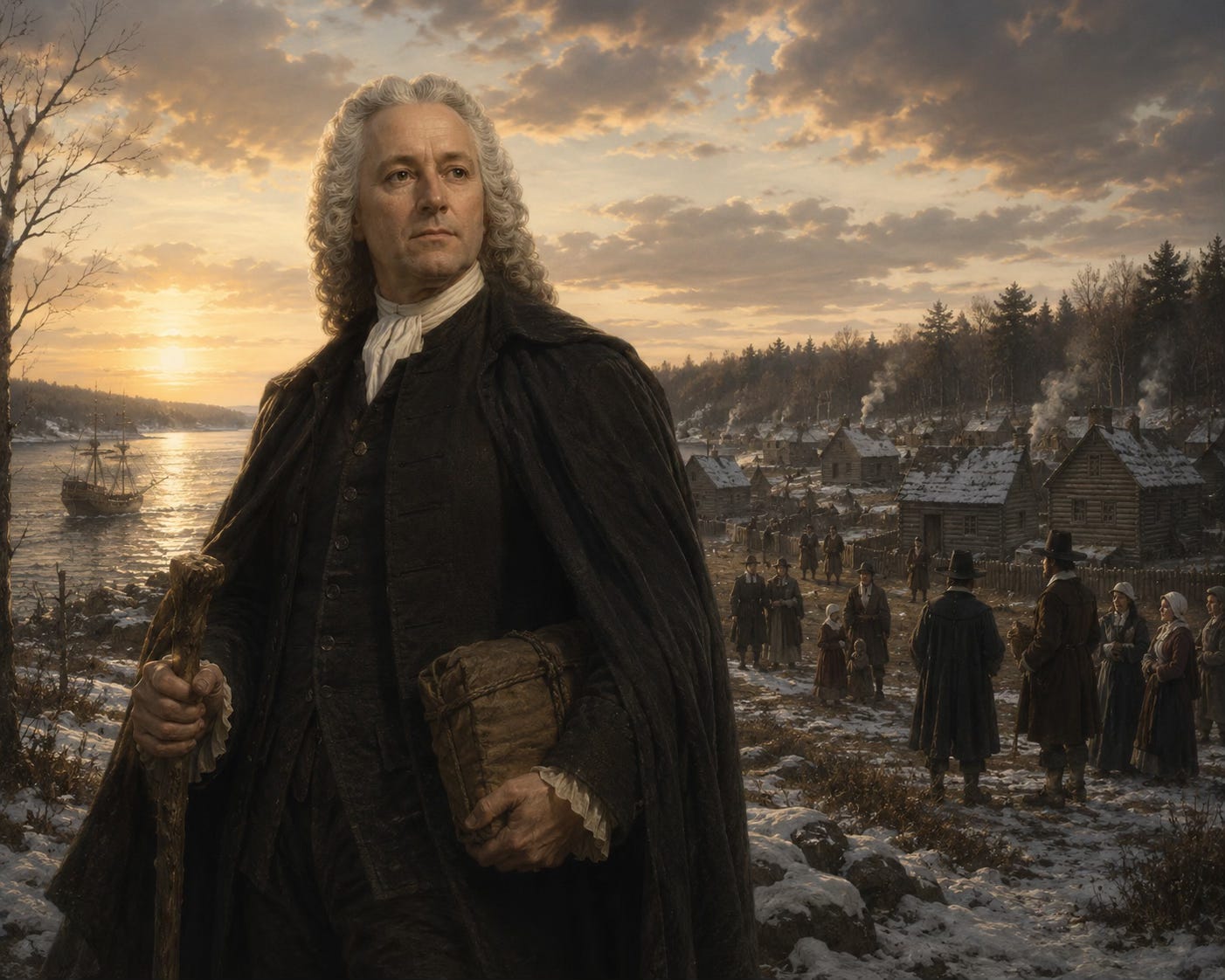
John Winthrop gets remembered. But Roger Williams should too.
Both men were Puritans. Both crossed the Atlantic searching for religious liberty. Both believed deeply in covenant.
Yet they reached opposite conclusions.
Winthrop believed the covenant required unity. Williams believed the covenant required freedom. That disagreement changed America.
Williams argued civil government possesses no legitimate authority over conscience.
The magistrate may punish theft, fraud, and violence. But belief? Never.
For expressing those views, Massachusetts banished him. Williams fled into the New England winter. Many assumed he would die.
Instead he founded Providence Plantations in 1636 as a refuge for religious freedom. His settlement would eventually join with three others and become Rhode Island and Providence Plantations (the official name of the state until 2020 when Providence Plantations was removed by state referendum).
It was a colony unlike any other: no established church but a colony committed to religious liberty and freedom of conscience with a complete separation between civil authority and religious belief.
Ironically, America’s religious freedom did not emerge despite Puritanism. It emerged because one Puritan followed the covenant further than everyone else.
Williams understood something extraordinary: if rights come from God... then government cannot own conscience.
Jefferson would eventually write similar ideas. Madison would defend them. The First Amendment would protect them. But Roger Williams lived them first.
Sometimes exile becomes foundation. Sometimes losing an argument changes civilization.
If you enjoyed this article, you’ll love the documentary.
Thread of Liberty follows the entire thread of the American experiment—from ancient Rome and the Puritans, through the Revolution and the Constitution, to Tocqueville, Lincoln, Calvin Coolidge, and the modern Administrative State.