
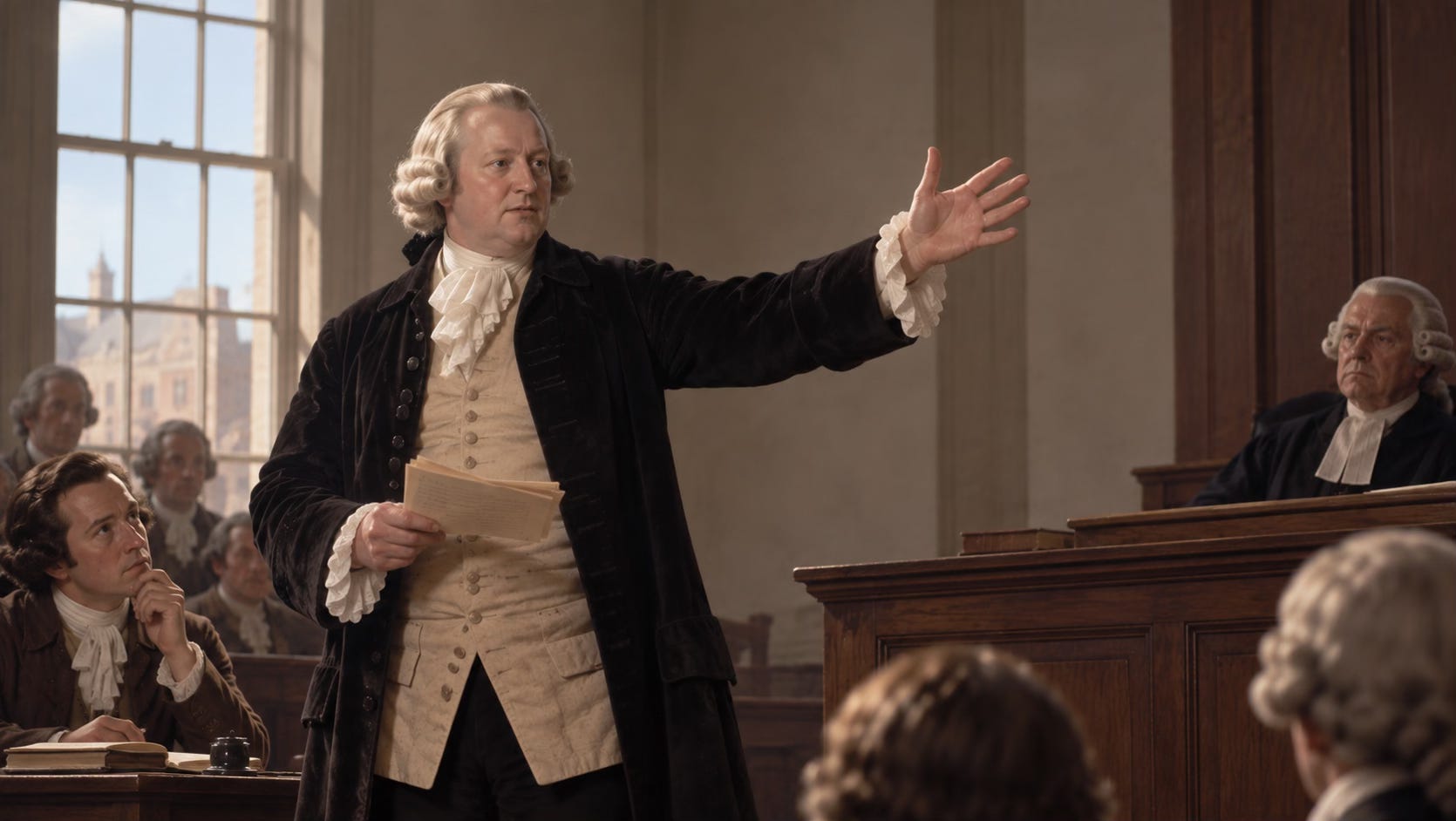
The case was about search warrants.
Specifically it was about writs of assistance — general warrants issued by the Crown that allowed customs officers to enter any house, shop, or warehouse, at any time, to look for smuggled goods. They named no particular place and no particular suspect. They did not expire. They were transferable. An officer holding one could search anyone.
Boston merchants hated them, and in 1761 they hired a lawyer to challenge their renewal.
James Otis was thirty-six, brilliant, well-connected, and had just resigned a lucrative Crown appointment as advocate general of the vice-admiralty court in order to argue the other side. He refused a fee for the case.
He spoke for something like four or five hours in what is now called the Old State House in downtown Boston.
A twenty-five-year-old lawyer named John Adams was in the room which was standing-room only, taking notes, and he spent the next sixty years telling people what he had seen. Otis, he wrote, was a flame of fire. He argued from natural law, from the constitution, from Coke, from the whole inheritance of English liberty, and he made an argument that went well past the technical question in front of the court.
The core of it was this: a man’s house is his castle, and while he is quiet in it he is as well guarded as a prince in his own fortress. A general warrant destroys that. And an act of Parliament that violates natural equity is void, and courts must refuse to enforce it.
That last point is Coke’s holding in Dr. Bonham’s Case, brought to Boston and pointed at the Crown.
Otis lost. The court, chaired by the royal governor, Thomas Hutchinson who also served as the Chief Justice, granted the writs.
Adams’ verdict on the day was that then and there the child Independence was born. He was writing decades later, as an old man with a stake in the story, and historians treat the line with appropriate caution. But he was in the room and nobody else who was left a comparable account, and something happened there that he never got over.
Three years later Otis published The Rights of the British Colonies Asserted and Proved, and it is a stranger and more radical document than its reputation suggests.
The famous part is the tax argument — that no part of His Majesty’s dominions can be taxed without consent, that every part has a right to be represented, and that taxation without representation is tyranny. That formula went into the colonial bloodstream and stayed there.
The part almost nobody quotes is what he wrote about slavery.
In 1764, in Boston, in a pamphlet about colonial rights, Otis argued that the colonists were entitled to their liberties as men — and then said plainly that this applied to black men as well as white, that nothing could be clearer than that all men are by nature free, and that the argument for enslaving Africans on the basis of a flat nose or a dark complexion was contemptible.
He went further, and said the slave trade was the source of most of the evil in the world, and that a man’s liberty could not be forfeited by the color of his skin any more than by the shape of his hair.
This is twelve years before the Declaration. It was not a popular position and he did not need to take it. He took it because his own argument required it, and he was the kind of man who followed an argument to the end regardless of where it landed him.
Which is also what destroyed him.
In September of 1769, after Otis published an attack on the Boston customs commissioners, one of them — John Robinson — confronted him at the British Coffee House. There was a fight. Otis was struck repeatedly about the head, apparently with a cane, and cut badly.
He won a large judgment in court and forgave the damages in exchange for an apology.
But he never really recovered. Whether the beating caused what followed or accelerated something already present is not knowable centuries after the fact, but from that point on his mental condition deteriorated, in public and in stages. He had episodes of incoherence and rage. He was at times confined by his family. He would appear at gatherings and talk brilliantly for an hour and then lose the thread entirely.
The man who had lit the fire in 1761 became a spectator to the revolution he started. What is little known is that he turned up at Bunker Hill with a borrowed musket, having slipped away from the house where he was being cared for, fought through the day, and was found afterward and taken home.
He had told his family more than once that when it was time to go, he hoped to be taken by a flash of lightning.
On May 23, 1783, standing in the doorway of a farmhouse in Andover watching a storm, he was struck by lightning and killed instantly. He was fifty-eight. The war he had argued into existence had ended a few months earlier.
There is something worth taking from the shape of that life.
Otis did not win his case. He did not sign the Declaration, did not serve in the Continental Congress, did not attend the Convention, and was not in his right mind for most of the war. By any conventional accounting he is a minor figure.
But the Fourth Amendment exists because of that courtroom. The specific requirement that a warrant describe the place to be searched and the persons or things to be seized is the direct answer to the writs of assistance, drafted by men who had heard the argument or been taught it by men who had.
A losing argument, made carefully enough, can outlive the man who made it and the court that rejected it. That is the entire premise of writing things down.
There is winning and then there is "winning." The second is more important than the first.