
June 15, 1775
Long before the Declaration of Independence, America faced a basic strategic problem: How do thirteen separate colonies become one people?
The answer, in many ways, began on June 15, 1775.
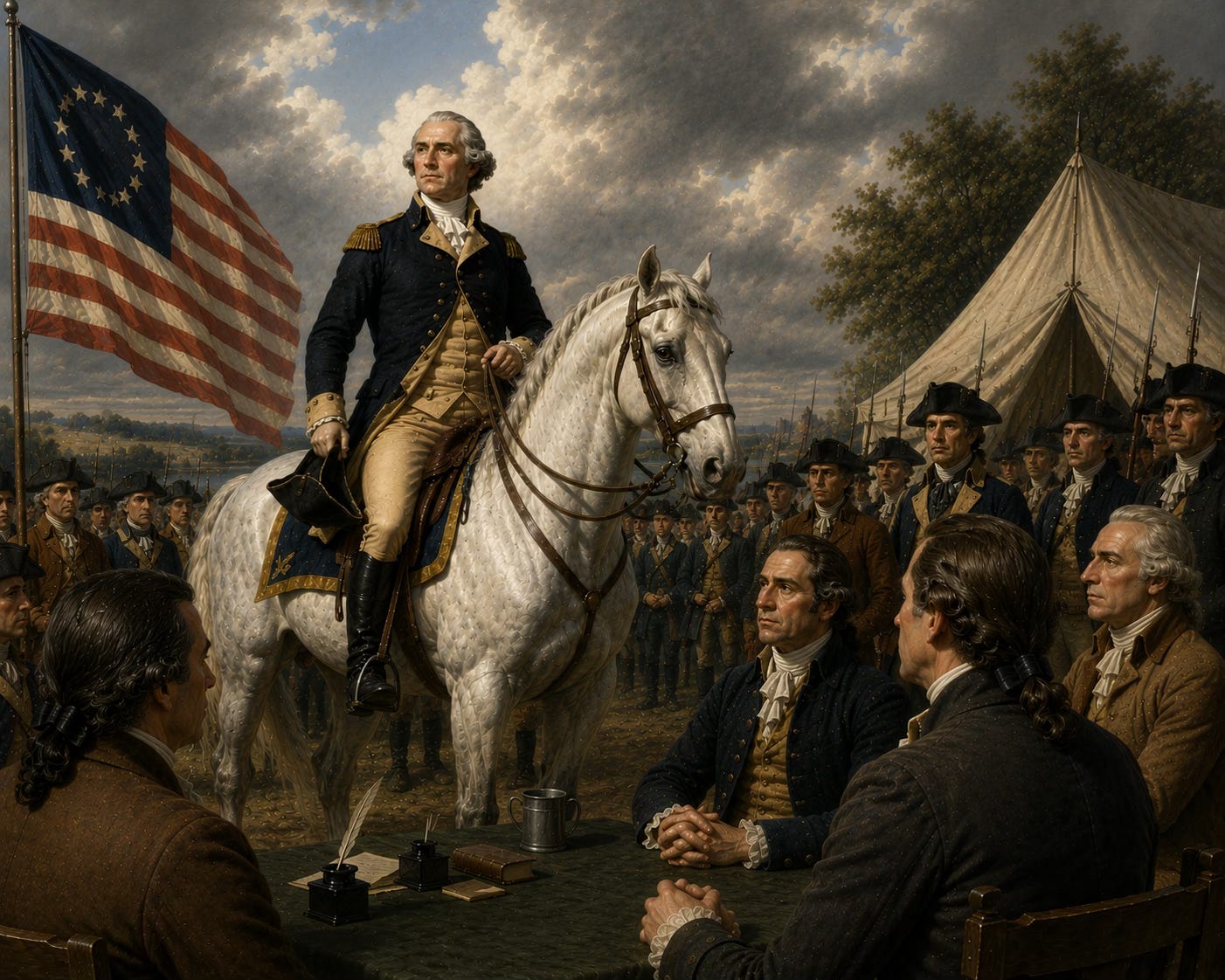
That was the day George Washington was unanimously appointed commander-in-chief of the Continental Army.
At the time, the colonies were not yet independent. Many still hoped reconciliation with Britain remained possible. Regional loyalties remained far stronger than national identity.
Massachusetts saw itself differently than Virginia. Virginia saw itself differently than Pennsylvania.
America existed more as an argument than a nation.
Washington helped change that.
His appointment mattered for military reasons, obviously. But its political significance may have been even greater.
Congress, with John Adams strongly advocating for it, intentionally selected a Virginian to command New England troops. That was not accidental.
The founders understood that if the Revolution became perceived as merely a regional rebellion centered in Massachusetts, it would fail.
Washington’s appointment transformed resistance into a continental cause.
And Washington himself understood the symbolic weight of the moment.
He arrived at Cambridge not as a dictator or strongman, but as a citizen-soldier accepting temporary authority on behalf of self-government.
That distinction mattered enormously.
Throughout history, military leaders frequently convert wartime power into permanent political dominance. Washington repeatedly refused to do so.
That restraint became one of the defining features of the American founding.
The Continental Army itself became an instrument of nationhood. Men from different colonies fought together. Suffered together. Endured together.
A shared identity slowly emerged.
Not perfect unity. Not uniformity. But something stronger than local isolation.
The significance of Washington’s command reaches beyond battlefield history.
The American Revolution succeeded partly because Washington embodied a radically different model of leadership than the European norm.
He exercised power reluctantly. Temporarily. Under civilian authority.
That sounds normal to modern Americans precisely because Washington normalized it.
But in the eighteenth century, it was extraordinary.
The appointment of Washington helped create not merely an army, but the foundations of republican civil-military order.
And without that, American independence may not have survived victory.
“He exercised power reluctantly. Temporarily. Under civilian authority.”
He made a conscious, intentional and deliberate choice so inexpressibly humble that literally made this country possible.
Compare that our lifelong career politicians today! He’d be gravely and deeply disappointed by what constitutes our political class these days.