
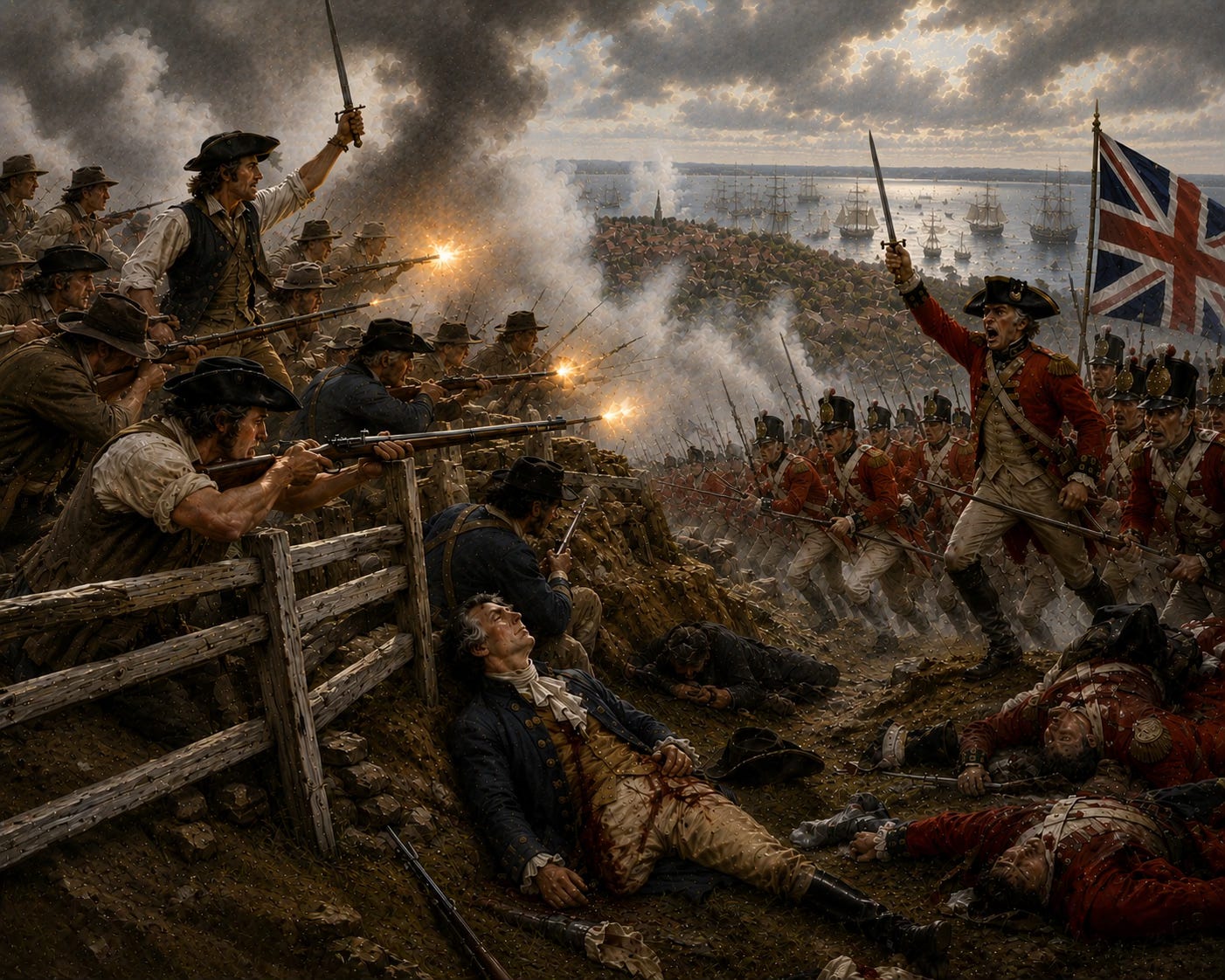
June 17, 1775
Technically, the British won the Battle of Bunker Hill. But in reality the victory deeply troubled them.
Most battles are sometimes reduced to a simple question: Who held the ground when the shooting stopped?
Bunker Hill was a bit different: what did the battle reveal? Because it revealed a great deal.
Two months earlier, blood had been shed at Lexington and Concord. Militia forces had surrounded Boston, trapping British troops inside the city. Yet many British commanders still viewed the colonial resistance as a temporary disturbance.
The colonists were nothing more than undisciplined farmers, provincial militias playing at war; amateurs with muskets.
On June 17, 1775, those assumptions and disdain died on Breed’s Hill overlooking Boston Harbor.
The Americans had spent the night fortifying positions on the heights above Charlestown, actually building their redoubt in a far more advanced position than originally planned. British General Thomas Gage recognized the danger immediately. If the rebels held that position and placed cannon inside the redoubt on Breed’s Hill, they would threaten British control of Boston itself.
So he sent General William Howe and 2,000 of the best British troops to attack. Howe took in the situation and sent some of his elite light troops down the Mystic River Beach to flank the Americans. John Stark of New Hampshire, along with sixty men, decimated the flanking attempt.
Undeterred, Howe divided his forces and sent his men straight up the slopes. Rows of British regulars advanced uphill into the Americans behind the rail fence and the earthen redoubt, the red-coated infantry marched in disciplined formation exactly as European armies had done for generations.
The Americans waited.
And waited.
According to tradition, William Prescott, commanding the redoubt, ordered his men not to fire until they could see “the whites of their eyes.”
Whether those exact words were spoken matters less than the reality behind them. Ammunition was scarce and every shot mattered. But even more so, Prescott, a veteran of the French and Indian War, knew green and untrained men typically fired too soon and too high. He had to make them wait for as long as possible.
A sheet of fire and flame hit the British at the rail fence and redoubt and the first British assault collapsed.
Then the second.
Stunned and exhausted, Howe and the British made one last push, leaving the rail fence at the top of the hill alone to focus their attacks on the earthen redoubt. Prescott, knowing the Americans were low on gunpowder, watched and waited, advising Dr. Joseph Warren, President of the Provincial Congress of Massachusetts and a newly appointed Major General, to retire. Warren refused.
The third assault came. Were it not for the Americans running out of gunpowder, they would have held the redoubt. Instead the redcoats forced their way in but were stunned that the Americans did not flee. In the vicious close combat that followed, Warren was killed covering the colonists’ retreat.
By the end of the day, the British technically held the ground but victory had come at a staggering price.
More than 1,000 British casualties.
Nearly half the attacking force.
Almost a hundred of the officers were killed or wounded.
The British Army had won the hill but lost confidence.
General William Howe reportedly reflected afterward:
“A few more such victories would have shortly put an end to British dominion in America.”
That statement captures the true significance of Bunker Hill. Howe, who became the British commander-in-chief after Gage was recalled, was never the same after Bunker Hill. He became more timid, less daring, more unsure of himself.
The battle also shattered the illusion that the colonies could be pacified cheaply.
The Americans had demonstrated they could stand against professional European troops and inflict devastating losses.
Just as importantly, they proved it to themselves.
The militia forces that fought at Bunker Hill were still disorganized. They lacked uniform training. They lacked centralized command. They lacked sufficient supplies.
What they did not lack was determination.
The battle revealed something deeper about the American character. It proved they could actually go toe-to-toe with one of the greatest military powers in the world.
The founders also understood that free societies often possess advantages centralized systems struggle to replicate: initiative, local knowledge, improvisation, and resilience.
Bunker Hill also transformed British thinking.
Before the battle, many British leaders still believed reconciliation remained possible. Afterward, increasing numbers began viewing the colonies as an organized rebellion requiring suppression.
Compromise became harder. Positions hardened. The road toward independence accelerated.
That is why June 17 matters.
Not because America won but because the British learned that defeating the colonies would require far more blood, treasure, and time than anyone in London had anticipated.
Empires are often defeated not by a single catastrophic loss.
They are defeated when the cost of victory becomes unbearable.
At Bunker Hill, Britain received its first glimpse of that future and America saw something equally important: they could in fact make the Empire bleed and feel pain.
In 1840, Judah Touro gave $10,000 to complete the Bunker Hill Monument, which had been floundering for years.
In fact, there is a fascinating poem by America’s great orator, Daniel Webster, at the dedication ceremonies in 1843, thanking Touro and Amos Lawrence for their funding of this monument:
"Amos and Judah—venerated names Patriarch and prophet press their equal claims. Like generous coursers running "neck to neck," Each aids the work by giving it a check, Christian and Jews, they carry out one plan, For though of different faith, each is in heart a Man."
https://thinktorah.substack.com/p/the-unknown-story-of-judah-touro