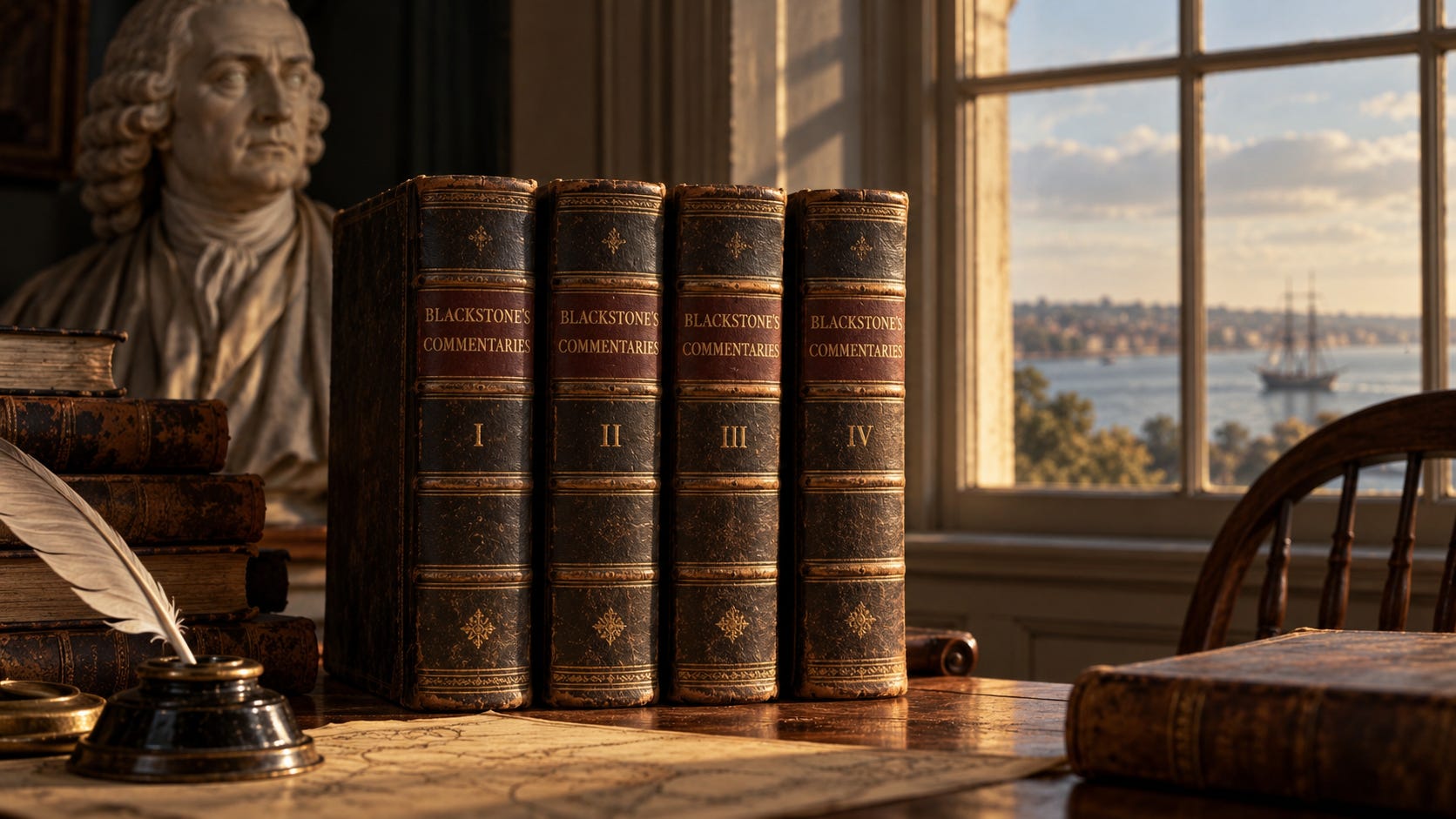
In 1775, arguing in the House of Commons for conciliation with America, Edmund Burke tried to explain to his colleagues why the colonists were so unusually difficult to govern.
Part of the answer, he said, was that they were lawyers. Not all of them, obviously — but the study of law was more widespread there than anywhere in Europe, and he had been told that nearly as many copies of Blackstone’s Commentaries had been sold in America as in England.
A population that reads law books, Burke warned, does not wait for oppression to arrive. It sniffs the approach of tyranny in every tainted breeze. He was right, and the detail about the book sales is one of the most consequential facts about the American founding.
William Blackstone published his Commentaries on the Laws of England in four volumes between 1765 and 1769 — precisely the years the imperial crisis was building. He was an Oxford professor, and his achievement was organizational rather than philosophical.
The English common law was, at that point, a vast unmapped accumulation: centuries of cases, statutes, customs, and technical writs, scattered across law reports in dog Latin and law French, accessible only to men who had spent their lives inside it.
Blackstone turned all of that into a book you could read.
Four volumes, clearly organized, in graceful English prose, arranged so that an intelligent person with no legal training could work through the whole structure and come out understanding how the system fit together.
In England that made him a successful author. In America it made him the foundation of a legal profession.
There were no American law schools worth the name. Men trained by becoming a clerk in an established lawyer’s office, not only receiving hand’s on training from that lawyer, but also by reading previous cases and commentaries and what they read, overwhelmingly, was Blackstone. Frontier attorneys who owned four books owned Blackstone. Abraham Lincoln, two generations later, essentially taught himself law out of it.
So when the imperial crisis came, the colonists did not argue in the language of natural rights alone. They argued as lawyers, from the specific charter laws and the inherited rights of Englishmen, with citations.
And Blackstone had given them the tools and the lists to do so.
He organized the absolute rights of individuals under three heads. Personal security — the right to life, limb, body, health, and reputation. Personal liberty — the right to move about and not be imprisoned without lawful cause. And private property — the right to use and dispose of one’s own possessions without interference.
He was emphatic about the third one. So great is the regard of the law for private property, he wrote, that it will not authorize the least violation of it, not even for the general good of the whole community.
A colonist reading that sentence in 1767, while Parliament imposed duties on his tea and glass and paper without his consent, did not need a philosopher to tell him something had gone wrong. He had it in a standard textbook, from an English authority, in the King’s own universities.
Blackstone also supplied the mechanism that makes rights real, which is the part usually skipped.
Declaring a right, he understood, accomplishes nothing by itself. What matters is the remedy — the ability of an injured person to go to an independent court and obtain redress against whoever injured him, including the government. A right without a court to enforce it is a sentiment.
Now the irony.
Blackstone was a Tory. He sat in Parliament and voted against the American position. He would have been appalled to learn he was arming a revolution.
And at the center of his system sat a doctrine the Americans had to destroy in order to exist: parliamentary sovereignty over the English Empire.
Parliament, Blackstone taught, has absolute and uncontrolled authority. It can do anything that is not naturally impossible. There is no power on earth that can undo what Parliament has done. Coke’s suggestion in Bonham’s Case that a court might void a statute contrary to reason was, in Blackstone’s view, simply mistaken.
This is the fork in the road, and everything downstream depends on which branch you take.
If Blackstone is right, then the rights he catalogues are gifts. They exist because the legislature has not yet chosen to remove them, and the only protection against removal is the good sense and restraint of the men in office.
If Coke is right, there is a law above the legislature, and an independent court can hold the legislature to it.
The Americans took Coke’s branch, and they built a machine to enforce it: a written rights-based constitutional form of government, ratified by the people rather than enacted by a legislature, superior to ordinary law, with courts empowered to measure statutes against it.
That is the single greatest American innovation in the history of government. Not the separation of powers, which came from Montesquieu. Not consent, which came from a dozen places. The written supreme law, above the ordinary lawmaker, enforceable in court by an ordinary citizen.
Which brings the question forward to our own arrangements.
A great deal of the law that now governs American life is not passed by Congress at all. It is written by faceless, unelected bureaucrats sitting in various departments and agencies, under broad delegations, in volumes that vastly exceed the statute books in length. Much of it never faces a vote by anyone the public elected.
Blackstone would have called that impossible, since for him lawmaking was Parliament’s defining act and could not be handed off.
Coke would have asked the sharper question, and it is the one the colonists learned to ask from both of them: when this rule is used against a particular citizen, is there an independent court where he can be heard — and does the standard it applies come from somewhere higher than the people prosecuting him?
If you enjoyed this article, you’ll love the documentary.
Thread of Liberty follows the entire thread of the American experiment — from ancient Rome and the Puritans, through the Revolution and the Constitution, to Tocqueville, Lincoln, Calvin Coolidge, and the modern Administrative State.
Watch the full feature documentary at ThreadofLiberty.com


This is all well and good. If it is true, then I should have standing in a court of law to claim redress for unconstitutional taxation (taxes on private property), and unconstitutional creation of agencies and departments for which taxes are collected to fund. Am I mistaken? Further, I should have standing in court to abolish the existing government for treason and failure to represent voters. Solid grounds for all of the above exists, right??? I do not recognize our current government as legitimate, ergo I move to abolish it.
This is probably one of the most profound observations I've seen in writing in the past several decades regarding the Founders and their understanding of English law. And yes, ironically, Blackstone sat on the other side of the argument the Founders made re: the tyranny of the English crown, but probably not entirely surprising. Thanks for this very thoughtful piece.