
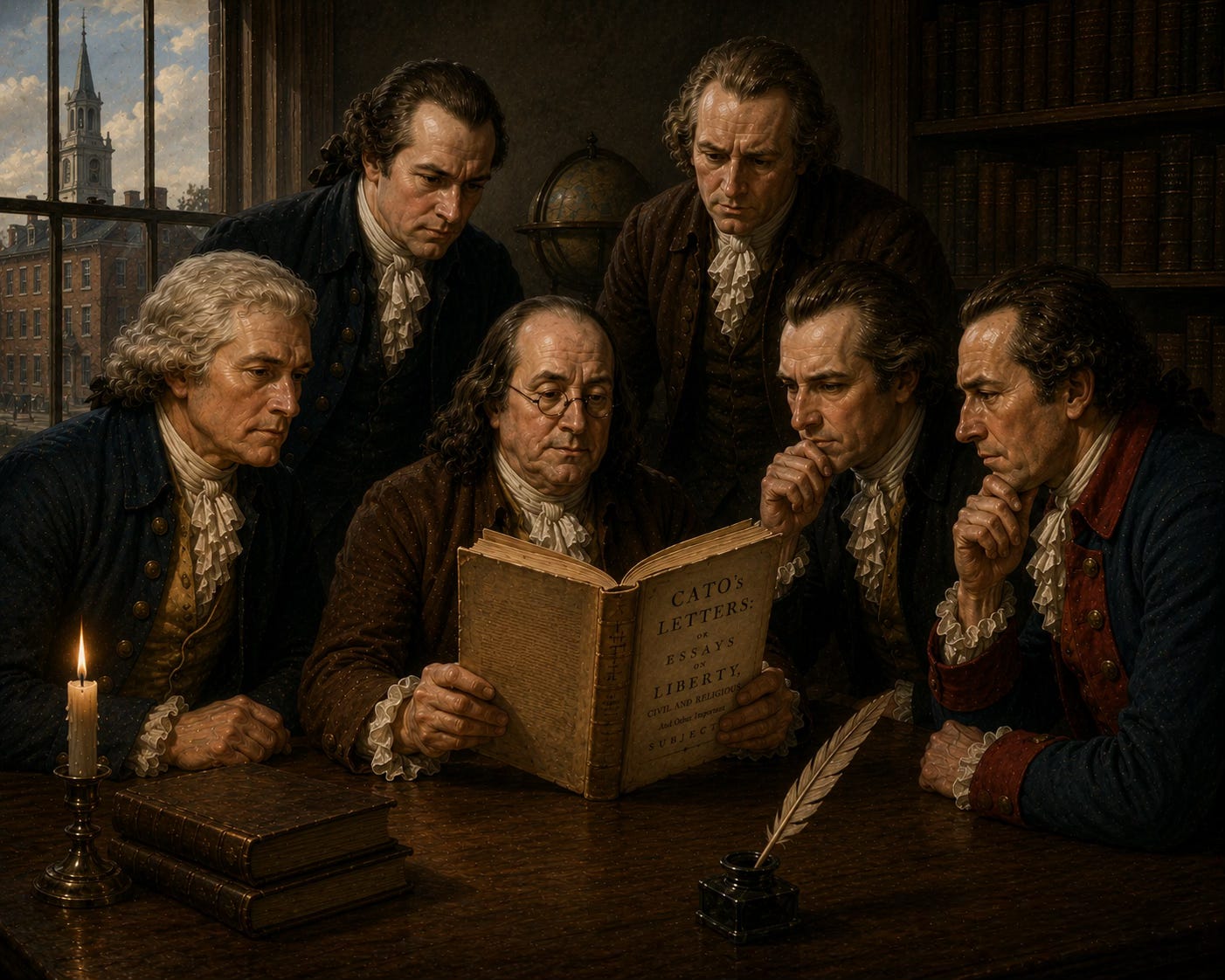
June 28, 1776
The American Revolution wasn’t born on a battlefield.
It was born in libraries. It was born in pamphlets. John Adams believed that the political pamphlets, like John Dickinson’s Letters from a Pennsylvania Farmer and Thomas Paine’s Common Sense of the 1760s and 1770s were significant catalysts for the American Revolution. He observed that the revolution occurred “in the Minds and Hearts of the People,” via that era’s relentless and numerous pamphlets, and essays.
One of the most influential books in colonial pre-revolutionary America, however, wasn’t written by a founder. It wasn’t even written by an American.
It was written by two Englishmen: John Trenchard and Thomas Gordon.
Their work became known as Cato’s Letters, named for Cato the Younger who fought to preserve the Roman Republic during its late stages.
Colonists devoured the book.
The central message was simple: Power expands and corrupts therefore power must be watched constantly. In their 144 essays, Trenchard and Gordon wrote that liberty is the unalienable right of all mankind and that the government’s primary purpose is to protect these rights. They viewed consolidated power with great suspicion, arguing that there should be checks and balances to diffuse power, and that citizens had a right to freedom of speech and conscience.
The founders quoted Cato’s Letters endlessly because they reinforced a lesson history repeatedly teaches: Liberty rarely disappears all at once.
It erodes gradually, through bureaucracy, through dependency, through centralized authority.
The Revolution was fueled as much by this suspicion of power as by taxation itself.
And that suspicion was one of America’s defining characteristics and one we would do well to resurrect.
Good piece. I'd invite you to read my essay, The Improbable Republic. I think you'll like it.