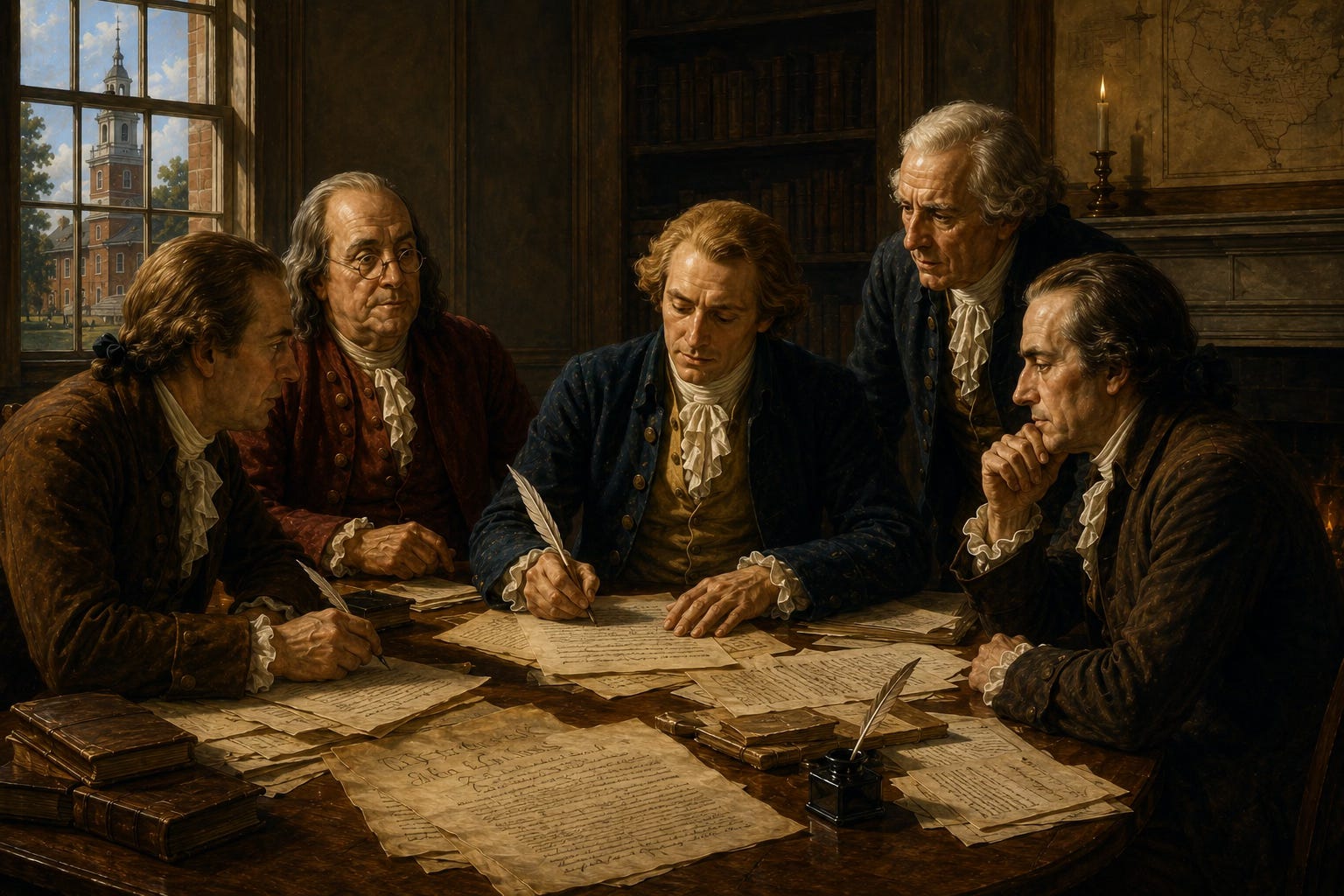
The Committee That Wrote a Civilization
Five men and the language of liberty
June 11, 1776
Four days after Richard Henry Lee introduced the independence resolution, Congress appointed a committee to explain to the world why America intended to separate from Britain.
Five men were chosen.
Thomas Jefferson. John Adams. Benjamin Franklin. Roger Sherman. Robert Livingston.
History remembers this as the Committee of Five.
But they were attempting something far larger: articulating the philosophical justification for self-government itself. After years of appealing to charter law and their inherited rights as Englishmen, they realized that once they declared independence they would no longer be Englishmen. So what then would their justification for a “separate but equal standing” be based upon?
Independence needed a moral, rational basis because a rebellion without moral coherence eventually collapses into chaos.
The founders understood they needed more than military resistance. They needed a statement of principles rooted deeply enough to justify independence before both history and God. But how should they craft it? Benjamin Franklin refused to author the document due to his horror of committee editing, John Adams also rejected authorship for fear any document he drafter would be rejected outright by his opponents in the Congress. He insisted that Jefferson should draft the document not only because Jefferson was from the important state of Virginia, but because he also possessed what Adams called “a happy talent for composition.”
But Jefferson did more than write elegantly. He condensed centuries of political thought into language ordinary people could understand.
Natural rights. Human equality. Government by consent. The right of self-government.
None of these ideas appeared from nowhere.
The Declaration drew from English common law, Protestant resistance theory, Enlightenment thought, classical republicanism, and colonial self-governing traditions already deeply embedded in American life.
But Jefferson fused them into something extraordinarily powerful: A universal argument against centralized tyranny and the right of the people to be sovereign.
That is why the Declaration still matters globally.
It was not merely a list of complaints against King George III. It was an assertion that legitimate government exists to secure and protect rights — not manage subjects.
And when government becomes destructive to liberty, citizens possess the authority to alter or abolish it.
That idea terrified monarchies across Europe.
Frankly, it still terrifies centralized bureaucracies today. Because the Declaration places sovereignty ultimately in the hands of the people rather than permanent ruling classes.
The Committee of Five was not simply drafting a press release. They were defining the moral architecture of the American experiment.
And the language they produced would outlive empires.

