
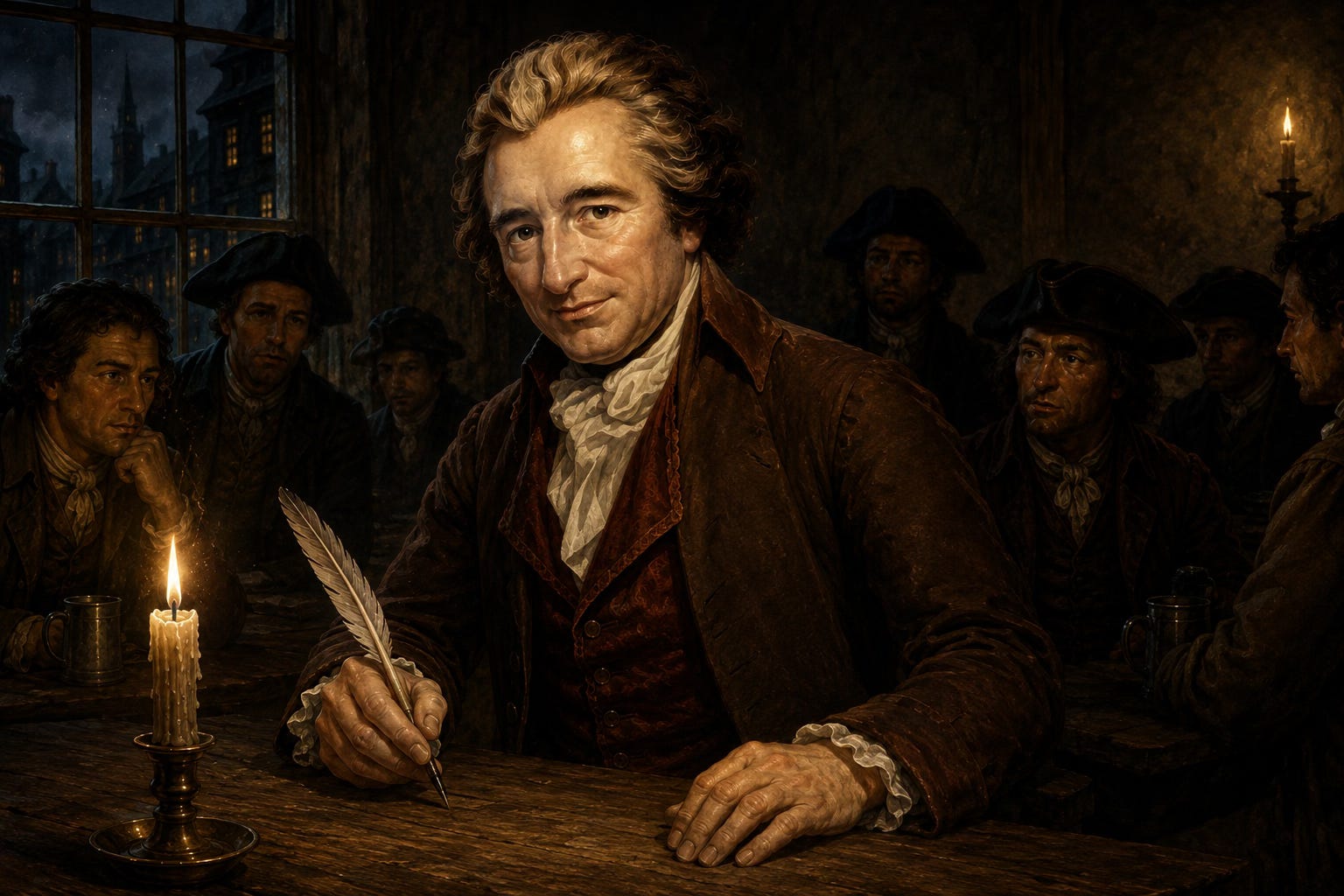
Thomas Paine arrived in Philadelphia in late 1774, thirty-seven years old and definitively, comprehensively unsuccessful.
He had been a corset-maker, like his father. He had been a sailor briefly. He had been an excise officer twice and been dismissed twice, the second time after organizing his fellow officers to petition Parliament for better pay — an early and unprofitable demonstration of his gift for annoying authority. He ran a tobacco shop into the ground. His first wife had died. His second marriage had dissolved.
What he had was a letter of introduction from Benjamin Franklin, whom he had met in London, and a prose style that had no equal in the English-speaking world.
Fourteen months later he published Common Sense.
It appeared on January 10, 1776, anonymously, credited only to an Englishman.
Understand what the argument looked like before Paine wrote. American resistance up to that point had been overwhelmingly legal. The colonists framed themselves as loyal subjects whose ancient rights as Englishmen were being violated by a corrupt Parliament and bad ministers. The King was misinformed. Petition him via charter rights and British common law and the inherited rights of Englishmen and he will see reason.
Paine’s contribution was to declare the entire frame somewhat ridiculous.
He did not argue that George III was misinformed. He argued that hereditary monarchy is an absurdity in itself — that the idea of a family born to rule other families as a divine right was really more just a superstition cloaked in the veneer of constructed, arbitrary respectability, with a dash of constitutionalism on top for good measure, when in fact its origin was not divine appointment but some ancient thug who got lucky.
Paine called the King a brute. He said the notion that an island should permanently govern a continent was a violation of the natural order. He said the time for argument was over.
And he wrote it in language a farmer could read aloud in a tavern. No Latin. No classical citations. No lawyerly hedging in legalese. Short sentences, plain nouns, moral heat.
It sold like nothing had ever sold in America. Estimates run to a hundred thousand copies within a few months in a colonial population of about two and a half million, and it was read aloud to many who could not read it themselves. Adjust for population and there is no modern equivalent; within a few years it was estimated one out of every five Americans owned a copy of Common Sense.
Six months later, Congress declared independence.
Correlation is not causation; Paine did not invent the sentiment. What he did was take a sentiment that respectable men had been holding privately and make it sayable in public. He moved the window of debate so that independence was no longer a treasonous idea but a common-sense one, which is exactly what the title promised.
The second act came at the worst possible moment.
By December 1776 the war was nearly over and losing. New York was gone. Washington’s army had been chased across New Jersey and over the Delaware into Pennsylvania, shrinking as it went. Enlistments were expiring at the end of the year. The men who remained were, by every account, in a condition somewhere between destitute and skeletal, some barefoot, many walking around in essentially rags.
Paine had served through the retreat as an aide to Nathanael Greene. He is said to have written by campfire on the march, using a drumhead for a desk — a story that may be embroidered but is not implausible.
The American Crisis, number one, appeared on December 19, 1776. Its opening is the most famous sentence in American political writing that is not in the Declaration:
“These are the times that try men’s souls.”
Then the twist of the knife: “the summer soldier and the sunshine patriot will, in this crisis, shrink from the service of their country.”
And then the argument, which is the part people forget. Paine did not tell the army that things were fine. He told them the opposite: that what is obtained cheaply is esteemed lightly, that heaven knows how to put a proper price on its goods, and that it would be strange indeed if something as valuable as freedom were not expensive.
Washington had it read aloud to the troops on the night of December 25. And then they crossed the Delaware in a blizzard and took Trenton.
Paine’s later life is a warning about the difference between a prophet and a founder.
He went to France, was elected to the National Convention, opposed the execution of Louis XVI, and was thrown in prison for it, narrowly escaping the guillotine. He wrote Rights of Man, which got him convicted of seditious libel in absentia in England. He wrote The Age of Reason, which attacked organized religion and revealed scripture, and which cost him nearly every friend he had in America.
He returned to the United States in 1802 and died in New York in 1809, largely reviled. The traditional count of mourners at his funeral is six.
He was a magnificent demolition contractor but a poor architect. He could show you with perfect clarity why the old building had to come down. He had considerably less to say about what to put up in its place, and no patience for the tedious business of joists and load-bearing walls that occupied Madison in constructing the machinery of the republic.
Both jobs were necessary. Only one of them was his.
There is a lesson here about how free peoples actually persuade each other.
Paine did not win the argument in a courtroom or a committee. He won it in the vernacular — in pamphlets that cost a couple of shillings, passed hand to hand, read aloud to many people who might never have read a work of political theory in their lives.
Self-government requires that ordinary citizens be able to follow the argument. That is why the founding generation cared so much about pamphlets, newspapers, sermons, and public reading.
A citizenry that cannot follow the argument and understand the issues, either thru apathy or intentional ignorance, does not stop being governed. It becomes ruled, never consulted and is shunted off to the side.
If you enjoyed this article, you’ll love the documentary.
Thread of Liberty follows the entire thread of the American experiment — from ancient Rome and the Puritans, through the Revolution and the Constitution, to Tocqueville, Lincoln, Calvin Coolidge, and the modern Administrative State.
Watch the full feature documentary at ThreadofLiberty.com