
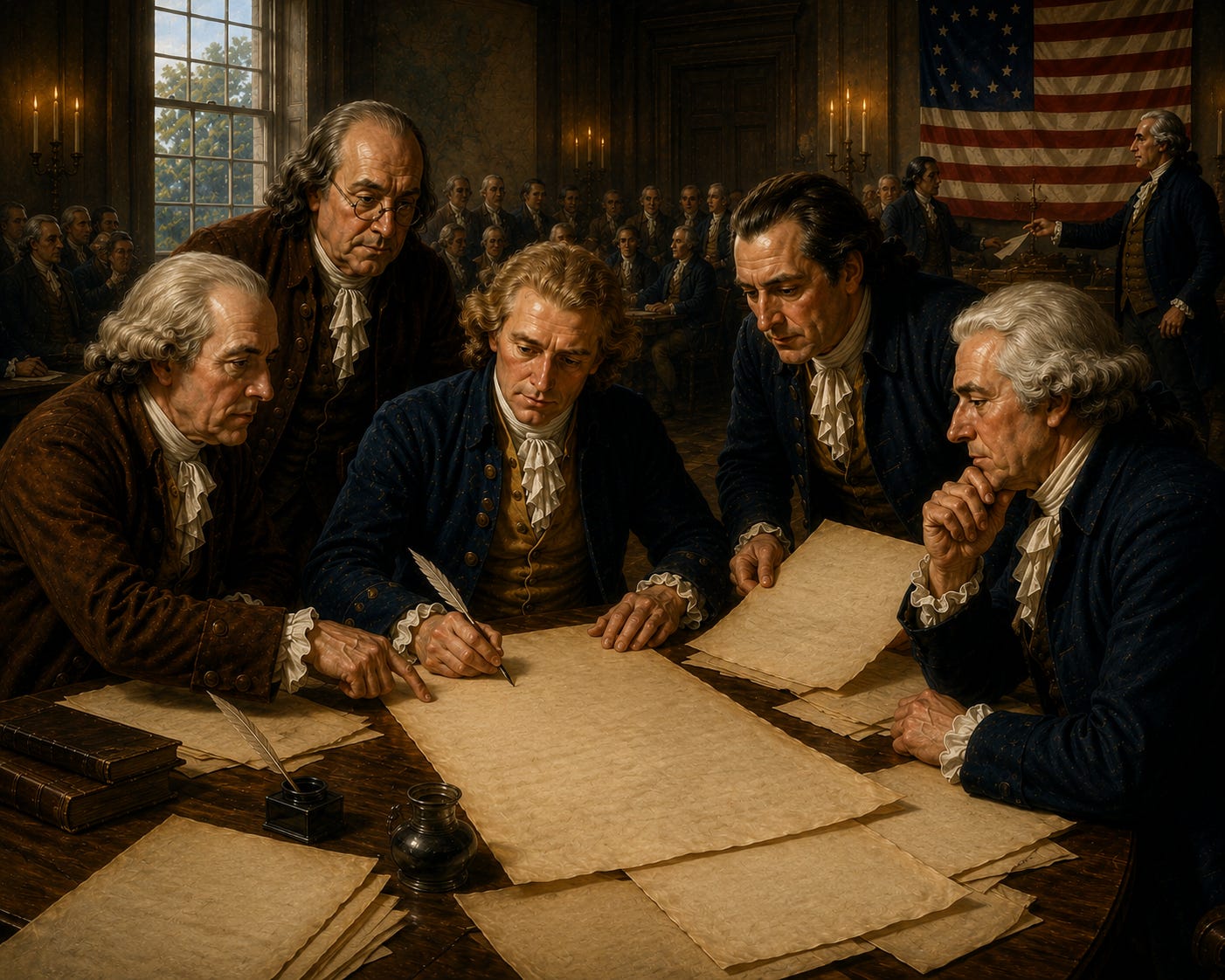
June 4, 1776
Modern Americans often imagine the Declaration of Independence appearing fully formed from the mind of Thomas Jefferson like some kind of political lightning strike.
History is usually messier than that. To be clear, Jefferson absolutely mattered. His brilliance mattered.
His ability to compress centuries of political philosophy into unforgettable language mattered enormously. But the Declaration was not a solo performance.
It was edited. Debated. Revised.
Negotiated under pressure by men trying to hold thirteen very different colonies together long enough to survive a war.
By mid June 1776, Jefferson’s draft was already being edited by Benjamin Franklin and John Adams, and then Robert Livingston and Roger Sherman. By the end of June it was presented to the entire Congress.
And almost immediately, delegates started changing it.
Sections were softened.
Phrases rewritten.
Arguments refined.
Most famously, due to the delegates from South Carolina and Georgia, Congress removed Jefferson’s long passage condemning the slave trade and blaming the Crown for perpetuating slavery.
That deletion remains one of the most morally revealing moments of the founding era. Jefferson was furious about the edits, which is understandable as writers tend to become emotionally attached to their sentences.
But the delegates were not primarily crafting literature. They were building consensus and consensus required compromise.
That tension sits at the heart of the American founding itself: The founders believed in universal principles while simultaneously navigating political realities that often contradicted them.
That contradiction does not invalidate the principles.
If anything, it demonstrates how difficult it is to build political systems that live up to moral truths consistently.
Congress understood something essential: the Declaration needed to speak not just for Virginia or Massachusetts. It needed to speak for all thirteen colonies simultaneously.
That required collective ownership.
The final document therefore became something larger than Jefferson himself.
Not merely a writer’s achievement. A civilization-level argument.
The Declaration transformed ancient concepts of natural rights, consent, and self-government into a coherent political philosophy capable of justifying revolution and enacting the sovereignty of the people in a rights based government.
But even more so, it was a declaration for all mankind. The Founders viewed themselves as champions not only for the American people but for the rest of humanity and the world.
That’s why once published those ideas escaped America entirely and spread outward across the world.
But the entire process by which the Declaration was drafted and then finalized also reminds us that the American founding was not simply the work of isolated genius. It was a collection of intellectual giants whose arguments refined the document through deliberation.
The Declaration survived because many men shaped it.
And in many ways, that collaborative tension is deeply American itself.
The men who composed that first Congress were an incredibly educated and intelligent collection of moral men we were so blessed to have all present at that time.
Our Congress today is more a collection of doofus ignoramuses in it for the money and the power who couldn’t even recite the Declaration their sworn to uphold.
How far we have fallen.