
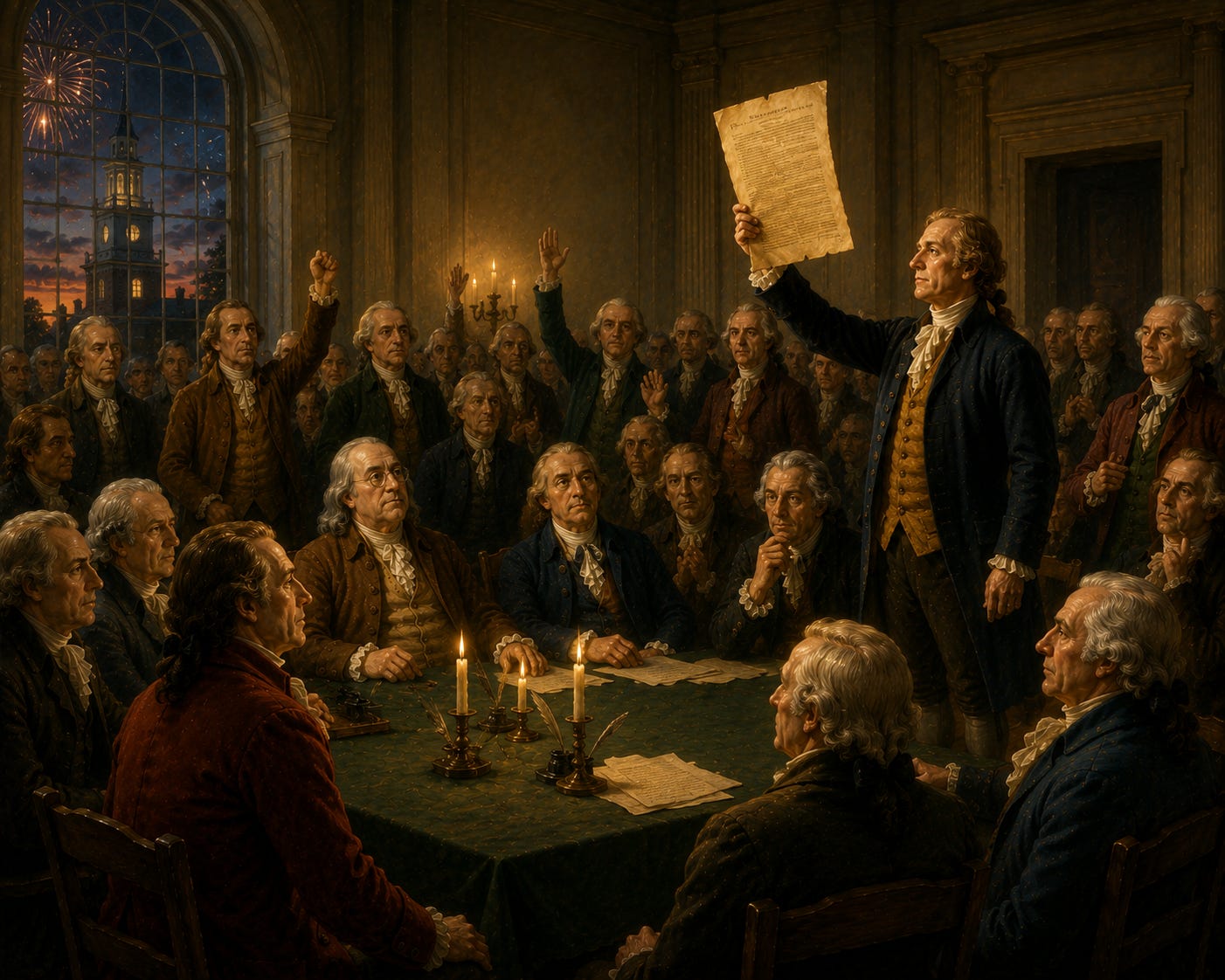
On July 4, 1776, the Continental Congress formally adopted the Declaration of Independence.
The document announced to the world that the American colonies no longer recognized British authority.
But the Declaration did something even more important than that.
It explained why.
That is what made it revolutionary.
Empires had risen and fallen throughout history. Rebellions were not new. What made the American Revolution different was the argument underneath it.
The Declaration asserted that rights do not come from governments. They come from God.
That governments derive “their just powers from the consent of the governed.”
That government and legitimate authority depend on securing and protecting natural rights rather than consolidating power.
And when government becomes destructive to those ends, citizens possess the right to alter or abolish it.
Those ideas detonated across the globe.
Not because America was militarily dominant. It wasn’t.
But because the Declaration articulated a radically different understanding of political legitimacy.
The old world organized society around hierarchy, monarchy, inherited authority, and centralized control. The Declaration organized political legitimacy around natural rights and self-government and set the stage for the Constitution in which the people would be sovereign.
That distinction changed history.
Thomas Jefferson’s language gave moral clarity to the Revolution. But the document reflected something much deeper already developing throughout colonial America: A civilization accustomed to local governance, civic participation, religious pluralism, and decentralized authority.
The Declaration did not create those habits. It codified them.
And that matters.
The American experiment succeeded not merely because of military victories, but because a culture of self-government already existed before independence was declared.
That is what Tocqueville later recognized. America’s strength came less from abstract theories than from the habits of free citizens governing themselves locally.
The Declaration transformed those habits into a universal political statement.
And nearly 250 years later, its central question still confronts every generation:
Are created human beings able to govern themselves? Or are they meant to be managed permanently by ruling experts?
The founders answered clearly.
They chose liberty.
Cannot possibly express how much I enjoy and appreciate these posts!
We must reinstitute American history, this real true American history, back into our classrooms from K- graduate level. It should be mandatory for all of our 50 states, each one a part of this miraculous union of a country, be required to teach its history, if we want to keep it.