
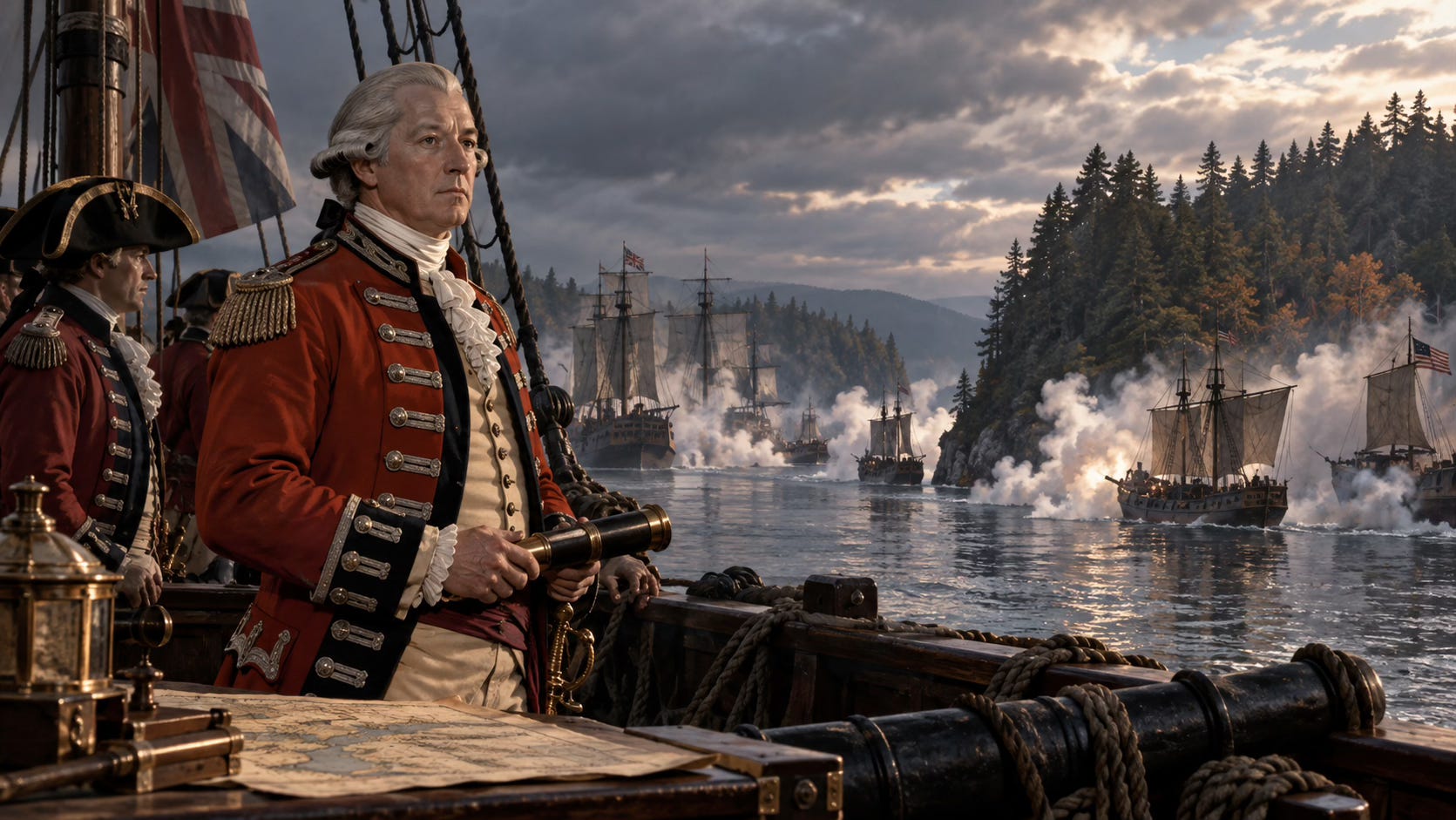
Set aside, for a thousand words, what Benedict Arnold became.
In the autumn of 1776 he was considered by both the British and the Americans the most talented battlefield commanded in the entire struggle. He earned Washington’s respect and trust by being the most aggressive fighting officer in the American service, and what he did on Lake Champlain the summer and fall of 1776 is one of the finest performances by any American commander in the entire war.
It has the additional distinction of being almost completely forgotten because he lost.
But the strategic situation Arnold was facing was straightforward and terrifying.
The American invasion of Canada had failed. Guy Carleton, the British commander at Quebec, now had a large army and the obvious plan: come south down Lake Champlain, take Fort Ticonderoga, continue down to Albany and the Hudson River, then sail down the Hudson to link up with Howe’s force coming north from New York thereby completely cutting New England off from the rest of the colonies.
It was the correct plan. The British would try it again the following year under Burgoyne.
The only thing between Carleton and Ticonderoga in 1776 was water. Lake Champlain runs a hundred and twenty miles north to south and at the time was the main “highway” from Canada into New York; it was dubbed by the Indians the Great Warpath. Any army moving troops down it of course needed control of the lake.
So both sides did something extraordinary: they built navies in what was relative wilderness.
At Skenesborough, at the southern end of Lake George, the Americans set up shipyards in the woods. Carpenters were recruited from Philadelphia and New England. Timber was cut green and went straight into hulls. Guns, rigging, and anchors were hauled overland from the coast. When the hulls of ships were done, they were rowed up Lake George to Fort Ticonderoga on the southern end of Lake Champlain where they were rigged and armed with cannons.
Arnold — who had been a merchant sea captain in the West Indies trade before the war and actually knew sailing and ships — took charge of the effort when he felt progress was too slow, dividing the men into two 12 hour shifts so that work never stopped. General Horatio Gates, commander of the Northern Department, eventually put Arnold in command of the result.
He got fifteen vessels ready for fighting by October: from eight flat-bottomed gondolas, to a handful of larger row galleys, with two schooners and a sloop thrown in as well to what Arnold called his Mosquito Fleet. Crews were soldiers who had never been to sea, most of whom had never fired a cannon, much less a cannon from a pitching and heaving deck of a ship, scraping them together from regiments that could spare them. He would complain to Gates that he had five hundred barely trained men who were somehow supposed to take on seven hundred trained sailors from the British navy.
The British, working at the northern end with Royal Navy personnel and prefabricated hulls, dragged down the St. Lawrence and around the rapids at St. Johns, built something considerably better — including the frigate Inflexible, which by herself outgunned much of Arnold’s fleet.
By October, Carleton had the superior force in every measurable category: more guns, heavier guns, better ships, and professional sailors to work them. Arnold could not win a fleet action. So he did not offer one.
Instead of waiting in the open lake, he took his fleet north and anchored it in the narrow channel between Valcour Island and the New York shore, in a crescent, with the island screening him from the north.
The point was geometry. The British were coming south with a north wind behind them. Sailing down the lake’s main channel, they would run past the entrance to Valcour before they saw anything — and then they would have to beat back upwind, into a confined channel, unable to bring their full force to bear or use their superior sailing qualities.
On the morning of October 11, that is exactly what happened. Carleton’s fleet swept past. The Americans came out far enough to be spotted. The British had to claw back into the wind and feed their ships into the strait a few at a time.
The fight lasted most of the day at close range in tight quarters.
It was brutal. For hours the two fleets slugged it out at no more than a few hundred yards, point blank range for cannons.
The gondola Philadelphia was hulled repeatedly and sank that evening — she was raised from the lake bottom in 1935, largely intact, and sits today in the Smithsonian, which means you can go look at a ship that fought in that battle. Arnold’s flagship Congress was hit again and again. The dead on both sides were thrown overboard into the lake. Arnold himself, by multiple accounts, moved from gun to gun aiming pieces personally because his crews did not know how.
By nightfall the American fleet was wrecked, three fourths of its gunpowder gone, and trapped. Carleton anchored his ships in a line across the southern end of the channel to finish the job in the morning.
Then Arnold did the thing that makes this story worth telling.
Sometime after midnight, in fog and darkness, he formed his surviving vessels into a single file. Each ship showed one shaded lantern astern, visible only to the ship directly behind it.
And they rowed straight through the British line. Close enough to hear the enemy. In silence.
At dawn Carleton discovered that the fleet he had bottled up was gone, headed south.
He caught them two days later off Split Rock, in a running fight down the lake. Several American vessels were taken. Arnold, with Congress and four gondolas shot to pieces and unable to run further, turned into a shallow bay on the Vermont shore, ran his ships aground, put the crews ashore, and burned every one of them — with the colors still flying, so that no British officer could claim to have struck them.
Then he marched his men overland to Crown Point and on to Ticonderoga, and got there ahead of the enemy.
He had lost eleven of his sixteen vessels. He had lost the lake.
But what Arnold had done was give the Americans time. Not necessarily at the Battle of Valcour, which was just a day long battle. He’d forced the British into an arms race that stretched on for months, delaying the British invasion from Canada.
By mid-October, Carleton came down to Crown Point, then sailed within a mile or so of Ticonderoga, looked at the fortifications, looked at the calendar — it was now late October in the Adirondacks — and decided he could not take the fort and winter safely that far south.
He turned around and went back to Canada.
The invasion was postponed almost a full year. When the British came again in 1777 under Burgoyne, the Americans had had twelve months to prepare, and while there was disaster with the surrendering of Ticonderoga without a shot, and weeks with the Americans in disarray, the campaign eventually ended at Saratoga with an entire British army surrendering.
Saratoga brought France into the war. France brought a fleet and an army. That combination ended the war at Yorktown.
The naval historian Alfred Thayer Mahan put the judgment in the form it deserves: the fleet was wiped out, but it had done its work. Arnold lost every ship and won the year, and the year was what the Revolution needed.
Two things to take from Valcour.
The first is tactical, and it is a permanent lesson: when you cannot match an opponent’s strength, do not fight on the ground where strength decides. Choose terrain that neutralizes it. Arnold could not beat the Royal Navy in open water, so he made sure there was no open water.
The second is about how we score things.
We keep books on battles the way we keep them on ball games — won or lost. By that scoring, Valcour Island is a defeat and Arnold is a man who lost his fleet.
By the only measure that mattered, delay, it may be the most valuable American operation of 1776.
Which raises the harder question that hangs over everything Arnold did, and which the sources cannot answer: the same qualities that made him indispensable in October of 1776 — the aggression, the certainty, the refusal to be told what could not be done — were still there in 1780, pointed the other way.
Institutions exist because character is not reliable.
That is the argument of this entire series, and Benedict Arnold is its most expensive proof.
If you enjoyed this article, you’ll love the documentary.
Thread of Liberty follows the entire thread of the American experiment — from ancient Rome and the Puritans, through the Revolution and the Constitution, to Tocqueville, Lincoln, Calvin Coolidge, and the modern Administrative State.
Watch the full feature documentary at ThreadofLiberty.com