
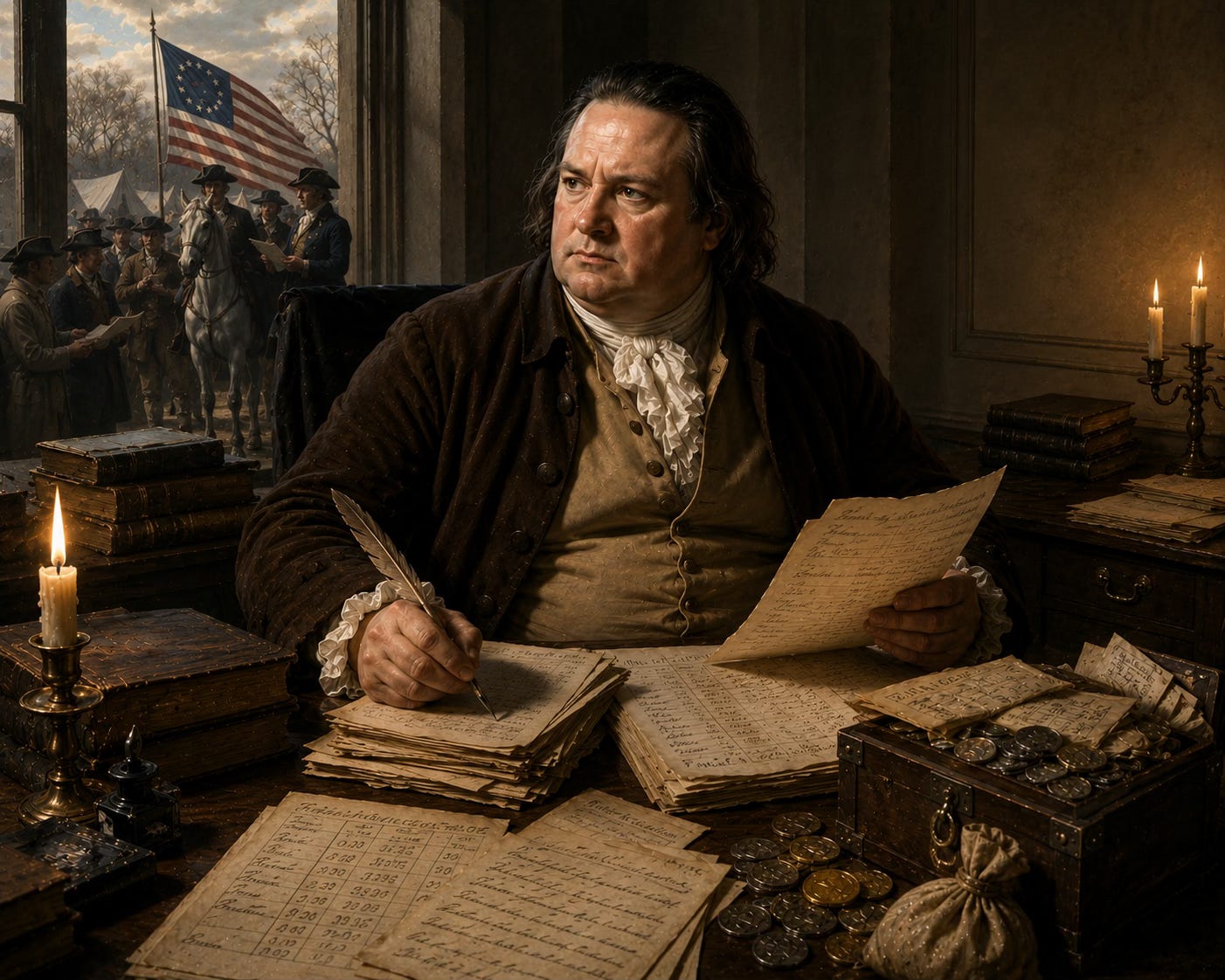
Most revolutions fail because they run out of money and resources before they run out of courage.
The American Revolution almost did both.
While Washington fought battles and Congress debated independence, one man spent most of the war confronting a simpler problem:
How do you finance a revolution? That man was Robert Morris. We remember Washington and Jefferson and other prominent Founders.
But history rarely remembers the man who kept the government solvent because it’s not quite as glamorous.
Morris understood something every founder eventually learned: Patriotism does not pay suppliers. Liberty does not feed armies. Principles do not automatically create credit.
The Continental Congress printed currency. Inflation exploded. Supplies vanished. Confidence deteriorated.
Morris stepped into the vacuum. To be clear, initially with real doubts and great hesitation. Morris leaned toward reconciliation with the Crown and feared the “independency movement” in the Second Continental Congress was pushing too hard, too soon. His hesitation stemmed in many ways from his great wealth: he was considered to be the richest man in the colonies, having made his fortune via Willing, Morris & Company, the company which he and Thomas Willing had founded in 1757.
The firm became one of the most successful import-export and financial businesses in the American colonies in the years preceding the Revolution, with global trade throughout the British Empire. A revolution would destroy that lucrative trade.
But in the end, Morris realized independence was the only route for the colonies. Once his mind was made up, he threw everything into the cause.
He used his own fortune repeatedly. He negotiated loans. Created systems of credit. Organized procurement.
Ultimately, he became the financial backbone of the Revolution.
When Washington critically needed cash in December 1776, Morris leaned on an old Quaker friend to dig up a chest of coin in the man’s backyard. Time and time again he came through for Washington in critical moments. Throughout the war until Yorktown, Washington’s army moved because Morris found the money.
That may sound less romantic than battlefield heroics. It was because most find logistics and numbers boring. Morris didn’t lead gallant charges or lead troops to victory but without him none of those would have been possible.
Because of his financial abilities he was indispensable to the cause and was dubbed “The Financier of the Revolution.” In the end, he gave everything for the Revolution he’d been so hesitant to support at its beginning. When we read the lines, “We mutually pledge to each other our Lives, our Fortunes and our sacred Honor” we should see Morris’ face: he was willing to risk his entire fortune for the sake of liberty.
His life is one of the recurring themes of the American founding:
Freedom requires competence. Not merely rhetoric or ideals but competence and systems.
Morris reminds us that republics survive when practical men solve practical problems.
The Revolution needed philosophers but it also needed finance men and accountants.
Many of the founders gave much or all of their fortunes to support the cause. Thomas Nelson of Yorktown was one. Also, when the Brits commandeered his house as their HQ (it was the nicest house in Yorktown at the time), he willingly encouraged his compatriots to lob a bomb at the British in his house. One of the cannonballs is still there.
Another early founder, James Iredell, ceded his role as head of Albemarle Sound (near Edenton NC), and the associated income. Iredell was one of the original Supreme Court Justices. His letters re. living in boarding houses to ride circuit belie the current “elite”’s ideas that those in such roles are “entitled” to luxury.
So few understand the character, discipline and self sacrifice of our Founders. Thank you for this piece on Morris.