
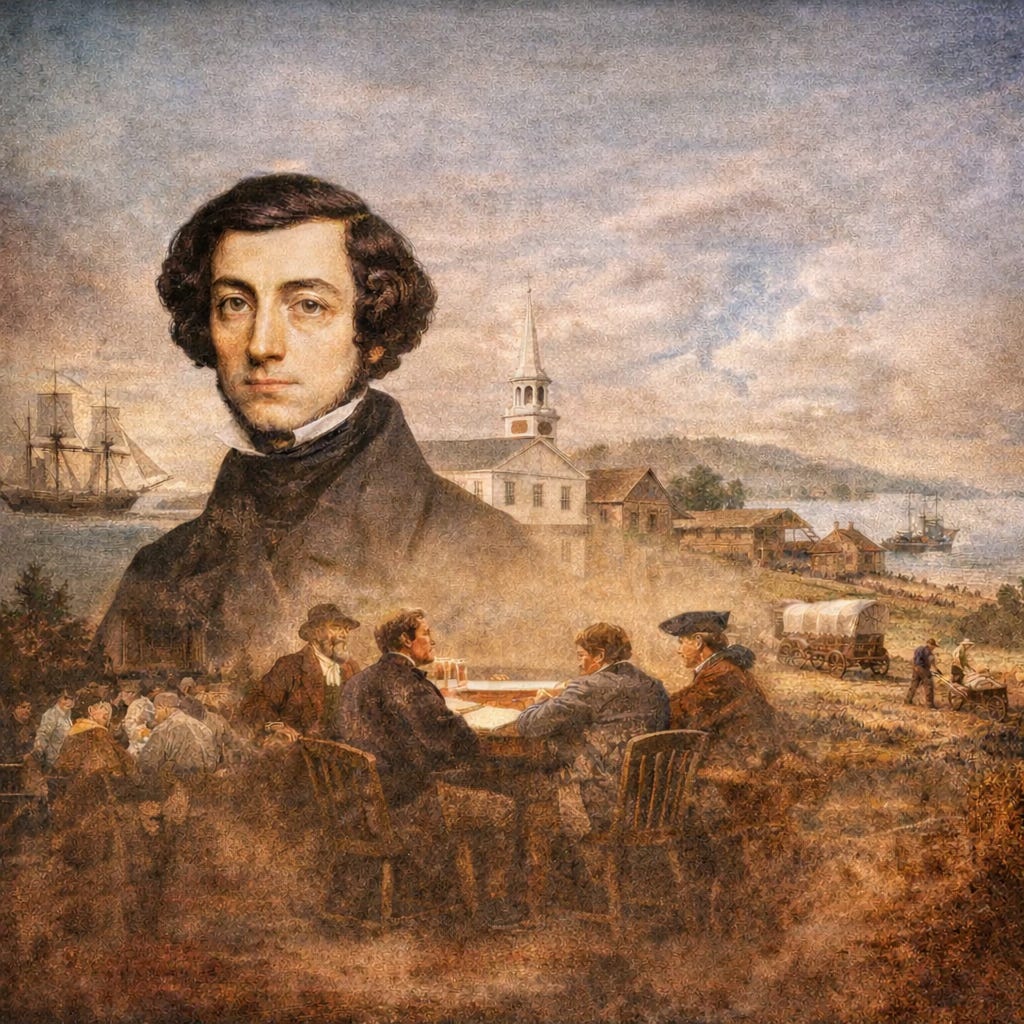
America is loud.
Not just “fireworks and pickup trucks” loud. I mean the other loud—the constant arguing about what America “is,” what it “was,” what it “should be,” and who’s allowed to say any of that out loud without being declared a heretic.
We do this every election cycle. We do it every time a statue comes down. We do it every time a celebrity decides the Constitution is “problematic,” which is a fun word people use when they can’t be bothered to define the problem.
And we’re doing it now because America is turning 250.
So here’s my proposal: instead of letting the usual cast of professional scolds narrate our anniversary—people who either treat America like a church (no questions allowed) or a crime scene (no gratitude allowed)—let’s hand the microphone to a man who arrived here with no dog in our fight.
A young French aristocrat.
In 1831, Alexis de Tocqueville sailed into New York Harbor. He came officially to study American prisons. Like any decent French bureaucratic mission, it was presented as something practical and boring. In reality, it was a cover story for something much bigger:
He came to understand the future.
Because Europe was wobbling. Old regimes were weakening. Revolutions were popping like summer thunderstorms. “Democracy”—the word was already in the air, heavy with promise and menace.
And Tocqueville wanted to know what democracy looked like once it moved in and unpacked its bags.
Not as an abstract theory. Not as a slogan. But as a lived-in condition.
So he came here.
And what he discovered—this is the key—was not primarily our Constitution, or our elections, or even our rights talk.
He discovered our habits.
Our local self-government.
Our associations.
Our restless energy.
Our religious virtue and restraint paired with religious and political freedom.
Our tendency to form a committee if stranded on an island with three strangers and a barrel of nails.
He saw, in other words, America’s democratic DNA.
And here’s the uncomfortable part: Tocqueville may have understood what made America work better than many Americans then… and certainly better than many Americans now.
Because Americans often talk about America the way fish talk about water: only when it’s polluted or missing.
Tocqueville gave us the gift of outside vision. He looked at our normal and said, “This is not normal.”
And that’s why this next series of posts begins with him.
Not because we need a Frenchman to validate us. But because sometimes you need an outsider to notice what insiders take for granted—especially when the insiders are busy trying to turn the national inheritance into a partisan weapon.
So what did he find?
He found a society where equality of condition—not perfect equality, not utopia equality, but the social leveling that comes from a broad middle class—was already changing everything: family, religion, commerce, politics, ambition, envy, manners, and even loneliness.
He found a people deeply suspicious of centralized power yet obsessed with progress.
He found citizens who could build a town, a church, a business, and a volunteer militia faster than a European government could approve the paperwork for a bridge.
He found something neither the Enlightenment philosophers nor the Founders fully anticipated:
That democracy is not mainly a political arrangement.
It’s a social state.
And once that social state arrives, it starts rearranging the furniture—whether you like it or not.
That’s the hook.
Because if you want to understand what America is right now—why we fight the way we fight, why we build the way we build, why we fracture the way we fracture—you can’t start with cable news.
You start with the deep code.
And Tocqueville is our guide into that code.
But before Tocqueville can tell us what he saw, we have to ask an earlier question:
Where did America’s ideas come from?
Because America didn’t spring out of the ground in 1776 like a Marvel origin story. The Founders did not invent human nature. They didn’t invent liberty. They didn’t invent rights.
They inherited a long civilizational argument and then did something rare: they tried to build, in defiance of history, a republic that would last.
And that inheritance—ironically, unavoidably—runs through Britain.
Which is where we go next.
It is taught in some schools. If we want it to be taught in more we will have to get the federal government out of education.
Soooo inspiring!! If only this is what would once again be taught in our schools the entire country would be all the better for it.