
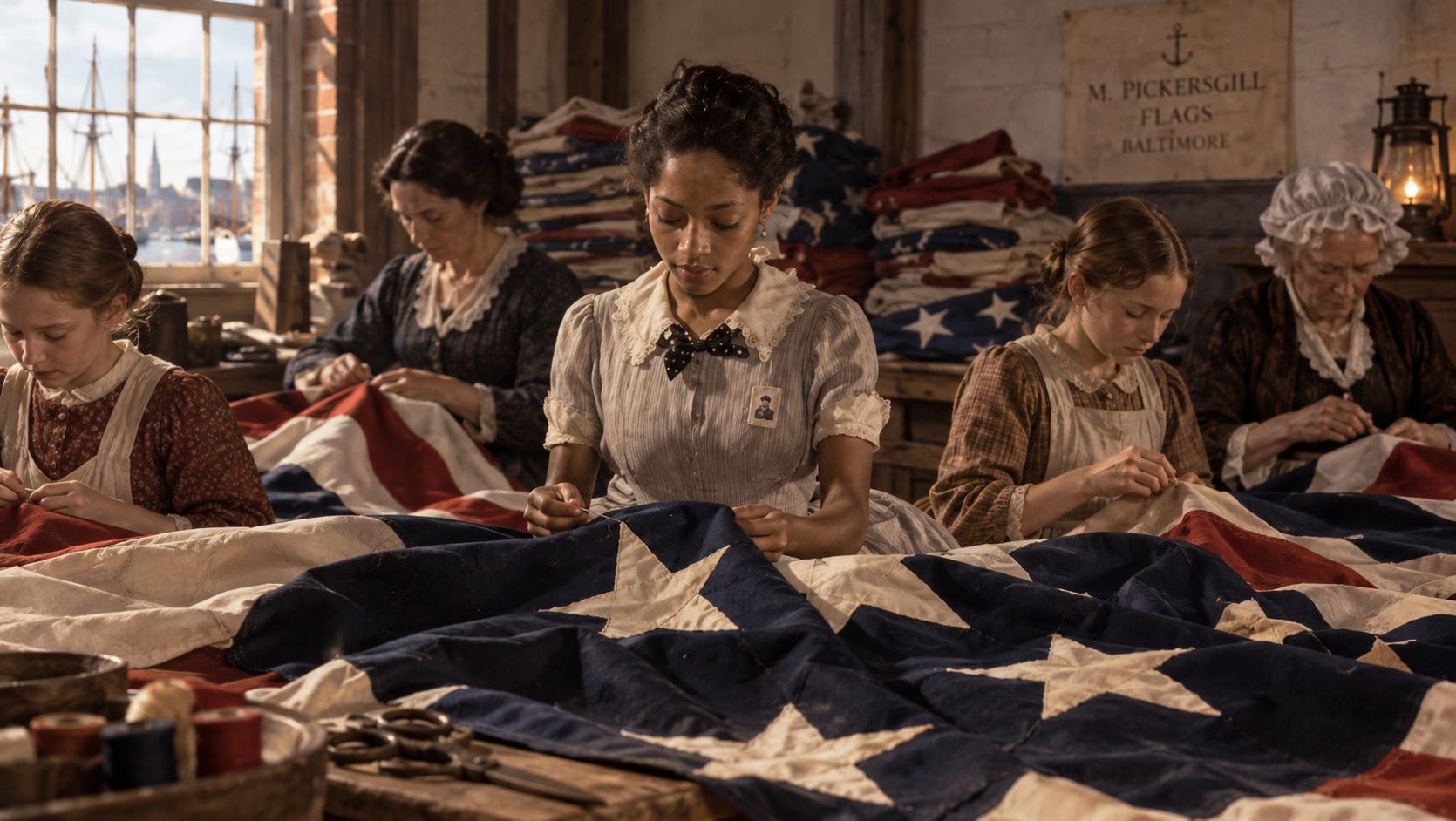
On January 6, 1810, a free Black woman named Jenny Wisher signed a contract in Baltimore binding her daughter to another woman’s household for six years.
Grace Wisher was about ten years old. The terms specified that she would learn what the document called “the art and mystery of housework and plain sewing.” Reading and writing were not mentioned, which was normal and which is the reason we have nothing from her in her own hand.
Indenture contracts were customarily signed by a child’s father. Grace’s was signed by her mother. Historians who have looked at the record point out that most free Black families in Baltimore at that time had recently come out of rural slavery, and that Jenny Wisher’s husband may have still been enslaved somewhere else, or dead, or otherwise unable to sign. There is no way to know.
The household she entered belonged to Mary Pickersgill, a thirty-something widow who made flags, something that Pickersgill was very good at it. She had learned the trade from her mother, Rebecca Young, who had made flags during the Revolution, and she supplied ships’ colors and signal flags to the merchant and naval traffic in one of the busiest ports in America.
In the summer of 1813, with a British fleet operating in the Chesapeake Bay and Baltimore expecting an attack, she took a commission from the officers responsible for the defense of Fort McHenry.
They wanted two flags. A storm flag, seventeen by twenty-five feet, for bad weather. And a garrison flag, thirty feet by forty-two — big enough, as the story around the order goes, that the British would have no difficulty seeing it from a distance.
Consider the scale of that object. Roughly twelve hundred and sixty square feet of wool bunting. Fifteen stars, each two feet across, cut from cotton and sewn on. Fifteen stripes, each nearly two feet wide. Every stitch by hand.
No reasonable person would expect that to be made, by hand, in seven weeks.
The flag was made by a room full of women and girls. Mary Pickersgill, her daughter Caroline, thirteen; her nieces Eliza Young, thirteen, and Margaret Young, fifteen. Her elderly mother, probably. An enslaved woman in the household whose name was never written down and is lost.
And Grace Wisher, thirteen years old, five years into her indenture, working the same needle as the daughter of the house.
The flag was so large it would not fit in the Pickersgill home. The final assembly was done on the floor of a nearby brewery, at night, after the malt house had closed. Mary Pickersgill and her team finished the flag on August 19, 1814 in seven weeks’ time.
Less than a month later, on the morning of September 14, after twenty-five hours of bombardment, that very flag went up over Fort McHenry, and a Baltimore lawyer named Francis Scott Key, watching from a truce ship in the harbor, wrote a poem about seeing it there.
Grace Wisher’s indenture would have ended around 1815 or 1816, when she reached the age of majority.
After that, the record stops. We do not know where she went, whether she married, whether she had children, when or where she died. There is no portrait and no description of her appearance. Everything we have about her life is one contract and an inference about a flag.
There is a painting at the Star-Spangled Banner Flag House in Baltimore, made in 1962, showing the Pickersgill household at work on the flag. Grace Wisher is not in it. In 2014, rather than alter the painting, the museum traced a figure of her onto the plexiglass covering it — a transparent outline, sitting and sewing, in the room where she actually was.
That is an unusually honest piece of curation. It does not pretend she was always remembered. It shows exactly what was done to the record and then corrects it in a way that leaves the correction visible.
Two things should be said plainly.
The first is that this is not a story about a symbol being tainted. It is the opposite. The flag was made by a working widow, three teenage girls, an elderly woman, an enslaved woman, and an indentured Black child, in a rented malt house, on a deadline, for money. That is a more American origin story than anything a committee could have imagined.
The second is harder and should not be dodged. The song Key wrote has a third verse, rarely sung, containing a line about the hireling and the slave finding no refuge. Scholars disagree about who he was referring to — whether it points at the Colonial Marines, the formerly enslaved men who had escaped to the British and fought against the United States, or whether it is generic period abuse of mercenary troops. The argument is genuine and unresolved.
What is not ambiguous is that a thirteen-year-old Black girl helped sew the flag in question, and that at that moment the country the flag belonged to would not have counted her fully as one of its own.
Both facts are true at once. Holding them together is not a concession to anybody’s politics. It is just the actual history of the thing, and this publication has argued from the beginning that the founding does not need to be improved — it needs to be read and appreciated.
What a tremendous story none of us would ever have known. I am grateful I found your site.