The Indictment of a King
Jefferson writes the case for self-government
June 11–27, 1776
Most Americans remember the Declaration of Independence for a handful of soaring lines: “We hold these truths to be self-evident, that all men are created equal, that they are endowed by their Creator with certain unalienable Rights, that among these are Life, Liberty and the pursuit of Happiness.–That to secure these rights, Governments are instituted among Men, deriving their just powers from the consent of the governed. . .”
But the majority of the document is actually not poetry: It’s a list of grievances and an indictment of King George III and his ministers.
The Declaration is in reality a long, methodical, prosecutorial case against centralized power and that matters.
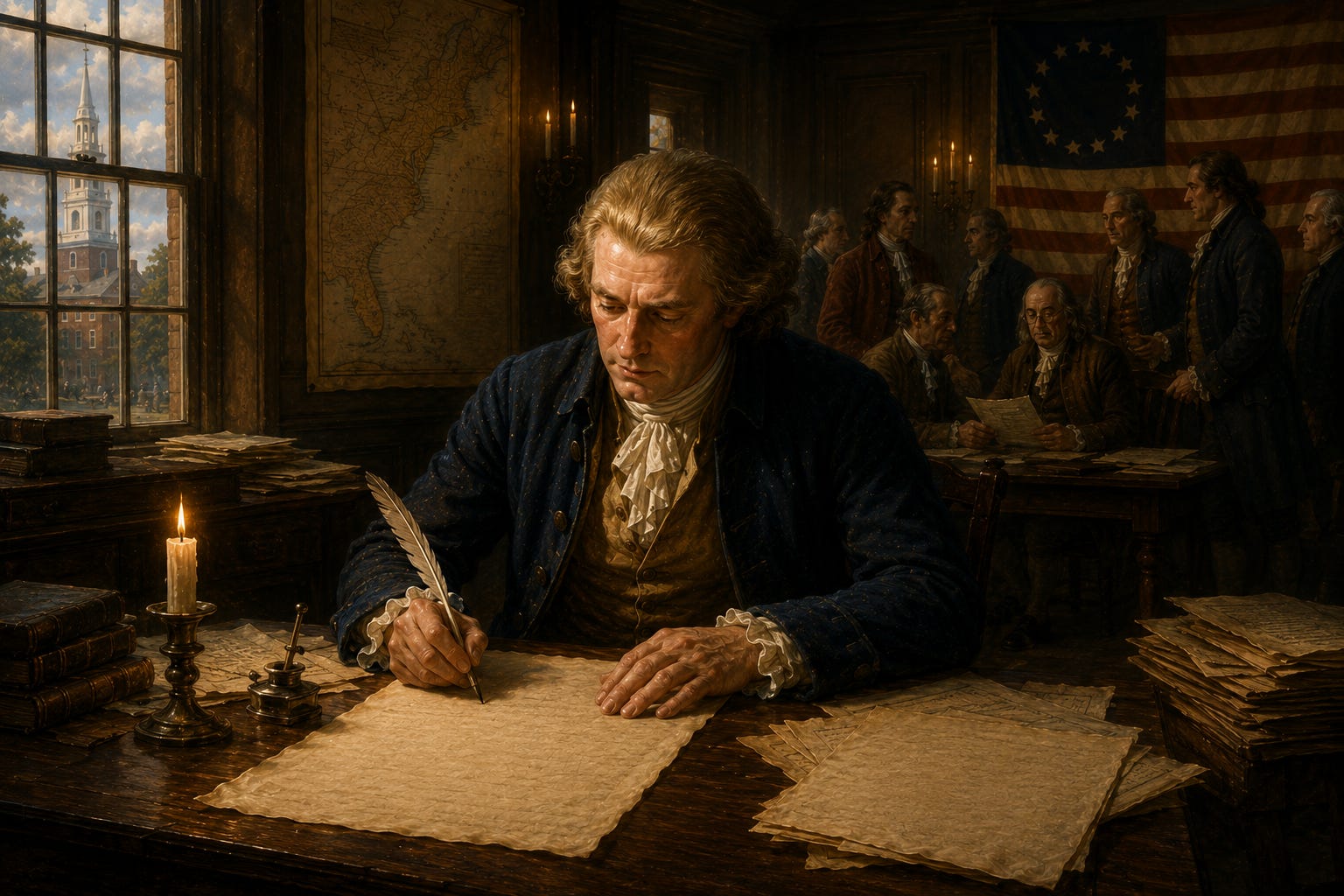
Between June 11 and June 27, 1776, Thomas Jefferson sat in Philadelphia drafting what would become one of the most consequential political documents in human history.
History tends to portray Jefferson as a philosopher floating above events in abstraction. That’s not quite true: in reality, he was building a legal argument for revolution.
The Declaration was not written as emotional rebellion. It was written as justification.
The founders understood something essential: If you are going to sever political ties with the most powerful empire on earth, you had better explain why. Not merely to foreign governments or future generations but to the American people themselves.
That is why the grievances matter so much.
Modern Americans often skip over them entirely, treating the list as repetitive filler between the famous introduction and the signatures at the bottom.
That is a mistake. The grievances are the core of the document.
They explain precisely what the founders believed tyranny looked like.
And remarkably, today, many of the warnings still feel uncomfortably familiar.
Jefferson accused King George III of:
obstructing self-government,
dissolving representative legislatures,
manipulating courts,
sending customs officials and revenue agents to the colonies to
strictly enforce tax laws and collect duties without colonial consent
which meant taxation without representation.
maintaining standing armies disconnected from civilian authority,
expanding bureaucratic control,
imposing authority without consent,
transporting Americans overseas for trial,
and cutting off local accountability.
In other words: The founders were not merely rebelling against a king.
They were rebelling against centralized power detached from the consent of the governed. That distinction matters enormously.
The Declaration was not fundamentally an anti-British document.
It was an anti-arbitrary-authoritarian power document.
The Crown, in the founders’ view, had violated the political covenant (consent of the governed) that made legitimate government possible.
That is why Jefferson frames the argument carefully: Governments are instituted to secure rights, but when governments become destructive to those rights, they lose legitimacy.
That idea in the 1770s was revolutionary.
Not because no one had ever criticized rulers before but because the Declaration relocated sovereignty itself.
The old world assumed authority flowed downward: God → King → Subjects.
The American founding increasingly argued: God → Natural Rights → The People → Government.
With the Declaration, and then the Constitution, the people became sovereign and government became conditional rather than permanent.
That single shift altered world history. And importantly, Jefferson did not invent these ideas alone in a vacuum.
The Declaration drew from:
English common law,
Protestant resistance theory,
Enlightenment philosophy,
colonial self-government,
and generations of local American political habits.
Jefferson synthesized them into a single coherent moral argument and he did so under extraordinary pressure. Congress was moving rapidly toward independence. War had already begun with massive British forces threatening the colonies.
Failure could mean execution for treason.
Yet Jefferson still understood that military victory alone would not sustain a republic. America needed a philosophical foundation.
That may be the greatest significance of the Declaration itself.
The Revolution was not merely about replacing rulers. It was about redefining legitimacy.
The founders were asserting that rights existed prior to government itself.
That liberty was not permission granted by power and that free people possessed the authority to govern themselves.
That remains the central American argument.
And it remains deeply threatening to every system built on permanent centralized control.
The administrative state depends on the assumption that citizens are too fragmented, uninformed, or irresponsible to govern themselves without constant management from above.
Jefferson’s grievances reject that premise entirely.
They assume the opposite: That concentrated power is the greater danger.
That is why the Declaration still matters nearly 250 years later.
Not because it is old.
Because the argument never stopped being relevant.

