
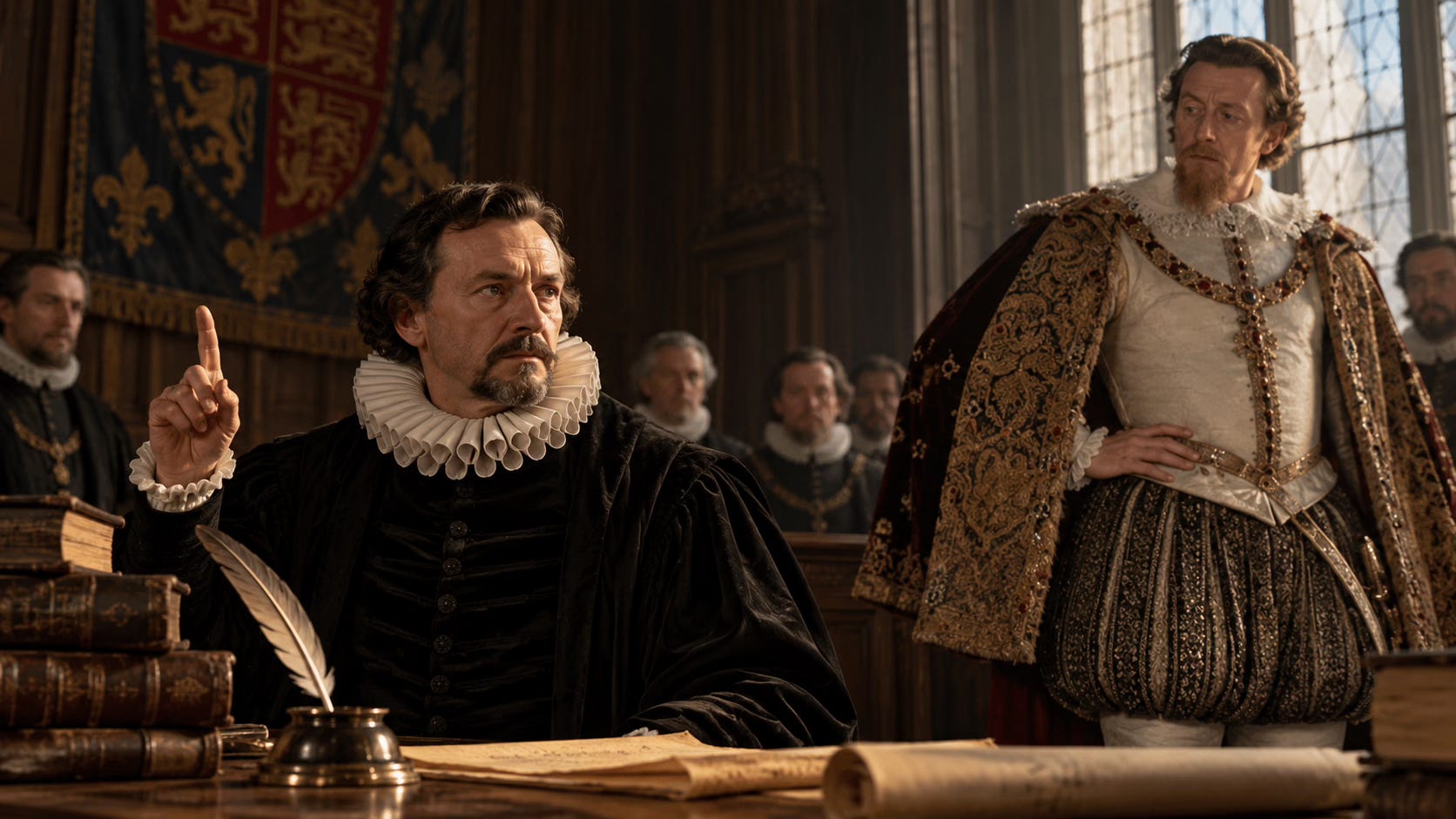
In 1610, the Court of Common Pleas in London heard a complaint from a physician named Thomas Bonham.
Bonham had a medical degree from Cambridge. He was practicing in London without a license from the Royal College of Physicians. The College fined him. He kept practicing. The College imprisoned him.
Look closely at what the College of Physicians actually was, because the shape of it should be familiar.
It had been given authority by statute to make rules governing who could practice medicine. It investigated violations of its own rules. It sat in judgment on the people it accused. It imposed fines and it could jail people. And under its charter, half of every fine it collected went into its own treasury.
Rulemaking, enforcement, adjudication, and a financial interest in the outcome. All in one body. In 1610.
Sir Edward Coke was Chief Justice of Common Pleas, and his judgment in Bonham’s case has been argued over by lawyers for four hundred years.
He held that the College could not be judge in its own cause. No man should be a judge in his own case — a principle old enough to be a commonplace and radical enough, applied here, to void an act of Parliament. Coke went on to say that when an act of Parliament runs against common right and reason, the common law will control it and adjudge it void.
English lawyers have spent centuries explaining why he did not really mean that, because in England Parliament became supreme and the sentence is an embarrassment.
Americans took it literally.
That single line is the seed of judicial review — the notion that a court can measure a statute against a higher law and find the statute wanting. James Otis argued it in Boston in 1761 against the writs of assistance, citing Coke, and a young John Adams sat in the room and wrote, “Then and there the child Independence was born.”
Ironically, Coke was not necessarily democratically inclined and would have been horrified by the suggestion. He was something more useful: a lawyer of ferocious learning who believed that the common law was an inheritance older than any living authority, and that kings and Parliaments were tenants in it rather than owners of it.
He proved it in person.
In 1607, James I informed his judges that since the law was founded on reason, and since he possessed reason as well as any judge, he could perfectly well decide cases himself.
Coke told him no.
The king, he said, was endowed with excellent natural gifts. But cases at law are not decided by natural reason. They are decided by the artificial reason and judgment of law — a discipline requiring long study and experience before a man can attain to it. And then he quoted Bracton at his sovereign: the King ought not to be under any man, but under God and the law.
By one account James was so enraged that he raised his fist and Coke went to his knees. He did not, however, take his words back.
He was eventually removed from the bench. So he got himself elected to Parliament, which turned out to be even worse for the Crown.
There, in 1628, as an old man, he was the driving force behind the Petition of Right — the document that reasserted that the King could not tax without Parliament, could not imprison without cause shown, could not billet soldiers in private homes, could not impose martial law on civilians in peacetime.
Every one of those grievances shows up again a hundred and fifty years later in a list of complaints against George III, and three of them ended up in the Bill of Rights.
And Coke did one more thing that shaped America more than any of it.
He resurrected the Magna Carta.
By 1600 the charter that the barons forced on King John at Runnymede in 1215 was a dusty medieval land document, largely forgotten, mostly concerned with feudal dues and fish traps. Coke read it as a constitution — as a statement that even the king was bound, that no free man could be seized or imprisoned or dispossessed except by lawful judgment and the law of the land, that justice would not be sold or delayed.
Whether that is what the barons meant in 1215 is a question for medievalists. It is unquestionably what the colonists thought it meant, because they read it in Coke’s Institutes, which sat in nearly every American law office that had any books in it at all.
Jefferson studied him and complained about how hard he was to read. Adams worked through him. Practically every lawyer in the Continental Congress had been formed by him.
Coke was not a saint. As Attorney General he had prosecuted Walter Raleigh with a viciousness that shocked even his contemporaries, in a trial that would now be considered a disgrace. The man who articulated the rights of the accused spent years trampling them for the Crown.
That complication is worth keeping. Principles are frequently discovered by people who violated them first.
But return to Dr. Bonham, and to why a four-hundred-year-old licensing dispute is not an antiquarian matter.
Coke’s objection was not that the College of Physicians was staffed by bad men. Presumably it was staffed by competent doctors who sincerely believed that unlicensed practice endangered the public, which it sometimes did.
His objection was structural. A body that writes the rule, prosecutes the violation, judges the case, and keeps a share of the fine is not administering justice (if this sounds familiar to our Administrative State, it should).
Coke’s answer was that something must stand between a governing body and the citizens, and that the something is the law, and that the law is not the property of whoever currently holds office. He said it to a king and lost his job for it. Within two generations, another Englishman would say something very similar and lose his head.
If you enjoyed this article, you’ll love the documentary.
Thread of Liberty follows the entire thread of the American experiment — from ancient Rome and the Puritans, through the Revolution and the Constitution, to Tocqueville, Lincoln, Calvin Coolidge, and the modern Administrative State.
Watch the full feature documentary at ThreadofLiberty.com
Why do you disable Pangram on your posts?