
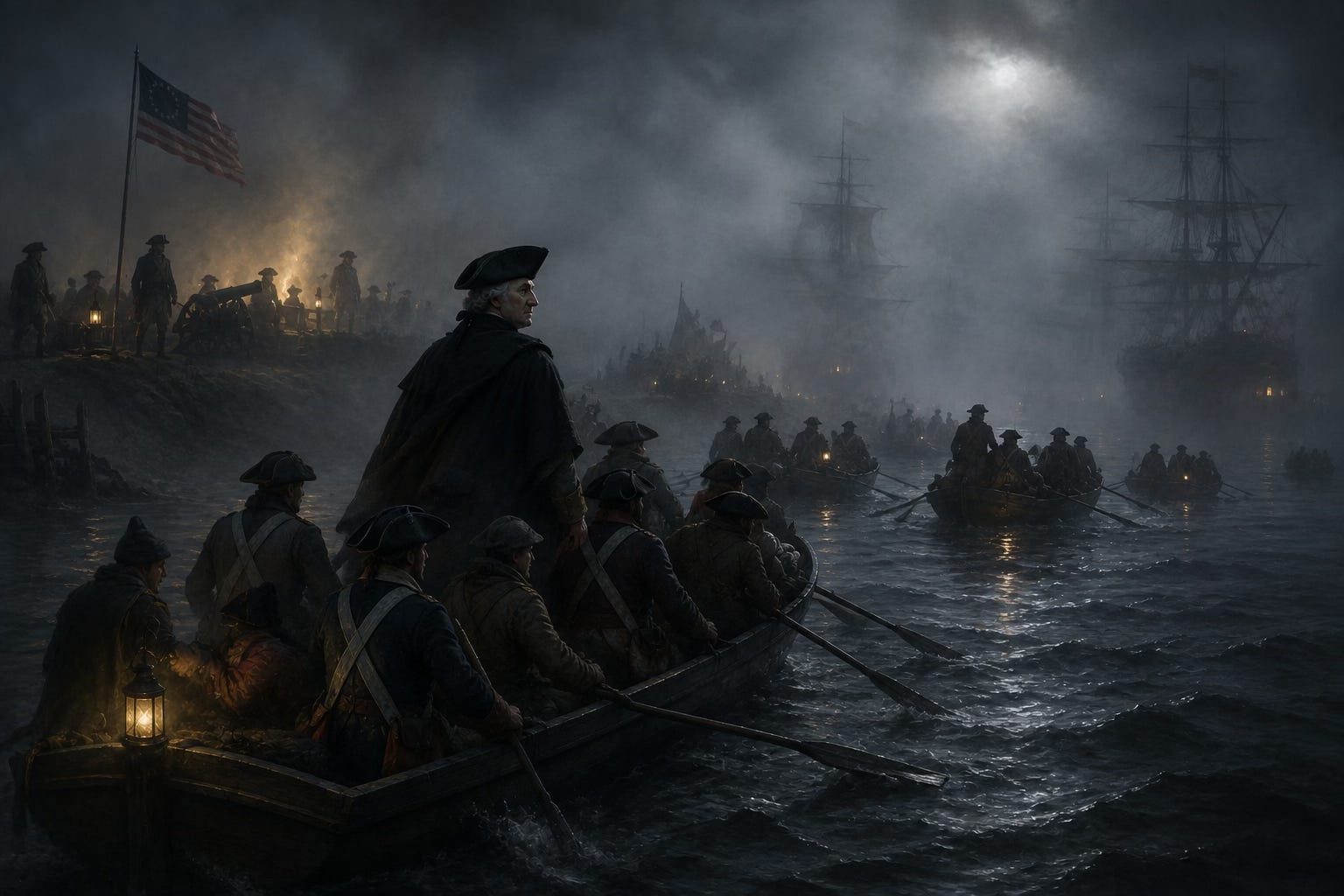
Washington’s army was finished on the morning of August 29, 1776.
Nine thousand men were penned into the fortifications at Brooklyn Heights, backed against the East River. In front of them, on all three sides, Howe’s engineers were digging diagonal siege trenches, working closer each night. Behind the Americans was a mile of open water with the Royal Navy lurking, waiting for the wind to shift so it could sail up the East River and close the trap.
A cold nor’easter had been coming down for two days, pummeling both sides with heavy rain and wind. Men were standing up to their knees in flooded trenches. Powder was wet. Men had not slept.
Any competent staff officer looking at that map would have written the same conclusion. The Continental Army, and with it the Revolution, had about seventy-two hours left.
Washington called a council of war on the afternoon of the 29th. The decision was to withdraw the entire force across the river to Manhattan.
Then he did something extraordinary, which is that he told almost nobody.
Orders went out for every small craft on the western end of Long Island and the Manhattan shore to be gathered at the Brooklyn ferry landing that evening. The stated purpose was to bring reinforcements over. Regiments were told to prepare for a night attack, which explained the movement and kept them quiet.
If word had leaked — to the British, or into the ranks, where panic would have done the job just as fast — the evacuation would have become a massacre on the waters of the East River. Rear guards were left in the lines with fires burning, entrenching tools sounding, sentries walking their posts.
The whole thing depended on nine thousand tired, terrified men keeping their mouths shut in the dark.
The men who actually performed the evacuation were fishermen.
John Glover’s 14th Continental Regiment came from Marblehead, Massachusetts, with Israel Hutchinson’s regiment from Salem. They were sailors and cod fishermen — men who had spent their lives handling small boats in bad water at night.
For perspective, the East River is not really a river. It is a tidal strait with strong currents and a reputation for killing people who do not respect it. One stretch of the river was literally called Hell Gate because of its vicious whirlpools.
The task for Glover and Hutchinson’s men? To transfer over 9,000 men and supplies across a mile of open water in the dark, in overloaded boats with water almost up to the gunnels, with oars muffled, and no voices allowed.
They began around eleven o’clock at night. They rowed until 8am, with some members of Glover’s regiment recounting eleven round trips that night.
Back and forth, hour after hour, ferrying not just men but horses, cannon, provisions, and equipment — because Washington was not merely saving an army, he was saving everything the army would need to keep existing.
The wind, which had held northeast for days, is the first piece of the story: it was precisely the wrong direction for British warships trying to work up the East River from the harbor to the south. They could not get into position. Several attempts were made and abandoned.
But the evacuation was stretching on: it would take nine-hours in total and at dawn, there would still be thousands of Americans on the wrong side of the river. Dawn on August 30 should have exposed everything. Boats still in the water. Regiments still on the Brooklyn side. British lines within musket range of works that were about to be discovered empty with the British growing suspicious in the early hours of the 30th that something unusual was taking place in the American lines.
But at 2am, another miracle happened: the wind began to die down and a heavy, dense fog rolled in across the East River, cloaking the evacuation. Benjamin Tallmadge, a young officer who would go on to run Washington’s spy network, wrote about it afterward. He described a fog so dense that a man could not see six yards, hanging over the Long Island side while the Manhattan shore stayed comparatively clear — as if the weather itself were covering the retreat and nothing else. He later wrote: “Providence seemed to have smiled upon this daring undertaking. The fog hung upon the river till the retreat was safely effected.”
The last boats finally passed thru the fog, Washington, by the accounts of men who were there, went in one of them, having stayed to the end.
When the fog lifted and British patrols moved forward into the American works, they found abandoned trenches and a few pieces of heavy artillery too stuck in the mud to move.
Over nine thousand men. Across a mile of tidal water. In one night. Under the guns of the most powerful navy on earth.
Not a man was lost; not one heavily overloaded boat capsized.
There is a temptation to tell this story as pure luck and leave it there. That misses what actually happened.
Luck does not muffle oars. Luck does not stage the withdrawal so the lines stay manned until the last hour. Luck does not produce a regiment of Marblehead fishermen at the exact moment an army needs to become a fleet. Luck does not keep nine thousand exhausted soldiers silent.
Washington’s contribution to the Revolution was rarely brilliance on the battlefield. He lost more battles than he won and he knew it. His contribution was that he kept the army in existence, and he understood — earlier and more clearly than his critics — that as long as the army existed, the cause existed.
An army that survives a lost battle has lost a battle but will fight another day. An army that is captured has lost the cause and the country.
The men of that generation, including men not much given to religion or piety, tended to describe the fog on the East River as Providential, as the direct intervention of God, and they said so publicly for the rest of their lives.
You may accept that theological explanation or you may not. What is not in dispute is the counterfactual.
Had the wind shifted, or had the fog not come, the entire Continental Army — with its commander-in-chief inside it, ten weeks after the Declaration was signed — would have been in British hands by noon on August 30, 1776.
The Revolution could have ended then and there: there would have been no Trenton. No Saratoga. No French alliance. No Yorktown. No Constitutional Convention.
The whole thread runs through one foggy morning in Brooklyn.
If you enjoyed this article, you’ll love the documentary.
Thread of Liberty follows the entire thread of the American experiment — from ancient Rome and the Puritans, through the Revolution and the Constitution, to Tocqueville, Lincoln, Calvin Coolidge, and the modern Administrative State.
Watch the full feature documentary at ThreadofLiberty.com
What a wonderful piece of history, which I knew nothing about.
Dunkirk was not the first salvation of a trapped army by civilian effort. Who knew! Wonderful accounting of an historical event I knew nothing about. Thank you!