
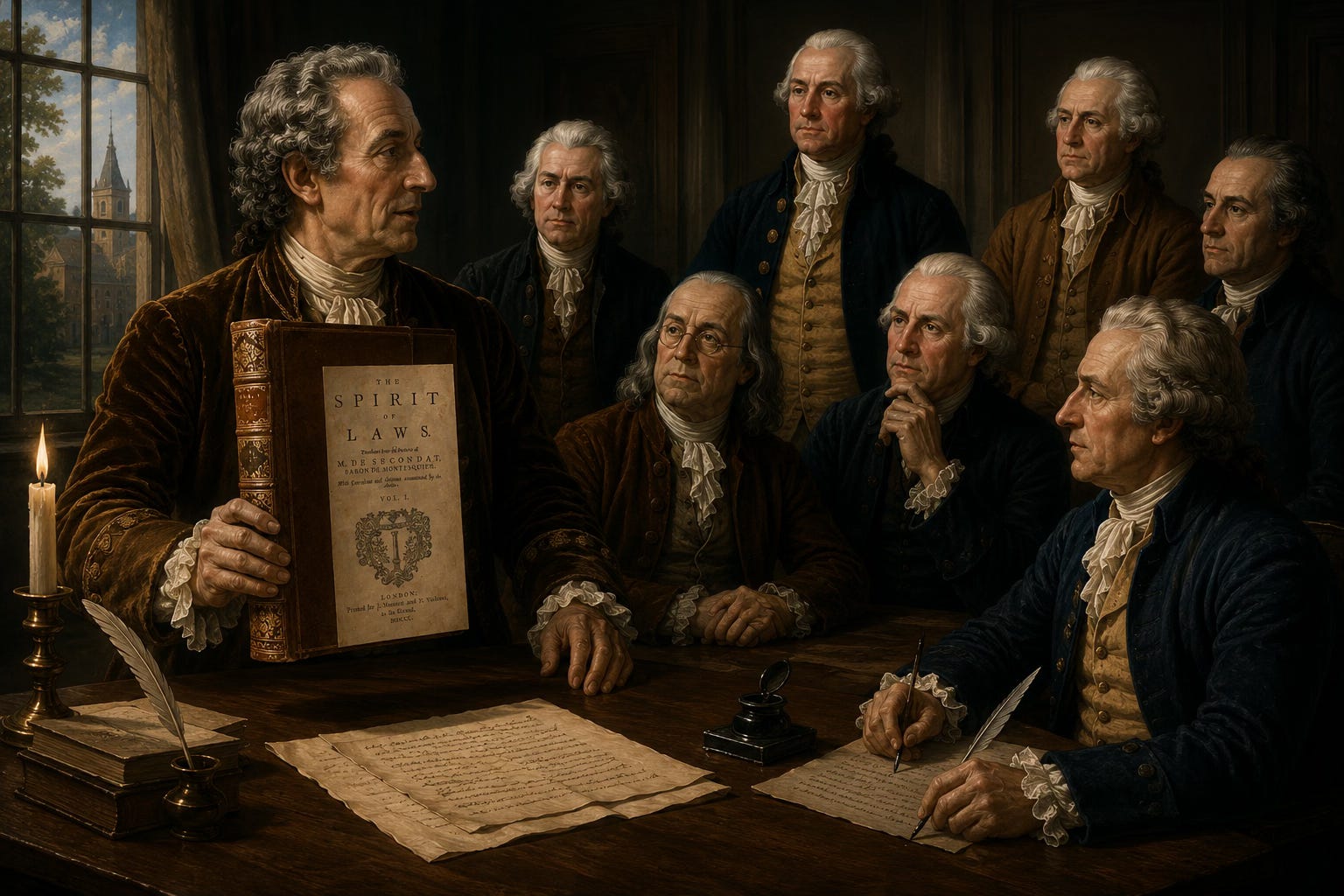
If you had asked an American in 1787 to name the greatest political thinker alive or dead, you would have heard Locke but you probably would have heard Montesquieu named more often.
Charles-Louis de Secondat, Baron de La Brède et de Montesquieu, was a French nobleman and former magistrate who spent roughly twenty years writing a single enormous book. The Spirit of Laws appeared in 1748. The Catholic Church put it on the Index of Forbidden Books three years later, which was, then as now, excellent publicity.
Scholars who have counted citations in American political writing from the founding era find Montesquieu at the top of the list of secular authorities. Not Locke. Not Hume. Not Blackstone. Montesquieu.
Madison, in Federalist 47, called him the oracle who is always consulted and cited on the subject of separated powers.
So what was in the book?
Montesquieu’s first move was to stop asking what the best government is and start asking what makes any government work.
Laws, he argued, are not free-floating propositions that a philosopher can deduce and a legislator can impose. They grow out of a people — their history, their religion, their commerce, their habits, even their geography. The spirit of the law is the relationship between a legal code and everything else about the society that produced it.
This is why he is sometimes called the first sociologist. It is also why he is deeply unfashionable in an age that assumes best practice can be exported anywhere by a sufficiently confident consultant.
His second move is the one that made him immortal.
Every government, he observed, performs three functions. It makes law. It executes law. It judges under law. And political liberty exists only when those three functions are held by different hands.
His reasoning was not procedural. It was psychological, and it should sound familiar after Rutherford and the Scots:
Every man invested with power is apt to abuse it. He will push until he meets a limit. And since he will not stop himself, only power can check power.
Not a better class of rulers. Not stronger oaths. Structure.
Montesquieu believed he had found the working model in the English constitution — King, Lords, and Commons, with an independent judiciary. Historians have argued ever since about whether he described England accurately or invented an idealized England that never quite existed.
It hardly matters. The Americans read the description and built the thing.
Here is what deserves more attention: the Founders did not simply copy him. They argued with him and beat him on his own ground.
Montesquieu held a view inherited from antiquity and shared by nearly everyone: republics must be small. A free state depends on citizens who share a common way of life, know one another, and can be virtuous together. Stretch a republic across a large territory with diverse interests and it collapses into faction, then into despotism.
The Anti-Federalists believed this and they used it like a hammer. Brutus in The Anti-Fedralist Papers, and others, quoted Montesquieu against the proposed Constitution: you cannot run a republic across thirteen states and a continent. The oracle himself says so.
It was the single strongest argument against ratification, made with the era’s most respected authority.
Madison’s reply, in Federalist 10, is one of the genuine intellectual achievements in the history of political thought. He accepted Montesquieu’s diagnosis and rejected his prescription.
Yes, faction destroys republics. Yes, human nature guarantees faction. But a small republic is precisely where faction is most dangerous, because a single interest can capture a majority and there is nowhere to hide from it.
Enlarge the republic and you multiply the interests. No faction can assemble a durable majority. The very size that Montesquieu feared becomes in Madison’s thinking part of the safeguard.
The Constitution is Montesquieu’s mechanism installed at Madison’s scale.
And then there is the sentence Madison wrote about what happens when the mechanism fails: when the legislative and executive powers are united in the same body, he wrote in Federalist 47, there can be no liberty. When judicial power is joined to them, everything is lost. The accumulation of all three in the same hands, whether one, few, or many, and whether hereditary, self-appointed, or elective — that is the very definition of tyranny.
Read that clause again. Whether hereditary, self-appointed, or elective.
Madison was not only worried about kings. He was worried about any entity that accumulates all three functions, regardless of how it got there and regardless of how well-intentioned it is.
Consider a modern federal agency. It promulgates rules and statutes that carry the force of law. It investigates and enforces those rules. And when you contest an enforcement action, your case was heard for decades, at least initially, by an administrative law judge employed by the same agency.
Legislative. Executive. Judicial. One roof.
Montesquieu did not need to imagine a tyrant to explain why this is dangerous. He only needed to observe that men with power push until something pushes back.
The question for our own moment is not whether the people staffing those agencies are wicked. Most of them are not, but they are imperfect human beings just like the rest of us, prone to do what they can, not what they should. The question is the one the oracle asked in 1748.
What, or who, exactly, is pushing back?
If you enjoyed this article, you’ll love the documentary.
Thread of Liberty follows the entire thread of the American experiment — from ancient Rome and the Puritans, through the Revolution and the Constitution, to Tocqueville, Lincoln, Calvin Coolidge, and the modern Administrative State.
Watch the full feature documentary at ThreadofLiberty.com
An exceptional amount of information in a very short space.
I sent Ned Ryun a copy of my book, The Democratic Cycle, though I suspect it may never have reached him. His excellent discussion of Montesquieu points toward something I believe is even more powerful than separation of powers as a defense against the illegitimate accumulation of power.
Separation of powers creates formidable obstacles. Anyone seeking concentrated power must overcome or circumvent multiple independent institutions—and federalism adds still more barriers. But history shows that, given enough time, those barriers can be weakened, captured, or made to cooperate rather than check one another.
The Democratic Cycle, as I call it, operates differently. When honest public debate leads to honest elections, faithful legislation, equal enforcement, transparent evaluation, and then back to debate and elections, power continually returns to its source: the people. As a cycle, it acts a the motor of self-government.
A functioning Democratic Cycle has no natural endpoint at which illegitimate power becomes permanent. It continually provides the means for peaceful correction. That is why those seeking lasting power must eventually damage the cycle itself—corrupt debate, compromise elections, evade electoral mandates, enforce laws unequally, and/or conceal the results from the public.
Montesquieu showed us how to make the accumulation of power difficult. The Democratic Cycle explains how a free people can keep correcting it indefinitely.