
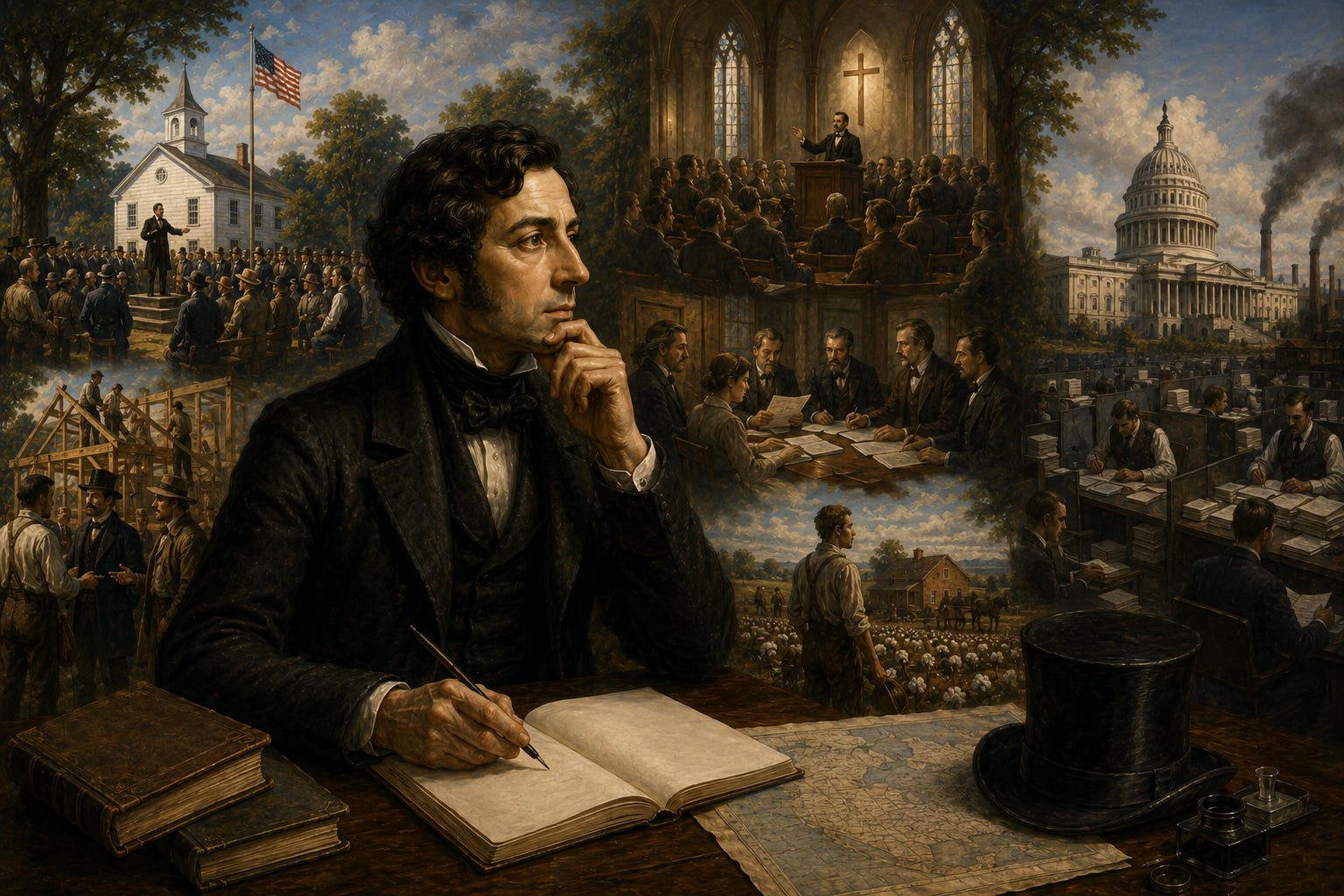
In 1831, Alexis de Tocqueville arrived in America. Officially, he was studying prisons. Unofficially, he was studying the future.
Europe was unstable. Monarchies were weakening. Democracy was rising — but no one knew what it would become. So Tocqueville came to observe the one place where democracy had already taken root.
What he found wasn’t what most people expected. Not primarily laws. Not institutions. Not documents.
He found habits.
Americans forming associations for everything, practicing local self-government. He also noticed something that he’d thought would be at odds: religion and politics.
It dawned on Tocqueville that religion was America’s “first of their political institutions.” While there was no state religion in the American republic like most European nations, religion helped shape American civic morality and allowed more freedom: if individuals govern themselves due to a belief in a transcendent Creator and eternal rewards and punishments, it leads to a freer society. In short, Tocqueville believed that for a free people to govern themselves, they must be “submissive to the Deity” to prevent disorder and anarchy. Thus religious belief, in Tocqueville’s mind, was paired with political freedom.
Tocqueville also saw a society where people acted — constantly — without waiting for permission.
He wrote:
“The greatness of America lies… in her ability to repair her faults.”
That’s the insight. America worked not because it was perfect.
But because it was structured — culturally and politically — to correct itself.
Tocqueville also saw the dangers. He realized that eventually America would have to confront the issue of slavery, which it did roughly thirty years after his visit. But he also saw that representative democracy could drift toward conformity and isolation.
Into what he called “soft despotism” which was realized with the rise of the Administrative State.
Tocqueville’s analysis of America was brilliant; that is why he still matters.
Because he didn’t just describe America. He diagnosed it. Today’s question is: will we take his diagnoses to heart again and correct our faults?
As I believe James Madison so aptly observed, our government as structured requires a moral people if it is to be successful.
As history here has born witness, the eradication of God from institutions and its slow erosion in the lives and hearts of the public at large over time, has served as the central cause of our devolution into all things from the crazy to the criminal. The absence of a conscience to the laws of the Almighty has given license to people - they think - to do all sorts of shady dealings, to be influenced by every kind of demonic influence and generally to wreak havoc on the society as a whole.
Unless and until we return our hearts and mind to the Lord, or even just things that good, right, and true, the devil will continue to do his best to see us in ruins.
Well stated and entirely accurate.
We seem to be at another cross road,
Can we choose the right turn?
Isn’t that what Turning Point is all about?