
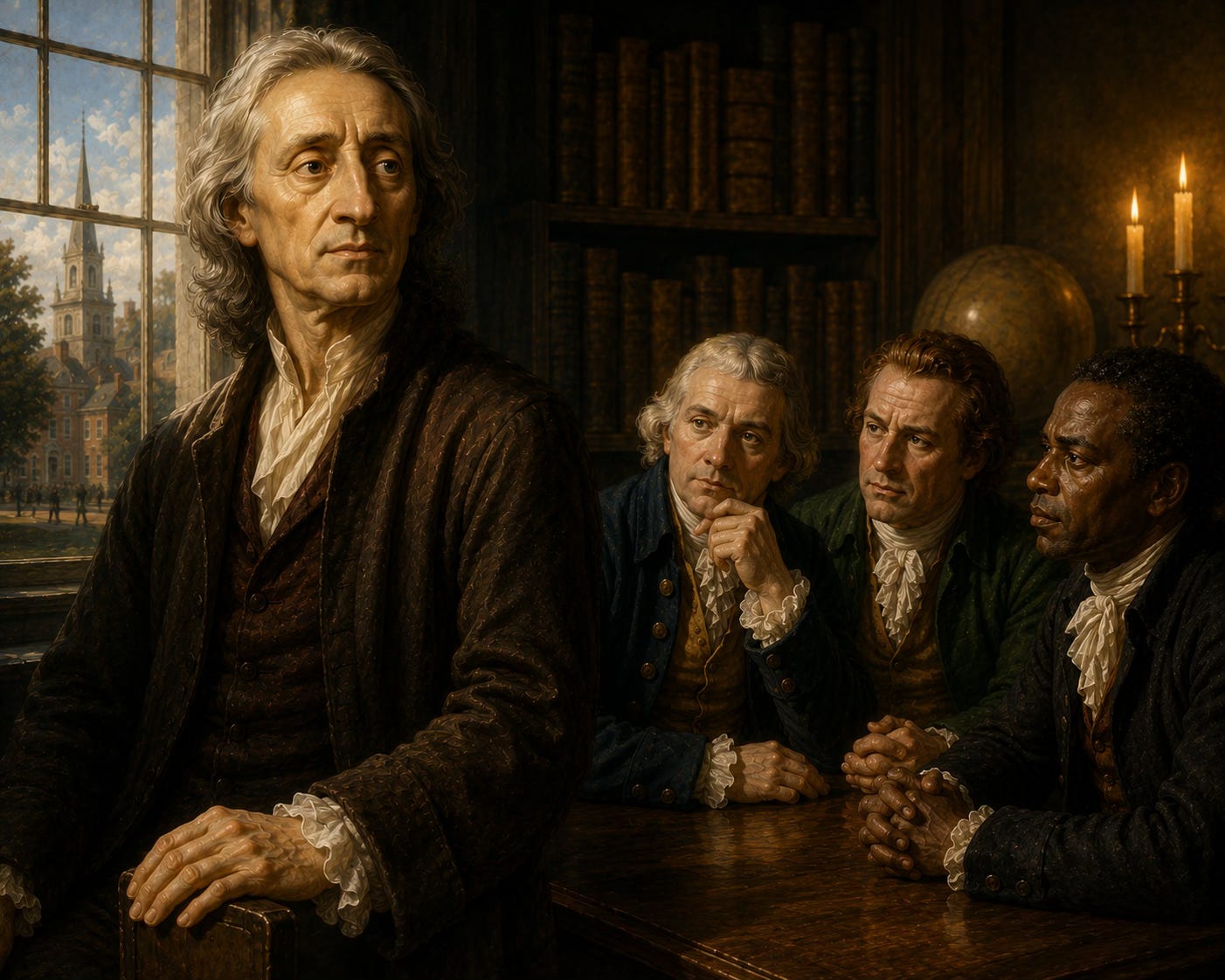
Before Jefferson wrote the Declaration, he’d read English author John Locke. So did Adams. So did Madison. So did almost everyone else.
Locke’s arguments were revolutionary for his time: governments exist to secure natural rights. Not create them or distribute them or redefine them.
Secure them.
And when governments consistently violate those rights? The people retain the authority to alter or abolish them. Jefferson did not invent that principle. He inherited it.
Then translated it into language ordinary people could understand.
So while the Declaration was uniquely American, we must understand that Jefferson and the Committee of Five drew heavily from different sources like Locke. Consider some of the central themes in Locke’s Two Treatises of Government, initially published anonymously in 1689:
All individuals possess inalienable rights to life, liberty, and property.
In a state of nature, those rights are vulnerable, so individuals form a “social contract” to create a government. Thus, in Locke’s thinking, the primary and sole purpose of government is to protect these rights because. . . that’s why governments are formed.
Which leads to this point: when a government fails to protect its citizens’ natural rights and breaks the social contract, citizens then have a right, even a moral obligation, to overthrow that government and establish a new one.
Now with Locke’s ideas in mind, think about the opening paragraphs of the Declaration of Independence:
We hold these truths to be self-evident, that all men are created equal, that they are endowed by their Creator with certain unalienable Rights, that among these are Life, Liberty and the pursuit of Happiness.–That to secure these rights, Governments are instituted among Men, deriving their just powers from the consent of the governed, –That whenever any Form of Government becomes destructive of these ends, it is the Right of the People to alter or to abolish it, and to institute new Government. . .
Locke wrote “Life, liberty and property.” Jefferson wrote, “Life, liberty and the pursuit of happiness” (there is some evidence that Jefferson didn’t want to include property for fear it might enshrine the idea that there was a right to slaves).
Jefferson is channeling Locke when he writes, “That to secure these rights, governments are instituted among men.” What Locke and later Jefferson were arguing for was a rights-based government: governments existed to secure natural inherent rights; not give them, not take them away–secure them. That was their only legitimate purpose.
And finally, just as Locke had written nearly a century before, Jefferson would write that, if and when, governments do not protect rights, and in fact become destructive to them, the people have a right to alter or abolish those governments.
Jefferson and the other Founders stood in the flow of ideas and philosophies from previous generations. But what made the American Founders unique was that they turned those ideas and philosophies into reality when they established, for the first time in the history of the world, a rights-based government in which the people were sovereign.