
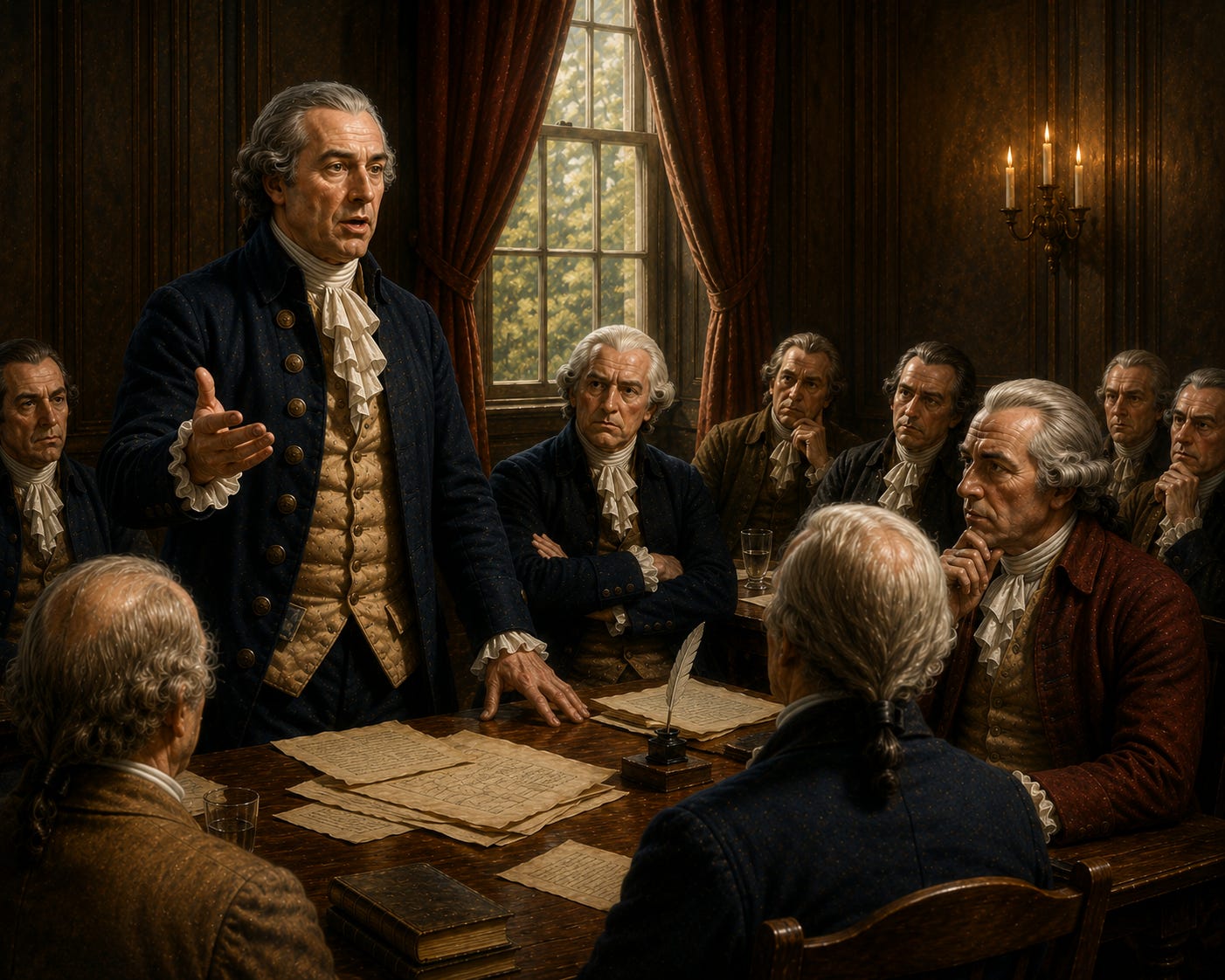
June 15, 1787
The Constitution was not written by men who trusted power or government.
That is the first thing modern Americans need to understand.
The founders did not gather in Philadelphia to create an efficient managerial system run by enlightened experts. They gathered because the Articles of Confederation were failing — but due to their lived experiences with the British Empire, many of them feared concentrated national power almost as much as they feared collapse itself.
That tension exploded into the open on June 15, 1787.
Just weeks earlier, the Virginia Plan—introduced by Edmund Randolph and heavily shaped by James Madison—proposed a far stronger national government. This plan featured representation based largely on population, three branches of government, a national judiciary, and the power for the new federal government to tax and regulate commerce.
The large states loved the idea of proportional representation based on population. They resented the Articles and every state having an equal vote regardless of size. Virginia was ten times the size of Delaware, yet Delaware had equal footing with Virginia under the Articles.
But the smaller states saw immediate danger. Not only could they become subjugated to the larger states, but lurking underneath the procedural arguments about representation was the deeper question:
Would America remain a union of sovereign states or in fact become a consolidated national system dominated by population centers?
That fear gave birth to the New Jersey Plan.
Introduced by William Paterson from New Jersey on June 15, 1787, the plan pushed back directly against the Virginia proposal.
Paterson argued that the Convention had not been assembled to destroy the existing federal structure entirely. The states, he believed, were not administrative subdivisions of one consolidated nation. They were political communities with their own sovereignty and legitimacy.
That distinction mattered enormously.
The New Jersey Plan demanded equal representation for states regardless of population. It proposed strengthening the Articles of Confederation rather than replacing them outright with a heavily centralized national framework.
Modern commentators often dismiss the New Jersey Plan as the “losing side” of constitutional history.
That’s a mistake because the New Jersey Plan forced the Convention to confront one of the central questions of the American experiment:
How do you create national unity without destroying local self-government?
The founders understood something many modern bureaucratic systems refuse to acknowledge: Centralization creates distance between rulers and the ruled and distance eventually erodes liberty.
Small states feared becoming politically invisible inside a purely population-driven system. They worried that large states would eventually dominate national policy permanently. More importantly, they feared the emergence of a consolidated governing class far removed from local communities.
Frankly, that fear was not irrational.
Much of modern American political frustration stems from precisely that dynamic: Power drifting further away from local accountability and concentrating inside permanent national institutions.
The New Jersey Plan represented resistance to that consolidation.
Not necessarily resistance to union itself but resistance to absorption.
That is an important distinction.
Paterson and the small-state delegates were not anti-American. They were attempting to preserve a federal balance where states retained meaningful independent authority rather than becoming administrative territories managed from the center.
And in many ways, they succeeded.
The New Jersey Plan itself was not adopted outright. But its arguments led to the eventual Connecticut Compromise, which created equal representation in the Senate.
Without the New Jersey Plan: no Senate as we know it. No federal balance. Possibly no Constitution at all.
The Convention may simply have fractured.
The significance of this debate reaches far beyond eighteenth-century procedural history.
The Constitution with its separation of powers was intentionally designed to slow consolidation.
That idea was present not only at the federal level—with Congress split between the House (with proportional representation for large state interests) and the Senate (with equal representation for small states)—but also in the Judiciary and the Executive. There was also Federalism, with power not specifically given to the federal government left to the states; ergo, the idea of state sovereignty. These were not inefficiencies accidentally left in the system.
They were safeguards.
The founders understood that concentrated power in the hands of a relative few — even when well-intentioned — eventually becomes self-protective, bureaucratic, and detached from the people it governs.
That is why the Constitution disperses authority so aggressively.
The administrative state despises this structure because friction slows centralized action. The founders viewed that friction as protection.
William Paterson may not receive the historical attention given to Madison or Washington. But his role was indispensable. He reminded the Convention that America was not supposed to become an empire managed from a distant capital.
It was supposed to remain a republic of self-governing states and citizens. That argument still matters, maybe now more than ever.
Excellent! Thank you for sharing this information. I have been reading Eric Metaxas’s book on the American Revolution. I started trying to understand how Christians derived the duty to revolt with my understanding of the biblical command to submit to government authority. I think it traces back to John Locke and further back to Thomas Aquinas who was a theologian and philosopher who seems to be the first Christian who believed that the people as a group had the duty to rebel against a government that was abusing the people. I don’t know where that theology can be derived from the bible, do you? Historically that ultimately led to the idea of individual God given rights, which is clearly a great improvement in our societies. But I don’t know how a Christian can come to the conclusion with others of like mind that there comes a time to violently overthrow a government. Of course now we have groups of people claiming rights that are not based on any God given expectation at least scripturally, and seeking to impose their beliefs of rights by government forces violently if necessary. “Social justice”. Was Aquinas wrong after all? The divine right of kings surely is not the ideal government is it? I definitely prefer the founding fathers of America view point even though it can be corrupted by flawed people and at present is in danger of being destroyed by socialism. These foundational ideas are very important to the general welfare of all people in any given country. Thanks for your input! Please let me know of any insight you have on these topics.
It seems "our"leaders have mostly all been bought off or blackmailed into NOT repping us AT ALL!! Public figures are approached WHEN THEY ARE ALONE,and corporates and foreign powers,( shoofly bottom feeders of narcissistic self interest) have prevailed,finally,against 'we the people'. Doesn't seem to matter who we elect to public office to serve,when they arrive in D.C.they "change" and rule against most of their own prior campaign speeches and wishes and we have been sold out to high bidders for at least 40 years,perhaps longer. We evidently must not be of that hardy stock that declared "Liberty or Death",and many of them did pay the ultimate price. We are,however,waking up,gaining insight and we are restless. The ones that want to watch our every move so closely should be the ones WE watch and control. Tthe PTB's really want,and continue to try to scare us into one fake pandemic after another but WE are not having it,not putting up with that and 'they' know that. "They"only push us till we stand up and refuse to play. All law currently practiced against us is contract law. Has been for at least 60 years. Under contract law the authorities have devised clever ways for us to give our sacred constitutional rights away - to judges and their (just us) legal monopoly. Most don't know enough to defend themselves. I do. I use their 'hidden,secret rules' back against them. But before you can become a free citizen,winning against every court summons,without a lawyer,you must know your rights because what you don't know WILL be used against you,and you must be brave and stand firm. Let 'them' know you may surrender but you will never give yourself away.
.