
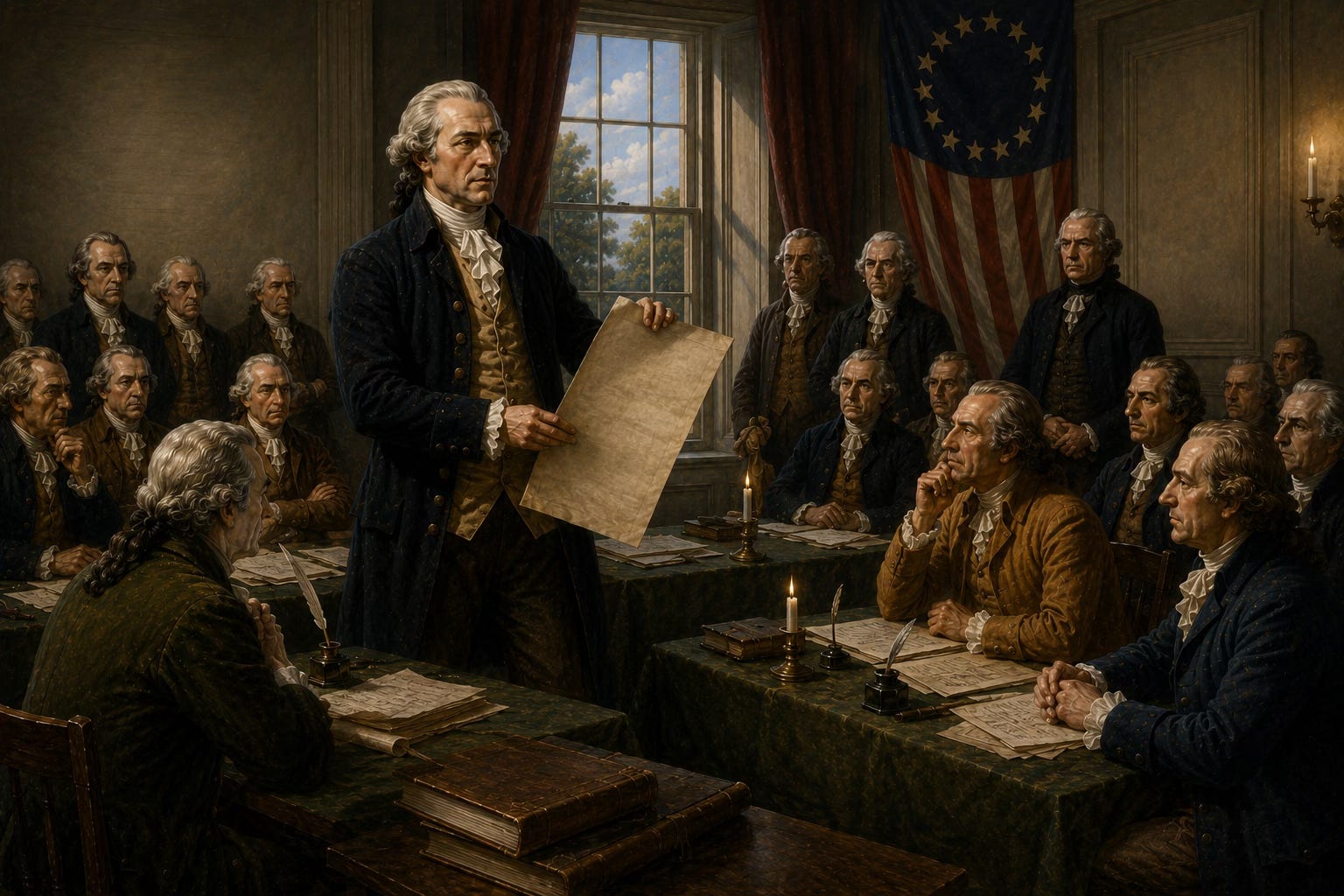
May 29, 1787
The Constitution was not written because the founders trusted government. They in fact did not and viewed it as a necessary evil.
So the Constitution was written from that mindset but also in the short term to prevent collapse and the potential for the American Revolution was not fought in vain.
Modern Americans often imagine the Constitutional Convention as a gathering of confident visionaries calmly designing the greatest political system in history.
That couldn’t be further from the truth. In reality, many delegates arrived in Philadelphia convinced the American experiment itself was on the edge of failure.
The Articles of Confederation were weak; states fought each other economically, debt spiraled, interstate commerce disputes intensified. Some states, with Rhode Island being the worst offender, were manipulating currency to their advantage.
The national government under the Article was weak, a plaything of the individual states that struggled to enforce basic obligations.
Foreign powers watched with great interest and doubted America’s survival.
Domestic unrest — especially Shays’ Rebellion — terrified political leaders.
The Revolution had succeeded militarily but the republic still might fail politically.
That was the atmosphere on May 29, 1787, when Edmund Randolph introduced what became known as the Virginia Plan.
Though Randolph formally presented it, the intellectual architect behind much of the proposal was James Madison.
Madison had spent years studying the collapse of republics throughout history.
And he had reached a dangerous conclusion:
Liberty without structure eventually destroys itself.
That concern shaped the Virginia Plan.
The proposal called for:
a significantly stronger national government,
three branches of government,
a bicameral legislature,
representation based largely on population,
and national authority capable of operating directly on citizens rather than merely coordinating states.
In other words: The Virginia Plan represented a dramatic shift away from the loose confederation established under the Articles.
That frightened many delegates, especially from the smaller states, immediately.
And understandably so.
Because the founders faced a genuine dilemma that still defines American politics today: How do you create a government strong enough to preserve order without creating one powerful enough to threaten liberty?
That is the central constitutional question.
Madison believed the Articles had leaned too heavily toward fragmentation and instability. The national government lacked sufficient authority to maintain coherence across the states.
But others feared the Virginia Plan pushed too far toward consolidation.
And they had reason to worry.
The Revolution itself had been fought against distant centralized authority.
Americans had just escaped one system where decisions increasingly flowed downward from remote power centers disconnected from local communities.
The fear was not abstract.
The founders understood that concentrated power possesses an almost gravitational instinct toward expansion.
That is why the Virginia Plan triggered immediate resistance from smaller states.
Representation based on population would inevitably increase the influence of large states like Virginia and Pennsylvania while weakening smaller states politically.
More importantly, many delegates feared the emergence of a consolidated national system capable of swallowing state sovereignty altogether.
That fear eventually produced the New Jersey Plan and later the Connecticut Compromise.
But before those debates exploded, the Virginia Plan accomplished something essential:
It forced the Convention to confront reality.
The Articles of Confederation were not sustainable long term.
The American experiment required a more durable constitutional structure.
That may be the true significance of the Virginia Plan.
Not that every proposal inside it survived unchanged.
Many did not.
But it established the basic architecture of the Constitution itself:
separation of powers,
bicameralism,
an independent executive,
an independent judiciary,
and a federal system capable of surviving beyond temporary political passions.
The plan also revealed something deeper about the founders.
They did not worship government.
Nor did they romanticize pure democracy.
They understood human nature too well for that.
The Constitution emerged from a tension between competing fears:
fear of tyranny,
and fear of disorder.
The founders believed both could destroy liberty.
That is why the American system was built not around blind trust, but around restraint.
Separated powers.
Federalism.
Checks and balances.
Competing institutions.
Layered sovereignty.
The system intentionally disperses power because the founders assumed concentrated authority would eventually abuse itself.
Modern Americans often debate whether the federal government is too large or too weak.
The founders debated the same questions from the beginning.
The Virginia Plan was where that argument formally began.
And in many ways, America has never stopped arguing about it since.
Superb description and analysis of the struggle by our founders to Create a More Perfect Union.
Now, if only we can keep it. 🙏❤️