
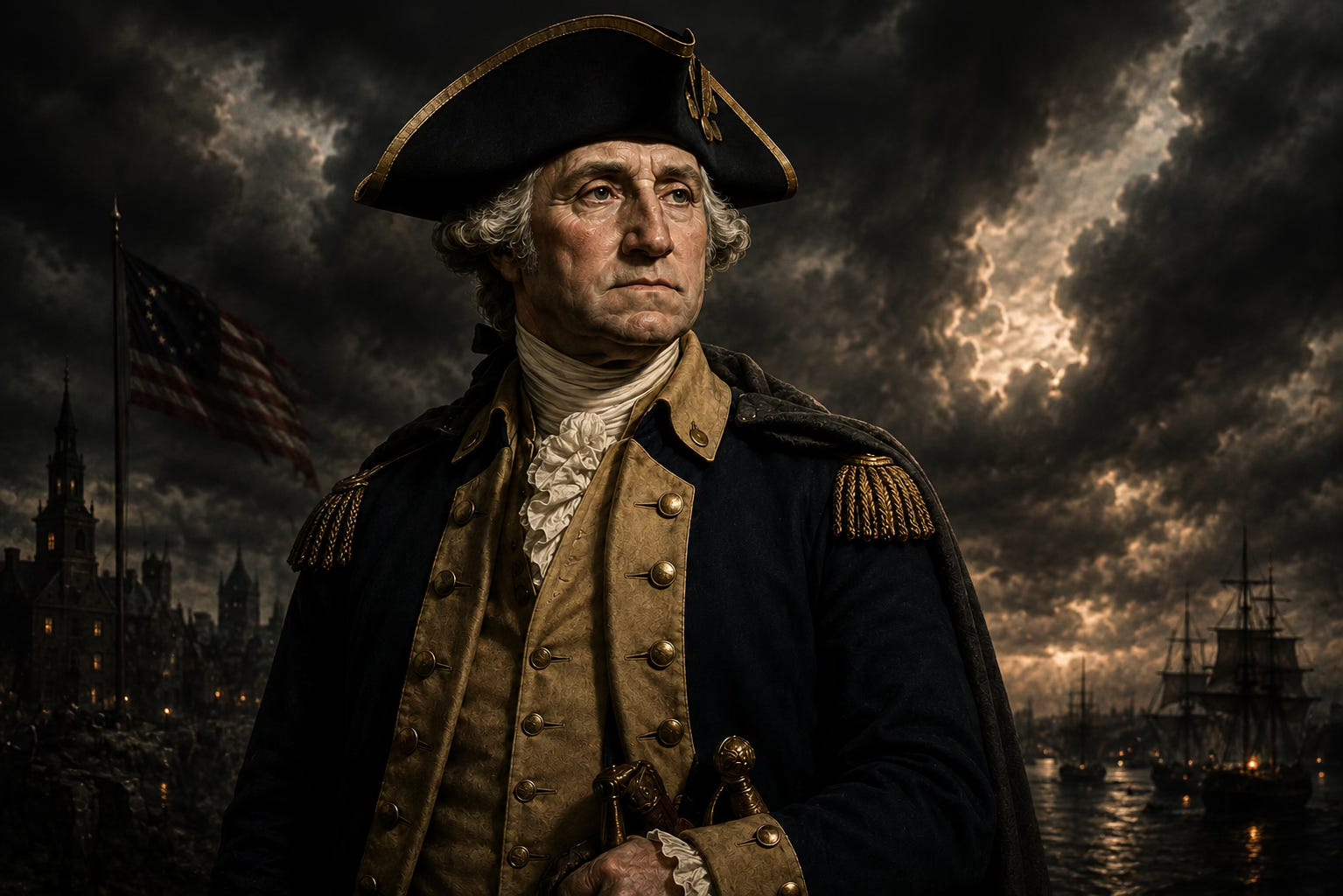
Six days before the Declaration of Independence was approved, the Continental Army executed one of its own.
Thomas Hickey was a private in the Commander-in-Chief’s Guard — Washington’s personal bodyguard, a unit selected for reliability and appearance, the men closest to him. Irish-born, a deserter from the British army, he had been in American service for some time.
On June 28, 1776, he was hanged in a field near Bowery Lane in New York before a crowd that contemporaries estimated at twenty thousand people.
It was the first execution of a soldier in the history of the United States Army. The story around it has been growing ever since, and it is worth separating what is documented from what is legend, because the documented version is more interesting.
Start with how it came apart, which was not through counterintelligence brilliance.
Hickey and another soldier were arrested for passing counterfeit money. This was ordinary criminal work — a bar of the era, a shopkeeper, bad bills.
In jail, Hickey talked.
He told a fellow prisoner that he and others were involved in something considerably larger than currency fraud: a Loyalist conspiracy in New York City, funded and directed from outside the army, which had recruited soldiers from the garrison and from Washington’s own Guard.
The prisoner passed it along. The provincial authorities, led by John Jay, began pulling threads.
What emerged was a network centered on William Tryon, the royal governor of New York, who had abandoned the city and was running his administration from a British warship in the harbor — a detail worth sitting with, because it captures the strange half-state of that spring, when the Crown’s governor was still governing, technically, from a boat a mile offshore.
Money moved ashore through intermediaries. Among those arrested was David Mathews, the Loyalist mayor of New York City, accused of distributing Tryon’s funds.
Perhaps a dozen or more people were taken up in the sweep, soldiers and civilians both.
Now the part that requires discipline.
The accounts that circulated at the time — and that have been repeated in popular histories ever since — described a plot to seize or assassinate Washington, spike the artillery, blow up the powder magazine, and cut the King’s Bridge at the very north end of the island to trap the army on Manhattan when the British fleet arrived.
One especially durable story holds that Hickey attempted to poison Washington with a dish of peas, and that a housekeeper named Phoebe Fraunces threw them out the window to a flock of chickens, which promptly died.
That story appears to be a nineteenth-century invention. It is a good story. It is not evidence.
Here is what the record actually shows: Hickey was tried by court-martial on June 26, 1776, and the charges he was convicted on were mutiny and sedition, and holding a treacherous correspondence with the enemy.
He was not convicted of a plot to assassinate the commander-in-chief.
The court had testimony that he had enlisted in the conspiracy and had taken Tryon’s money. It evidently did not have proof sufficient to convict on the murder plot, and a court-martial that was fully prepared to hang him did not charge it.
Hickey’s own defense, offered at trial, was that he had joined the scheme only to cheat the Tories out of their money and had never intended to act on it.
The court did not believe him, and it was probably right not to. But the honest summary is: a real Loyalist conspiracy, funded by the royal governor, that had penetrated Washington’s own bodyguard — with the most sensational specific allegation unproven.
That is still an appalling security failure that does not need embellishment.
Washington’s general orders after the execution are the strangest document in the affair, and the most human.
He did not use the occasion to warn the army about British gold, or about Loyalist recruiters, or about operational security.
He used it to warn them about women and drink.
The orders express his hope that every soldier will take warning from Hickey’s fate, and attribute the man’s ruin to lewd women and to a life of profligacy — and they end by recommending that the soldiers avoid both, and instead attend to their duty.
Washington had commanded troops for a year at that point and had a clear-eyed view of what actually destroyed men in an army. Not ideology. Habits.
Which is, in its way, the most Founding-era conclusion available: a republic’s security ultimately rests on the private character of the men who serve it, and character is built or destroyed in small daily choices long before it is tested by an enemy agent with a purse.
Two things to carry out of this.
The first is a caution about how history gets told. The poisoned peas are more fun than the court-martial record. That is precisely why they spread, and it is why serious people should check.
A movement that cannot tell the difference between what it can prove and what it enjoys believing will eventually be unable to persuade anyone who is not already persuaded. The founding does not need to be improved. It needs to be read.
The second is about the season.
June of 1776 is remembered as a month of committees and drafting — Jefferson at his desk on Market Street, Congress edging toward a vote. It was also a month in which the royal governor of New York was buying soldiers out of the American commanding general’s own guard, and the army responded by hanging one of them in front of twenty thousand witnesses five days before independence was declared.
The founding was not a seminar. It was a fight, conducted by men who understood that they were surrounded by enemies without and within — and that some of the enemies surrounding them were actually wearing the same uniform.
If you enjoyed this article, you’ll love the documentary.
Thread of Liberty follows the entire thread of the American experiment — from ancient Rome and the Puritans, through the Revolution and the Constitution, to Tocqueville, Lincoln, Calvin Coolidge, and the modern Administrative State.
Watch the full feature documentary at ThreadofLiberty.com
Thanks for the history lesson. This is all new to me.