
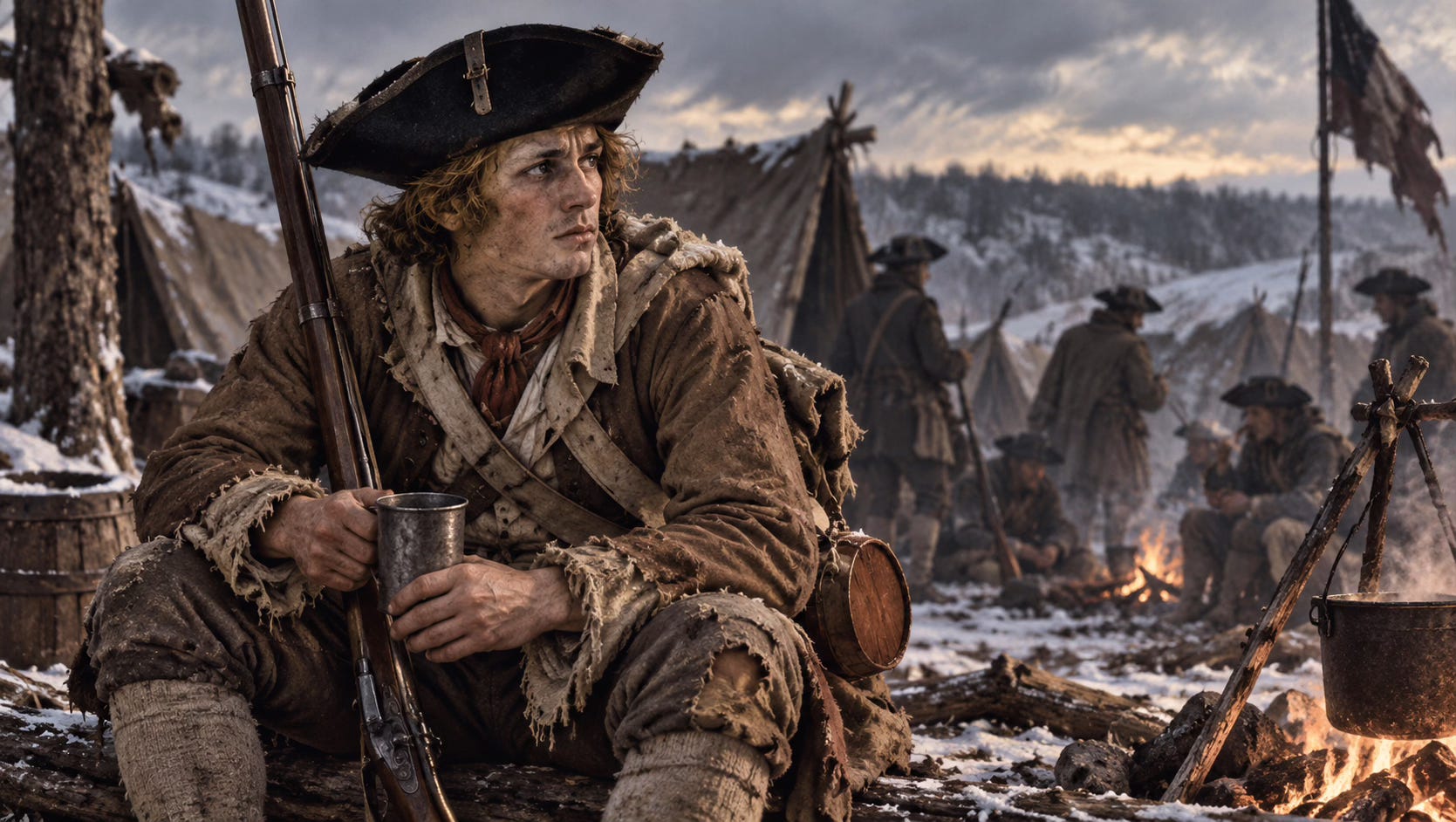
Almost everything we know about what the Revolution felt like from the ranks comes from one book, written by one man, published anonymously in Maine in 1830, and largely ignored for a century.
Joseph Plumb Martin was born in 1760 in western Massachusetts and raised by his grandparents in Connecticut. He enlisted in 1776 at fifteen, over their objections, mostly because he wanted to see something happen.
He saw all of it.
He was on Long Island in August 1776 and in the defensive works at Brooklyn. He was at Kip’s Bay when the militia ran and Washington rode among them with his hat in his hand trying to stop them. He was at Harlem Heights and White Plains. He was at Fort Mifflin during the siege in 1777, which he described as the worst thing he endured in eight years, under a bombardment so heavy that men were being killed faster than they could be replaced at the guns.
He was at Valley Forge. He was at Monmouth in the heat. He was at Yorktown with the Corps of Sappers and Miners, cutting the abatis in front of Redoubt No. 10 in the dark ahead of the assault.
And what he mostly writes about is being hungry.
This is the thing that makes his book unlike the memoirs of officers. Generals write about decisions. Martin writes about food and shoes and cold and the specific quality of exhaustion that comes from marching all night on nothing.
He describes going days without provisions of any kind. He describes the army roasting shoes. He describes standing on a frozen road with rags on his feet and doing the arithmetic on whether he could get home. He describes, at Valley Forge, the men in the huts chanting for meat until the officers made them stop.
There is no self-pity in it, which is what gives it its authority. He is frequently funny. He is sardonic about officers, contemptuous of contractors, and unsentimental about the civilians who would not sell food to a starving army except at a price it could not pay. He notes without much heat that the country seemed to expect its soldiers to fight for nothing and be grateful for the opportunity.
In 1780 the Connecticut Line mutinied over exactly this — no pay in months, no meat in days. Martin was there. He describes the officers talking the men down, and he does not pretend he was on the officers’ side.
He served, by his own reckoning, until the end. He was discharged in 1783 with a certificate for back pay that, like everyone else’s, was worth a fraction of its face value and which most soldiers sold to speculators for whatever they could get.
Then the country he had fought for gave him a lesson in how these things usually end.
Martin went to Maine, settled in the town of Prospect on the Penobscot River, married, had five children, farmed poor ground and held minor town offices. And the land he had settled turned out to fall inside an enormous tract claimed by the heirs of a Massachusetts proprietor — a claim that passed to Henry Knox.
Knox had been Washington’s chief of artillery. He had commanded the guns at Trenton. He had been Secretary of War. He had also acquired, through his wife’s family and his own speculation, a vast holding in Maine, and he pursued the settlers on it for payment.
Martin wrote to him. The letter survives and it is painful to read: an old soldier explaining that he had a family, that he was poor, that he had served through the war, and asking for terms.
He eventually paid Knox a reduced sum for a fraction of what he had cleared. He spent the rest of his life poor. In 1818, when Congress finally established pensions for Revolutionary veterans in need, he applied, and swore in the required statement that he owned essentially nothing — a few tools, some worn furniture, no land worth listing.
He published the narrative in 1830, anonymously, through a small Maine printer. It sold badly. He died in 1850, at ninety, and was buried in Sandy Point.
The book was rediscovered in the twentieth century and is now the single most quoted enlisted account of the Revolution. Nearly every serious history of the war leans on it, because there is nothing else like it.
Here is why he belongs in a series about the founding rather than in a footnote to it.
This Substack has spent a good deal of time on ideas — on Rutherford and Coke and Montesquieu and Madison, on the architecture of divided power and the theory of consent. That work is real and it matters.
But the architecture was built on top of eight years in which a few thousand men stayed in the field without pay, without shoes, and without any reasonable expectation of winning. Martin is the record of what that cost, kept by someone who paid it.
He does not end his book with a flourish about liberty. He ends it closer to an accounting — that the country got what it wanted from men like him and then, when the danger passed, found it convenient to forget the terms.
If you enjoyed this article, you’ll love the documentary.
Thread of Liberty follows the entire thread of the American experiment — from ancient Rome and the Puritans, through the Revolution and the Constitution, to Tocqueville, Lincoln, Calvin Coolidge, and the modern Administrative State.
Watch the full feature documentary at ThreadofLiberty.com
What a wonderful man and a touching story. This is the kind of truth I am looking for.