
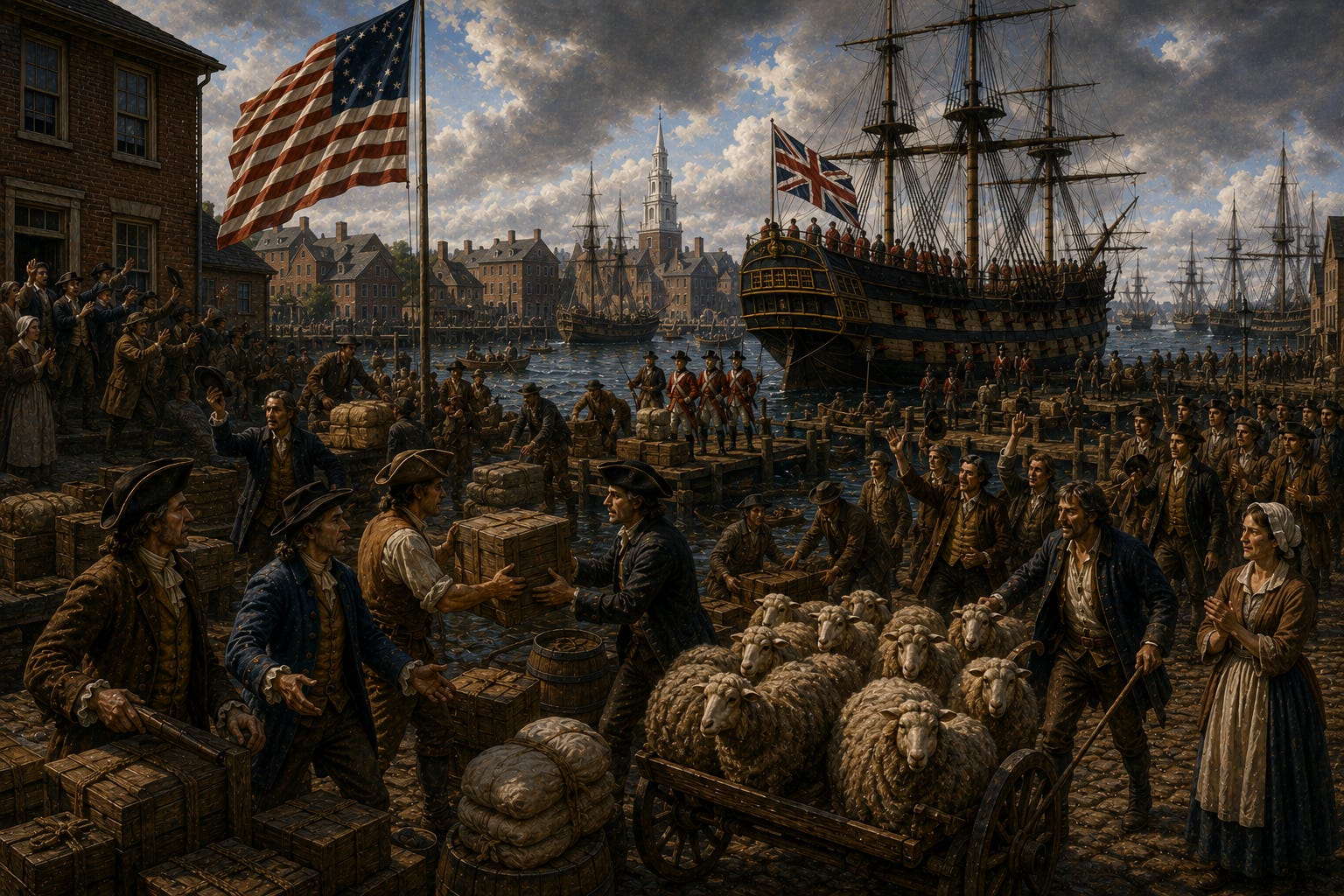
June 1, 1774
Empires often misunderstand resistance. They assume punishment produces obedience; sometimes it produces solidarity instead.
That is exactly what happened when the Boston Port Act took effect on June 1, 1774.
Through a series of punitive acts, collectively known as the Coercive or Intolerable Acts, Parliament intended to make an example out of Boston after the Tea Party: Shut down the harbor, crush the local economy, isolate Massachusetts politically and force submission. The Port Act, passed in March, intended to cut Boston off from commerce. The Massachusetts Government Act stripped the colony of its right to self-government and placed it under strict royal governance. The Quartering Act, actually passed on June 2, 1774, violated the 1689 Bill of Rights by forcing private citizens to house and feed British soldiers.
From the British perspective, the logic seemed straightforward: the colony was rejecting Parliament’s sovereignty and must be made an example of; punish one colony harshly enough and the others would distance themselves from the troublemakers.
But instead, something unexpected happened.
The colonies did not pull back from Massachusetts; instead, they rallied around Boston. Food shipments arrived from Virginia, Pennsylvania, Connecticut, and South Carolina. In August of 1774, Israel Putnam, a legend from the French and Indian War, would drive a flock of 130 of his own sheep from Connecticut into Boston to help the suffering Bostonians.
Other local assemblies organized relief while Committees of Correspondence intensified communication. What Britain intended as isolation instead became coordination and unification.
And psychologically, the crisis changed everything. For years, colonial resistance had often remained local:
Massachusetts resisting taxes.
Virginia protesting legislation.
Merchants opposing trade restrictions.
But the Port Act and the Intolerable Acts writ large transformed scattered grievances into something larger: a shared American cause. The colonies increasingly began viewing attacks on one colony as attacks on all of them.
That shift matters enormously. Because nations do not emerge fully formed from documents. They emerge from shared struggle and experiences, and Britain, ironically, helped create that struggle.
The founders understood what Parliament did not: Heavy-handed centralized power often accelerates the resistance it hopes to suppress.
Especially among populations already accustomed to governing themselves locally. Boston became a symbol because ordinary Americans recognized something dangerous in the Intolerable Acts:
The Crown was no longer merely regulating trade. It was using economic punishment to enforce political obedience. That distinction radicalized many previously moderate colonists, including people who still hoped reconciliation was possible.
The Intolerable Acts also revealed one of the deepest tensions in American history: Local self-government versus distant centralized authority.
The founders believed free people govern themselves best closest to home. The British increasingly believed imperial stability required decisions flowing downward from centralized administration.
That conflict still echoes today.
And by trying to break Boston, Britain accidentally began creating something that had not fully existed before: a shared American political identity.