
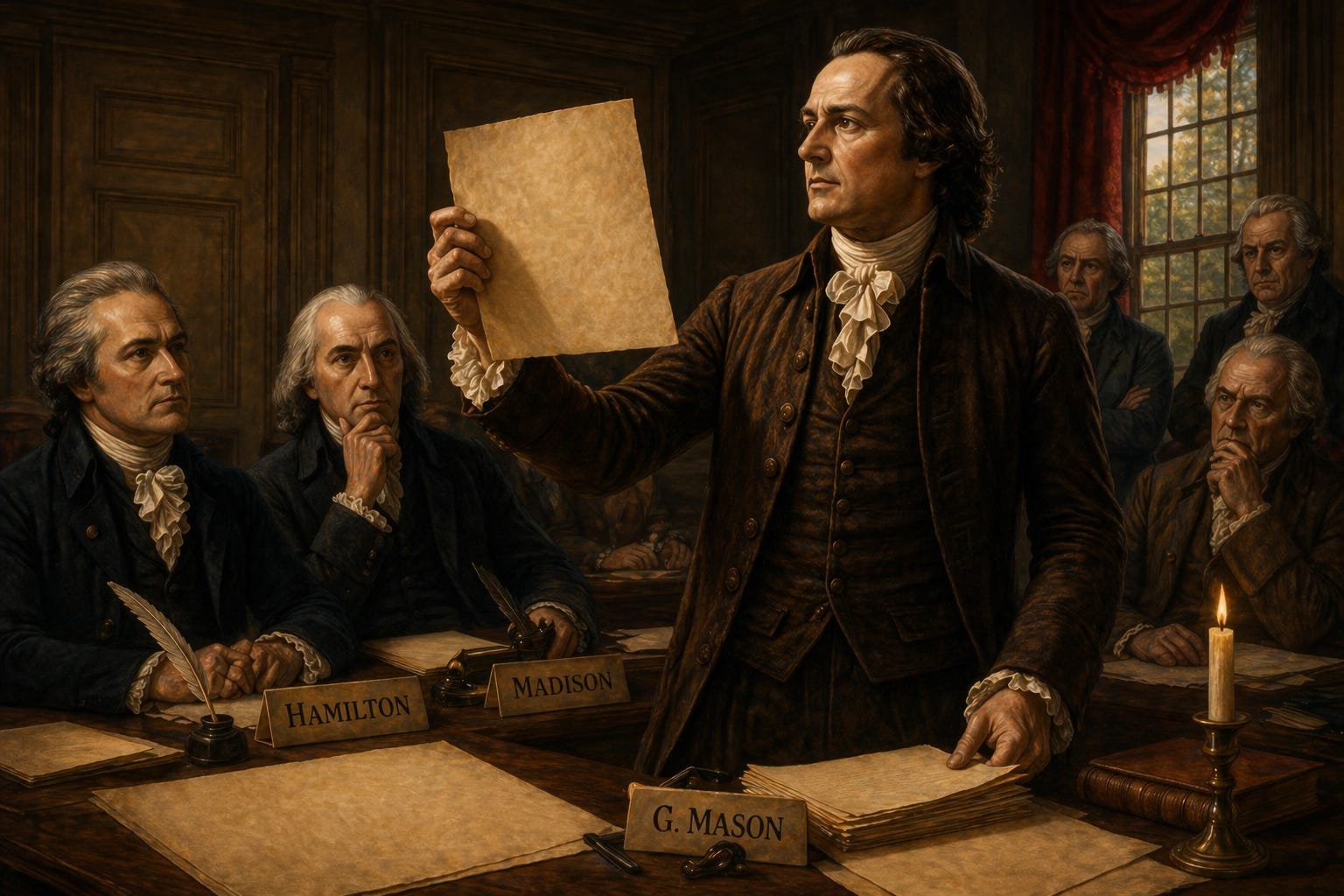
At the Constitutional Convention, most delegates wanted closure. Agreement. Finality. They’d spent four long months in hot, humid Philadelphia, hammering out compromises and trying to fashion the Declaration’s promises and framework into a workable Constitutional Republic that brought its ideals to life.
But George Mason wanted something else: explicit protection, clearly stated in words on paper.
He’d studied history and governments of the past, even penned Virginia’s Declaration of Rights in 1776 in which he stated that government, “is best which is capable of producing the greatest degree of happiness and safety and is most effectually secured against the danger of maladministration.” So Mason looked at the proposed Constitution and saw a danger lurking in the background: a stronger national government run by imperfect human beings with no explicit protections for individual rights. The story of republics throughout history is the eventual consolidation of power into the hands of a few and in his mind there were not clear enough limits on the envisioned new federal government.
The Constitution was a powerful framework — but incomplete. So Mason refused to sign because there was not an enumerated bill of rights. This was not a symbolic act of defiance.
It was leverage.
One debate at the federal convention, now known as the Constitutional Convention, was between Alexander Hamilton and James Madison on one side and Mason on the other. The central issue in the disagreement was the question: “What is the greatest protector of national inherent rights in the new government?” For Hamilton and Madison, the answer was the machinery of the republic, the structure: make the government strong enough to act effectively, yet diffuse power enough so that it could never centralize and consolidate to abuse natural rights. Thus the separation of powers at the national level and the idea of federalism.
Mason didn’t buy that argument entirely. He believed that structure alone could not restrain power. Explicit boundaries were needed, and his refusal to sign—and frankly, his determination to resist the ratification of the Constitution—forced the issue.
But out of Mason’s refusal to sign the Constitution and the resulting heated ratification debates between the Federalists and Anti-Federalists came the Bill of Rights. This means one of the most important components of the American system came from dissent, not consensus.
Mason reminds us of something modern politics tries to forget: rational, thoughtful disagreement is not a weakness in a republic. It is often the mechanism that improves it.
Amen! Thank you for this lesson in history. We all need it. I get tired of hearing the politicians refer to America as a democracy.
Excellent!