
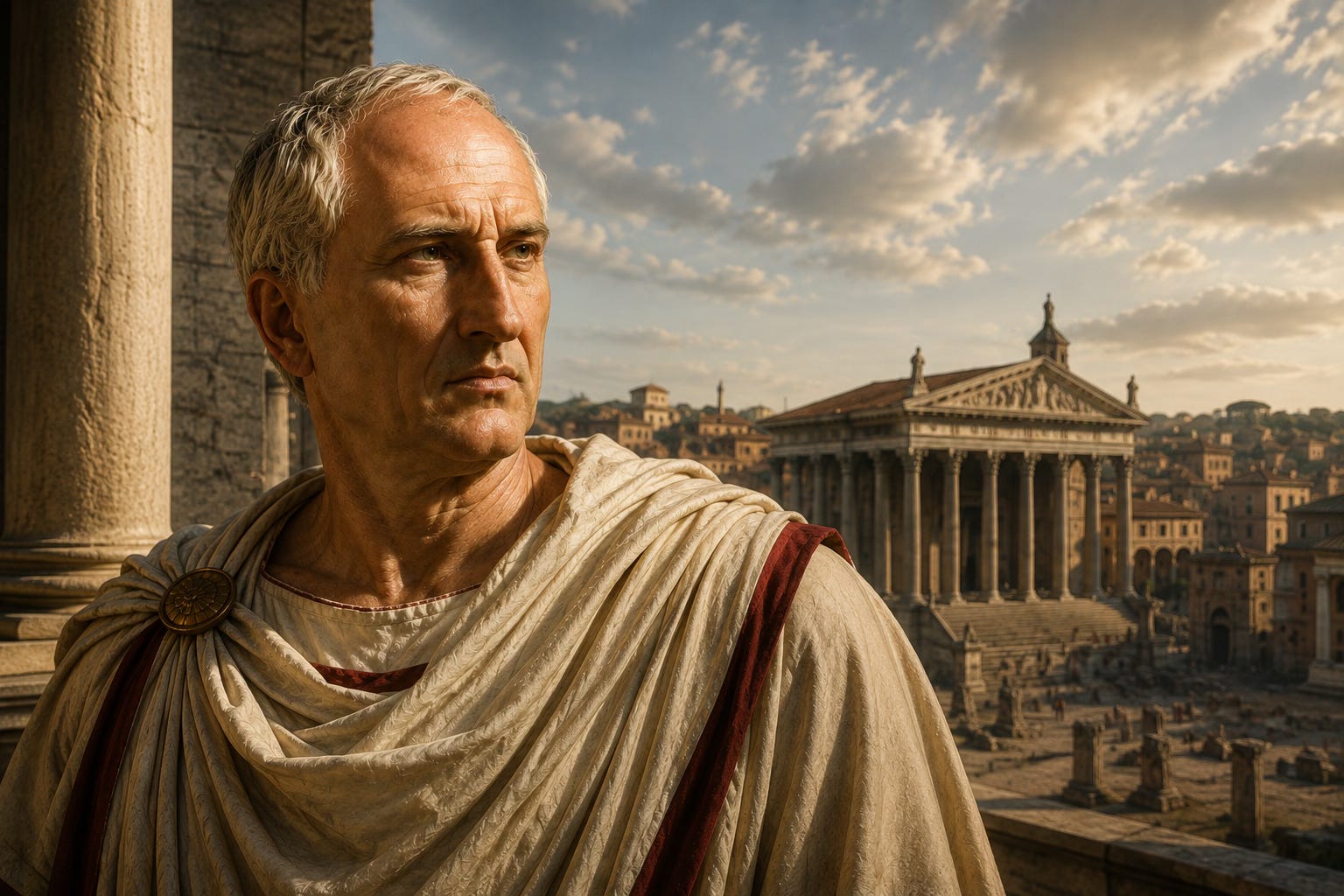
Every educated American of the founding generation learned Latin and many of them learned it on Marcus Tullius Cicero.
That is not a small detail. It means that a Virginia planter’s son and a Boston lawyer’s son and a Princeton divinity student had all spent their adolescence inside the head of a Roman politician who watched a republic die and wrote down exactly how it happened.
John Adams read him constantly and said so, even dubbing Cicero “Tully.” Jefferson kept him close. The pseudonyms the founders used in the newspapers — Publius, Brutus, Cato, Cincinnatus — came from a shared Roman vocabulary that Cicero had done more than anyone to transmit.
They were not being decorative. They believed they were living through the same problem.
Marcus Tullius Cicero was born in 106 BC, outside the Roman aristocracy, in a country town. He had no ancestors in the Senate. What he had was an extraordinary command of language, and in a republic that argued its way to decisions, that was enough to carry a man to the Senate and eventually to the consulship.
He got there in 63 BC and spent his year in office breaking the Catiline conspiracy — and then spent the rest of his life being attacked for how he did it because he had executed Roman citizens without trial under an emergency decree of the Senate.
Hold onto that. The great defender of legal process suspended it once, under emergency powers, for what he considered the survival of the state. It cost him his reputation, got him exiled, and haunted him for twenty years. Even the man who wrote the theory found the exception tempting when he was the one holding the office.
The theory is what survived him.
In On the Republic and On the Laws, Cicero set down the proposition that would run through Aquinas and Hooker and Locke and end up influencing men sitting inside a hot room during a Philadelphia summer.
There is a true law, he argued, which is right reason, in harmony with nature. It applies everywhere, to everyone, without variation. It cannot be repealed by a senate or a people. No commentary is needed to explain it and no magistrate has the authority to set it aside. It is not one law at Rome and another at Athens, one thing now and another later. It is the same law, binding all nations at all times, and its author and enforcer is God.
Read that again with American ears.
A standard above legislation. Binding on the government itself. Not created by the state and therefore not repealable by it. Knowable by ordinary reason rather than revealed only to authorities.
That is the intellectual raw material of the sentence about self-evident truths and unalienable rights. Jefferson did not invent that structure. He inherited it, and he inherited it in Latin, at school, before he was old enough to shave.
Cicero also gave the founders their definition of a republic — not simply a crowd of people living in one place, but an assembly united by a shared sense of justice and a common interest. A people, on that definition, is a moral fact before it is a political one. Take away the shared sense of justice and you no longer have a republic with problems. You have a population.
And he watched it happen.
The Roman republic did not fall because of a shortage of good ideas about government. Rome had a mixed constitution that political theorists admired for centuries — consuls, Senate, popular assemblies, tribunes of the plebs, each checking the others. On paper it was the finest machinery in the ancient world.
It fell because the machinery stopped mattering.
Armies came to be loyal to generals rather than to the state. Political violence became normal under Marius and Sulla, then routine, then expected. Emergency measures were used to settle ordinary disputes. Offices were held longer than the law allowed, and then longer than that, and each violation made the next one easier. The forms remained. The Senate still met. Elections were still held.
But the question of who actually governed had been transferred somewhere else, and everybody knew it.
Cicero’s last stand was against Mark Antony, in a series of speeches he called the Philippics, in which an aging lawyer with no army attacked a general with one, in public, by name, repeatedly.
It was brave and it was also suicidal. When Antony, Octavian, and Lepidus divided the state among themselves and published lists of men to be killed, Cicero’s name was on Antony’s and Octavian, even though he’d been tutored by Cicero, let Antony proscribe Cicero.
He was caught near the coast in December of 43 BC, trying to escape by sea. The accounts say that once he knew it was over, Cicero leaned out of his litter and offered his neck to the soldiers.
They cut off his head and his hands and nailed them to the Rostra in the Forum — the hands because they had written the speeches, the head because it had delivered them. Antony’s wife is said to have pulled the tongue out and stabbed it with a hairpin.
You do not do that to a man whose words did not infuriate and frighten you.
Americans tend to imagine the death of a republic as a single dramatic event — tanks, a proclamation, a man on a balcony. Cicero watched the real version, which is slower and much harder to see; the Roman Republic did not collapse overnight. It fell over the course of roughly a hundred years, slowly crumbling from within.
The real version is that the institutions keep operating while the substance drains out of them. The Senate still convenes. The votes are still recorded. And the decisions that matter are made somewhere else, by people who did not stand for election, and the citizens gradually stop expecting otherwise.
The founders knew that story the way we know the plot of a film we have seen a dozen times. It is why they were so obsessive about structure, so suspicious of standing armies, so alert to the accumulation of offices, and so preoccupied with a question that sounds quaint until you understand where they learned it.
What happens when a man with power decides the rules no longer apply to him?
Rome answered that question in the negative for four centuries. This series ends with an American answering it differently, in a small brick statehouse in Maryland, with a piece of paper in his hand.
If you enjoyed this article, you’ll love the documentary.
Thread of Liberty follows the entire thread of the American experiment — from ancient Rome and the Puritans, through the Revolution and the Constitution, to Tocqueville, Lincoln, Calvin Coolidge, and the modern Administrative State.
Watch the full feature documentary at ThreadofLiberty.com
I learned something new today. I had no idea the fall of the Roman Empire took so long. I see the same things happening here and now.
This was a powerful post. Thank you. I will consider pledging in the future.