
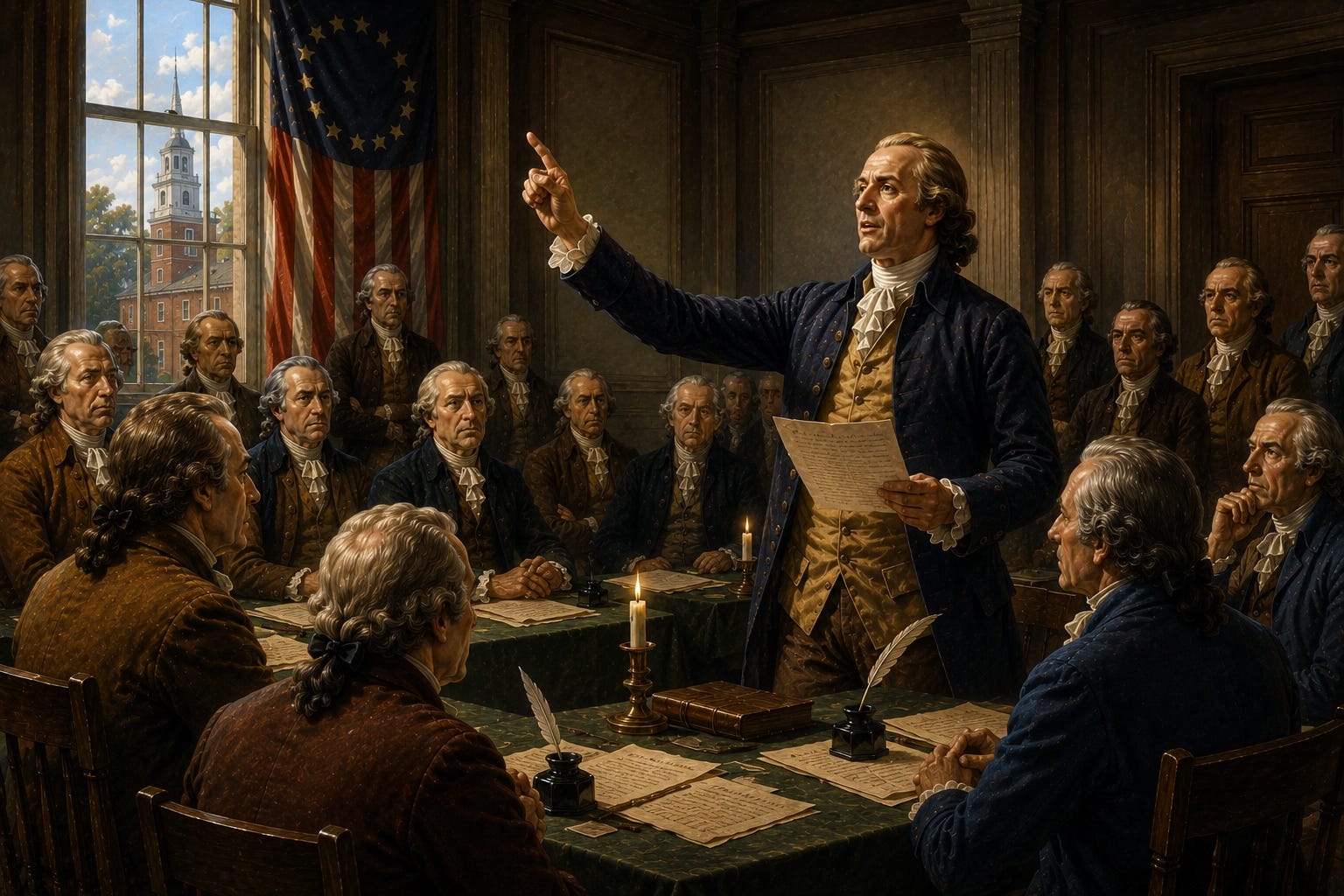
June 7, 1776
Every political system eventually arrives at a moment when ambiguity becomes impossible.
June 7, 1776 was that moment for America.
On that day, Richard Henry Lee of Virginia stood before the Second Continental Congress and introduced a resolution that forced every delegate to confront the question many had been dancing around for months, refusing to accept reality.
It was not about reform. Not reconciliation. Not negotiation.
It was about independence.
Lee’s resolution declared: “These United Colonies are, and of right ought to be, free and independent States.” Simple. Direct. Irreversible.
Once spoken publicly inside Congress, the political center of gravity changed immediately.
There had been debate for months and months in Philadelphia about independence versus reconciliation. But now delegates had to choose.
Not whether Britain had behaved unfairly. Not whether Parliament had exceeded its authority.
But whether Americans possessed the moral right to govern themselves at all.
That was the real issue beneath the Revolution.
The British Empire viewed political authority as flowing downward from the monarchy and Parliament. The American revolutionaries increasingly believed legitimate authority flowed upward from the people themselves.
Lee’s resolution transformed that philosophical argument into a concrete political decision. And importantly, it happened before the Declaration of Independence existed.
The Declaration did not create independence. It explained independence.
Lee’s resolution is what actually clarified the moment, forcing the choice.
Some delegates like John Dickinson feared it was all moving too quickly. Others like John and Sam Adams believed delay itself was dangerous.
But something deeper was already happening throughout the colonies: public opinion was shifting.
Thomas Paine’s Common Sense had circulated throughout the colonies for nearly six months. Local governments were already replacing royal authority. Militias had already shed blood the year before at Lexington, Concord and Bunker Hill. The old relationship with Britain had become politically unsustainable.
Lee simply forced Congress to admit reality; that is often how history works.
The decisive figure is not always the person who invents the movement. Sometimes it is the person willing to formalize what everyone already knows is happening.
The significance of June 7 cannot be overstated.
Lee’s resolution gave the Continental Congress the shove it needed to finally accept that independence was the only course. America had been moving toward nationhood. Richard Henry Lee forced the colonies to say it aloud.
And once they did, there was no going back.