
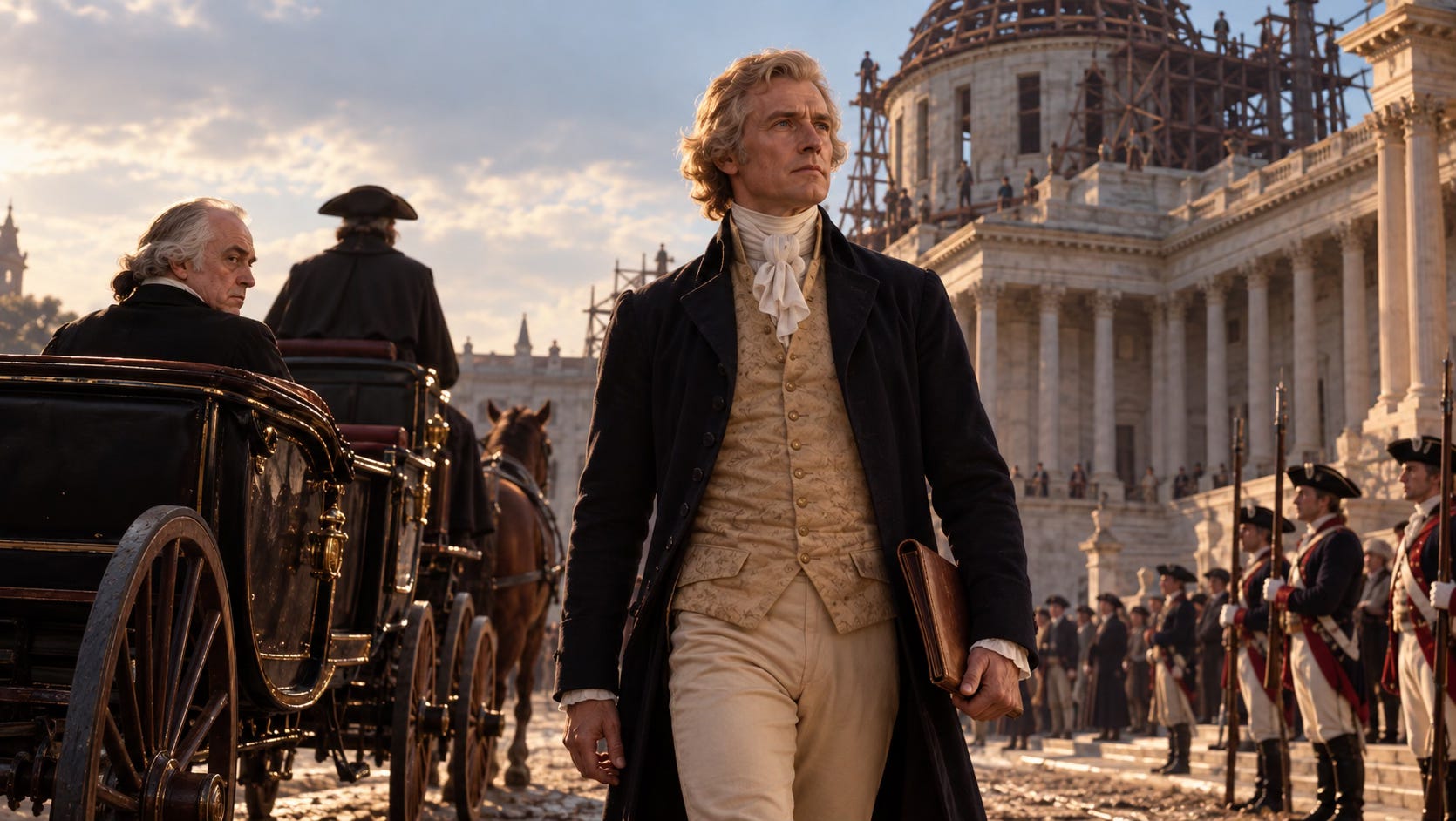
On the morning of March 4, 1801, Thomas Jefferson walked from his boardinghouse in Washington DC to the unfinished Capitol and took the oath of office.
John Adams was not there. He had left Washington before dawn.
It was an awkward morning. It was also one of the most important mornings in the history of self-government.
For the first time under the Constitution, power passed from one faction to its bitter rival. The campaign had been vicious. The two men on the Committee of Five that drafted the Declaration of Independence had stopped speaking.
And yet no army moved. No one was arrested. The losing side packed its bags and went home.
Jefferson would later call it the revolution of 1800 — as real a revolution in the principles of government as 1776 had been in its form.
The difference was the weapon. In 1776 it was the musket. In 1800 it was the ballot.
The Primary Control
The men who wrote the Constitution did not trust power. We have spent a great deal of time on that here — Montesquieu, the Scots and their enlightenment, Madison’s machine of competing ambitions.
But every machine needs a power source.
Madison named it plainly in Federalist 51. A dependence on the people, he wrote, is no doubt the primary control on the government. The separation of powers, the checks and balances, the whole elaborate architecture — he called those “auxiliary precautions.”
Auxiliary. Backup.
The first line of defense in the American system was never the courts or the Senate. It was always the virtuous and educated citizen who played an active role in the upkeep of the Republic.
That is why the House of Representatives stands for election every two years. In Federalist 52, Madison argued that the House must have an immediate dependence on, and an intimate sympathy with, the people — and that frequent elections were the only way to secure it. The framers wanted representatives looking over their shoulders constantly.
They built the republic on the assumption that someone would be looking back.
The Founders’ Bet
The Founders also knew that a ballot by itself guarantees nothing.
Madison said it at the Virginia ratifying convention in June 1788: “To suppose that any form of government will secure liberty or happiness without any virtue in the people, is a chimerical idea.”
John Adams, writing to the Massachusetts militia ten years later, put it more bluntly. “Our Constitution was made only for a moral and religious People. It is wholly inadequate to the government of any other.” Which by the way, the religion that dominated the newly independent United States at the time was in fact traditional Christianity.
But this reliance on the people was essentially THE bet for the future of the Republic. Not on a wise king. Not on a class of credentialed managers. On ordinary, virtuous people, informed and engaged, governing themselves.
Jefferson made the bet explicit in an 1820 letter. He knew of no safe repository for the ultimate powers of society but the people themselves. And if the people were not enlightened enough to exercise that control wisely, the remedy was not to take power from them. It was to help inform and reform their indiscretion and allow them to repair their faults.
Read that again. The answer to an uninformed citizenry was never fewer citizens. It was better ones.
Where Liberty Is Learned
When Alexis de Tocqueville came to America in 1831, he went looking for the secret of the thing. He found it in the New England township.
Town meetings, he wrote, are to liberty what primary schools are to science. They bring it within the people’s reach and teach them how to use it.
Self-government was not something Americans received. It was something they practiced — in the town meeting, on the jury, in the vestry, on the school committee. The Constitution assumed those habits already existed. It did not create them.
Now look at where we are.
The offices with the most direct power over your daily life — the school board, the county commission, the city council, the sheriff, and in many states the judges — are routinely decided by a small fraction of eligible voters. In many cities, municipal elections draw a fifth of the electorate or less.
The national race has all the “sizzle” and gets the attention. The local race decides what your children read, what your property is worth, and whether your streets are safe.
What Leviathan Needs
Here is the uncomfortable part.
No one votes for a federal agency. The rules that govern your business, your land, your health care, and your children’s schools are increasingly written by people whose names you will never know and whom you can never remove.
The Founders did not design that system. But they did leave us the tool to answer it. The only officials with the authority to rein in the administrative state — to write the laws, control the purse, and confirm the appointments — are the ones you elect.
When citizens disengage, the elected branches quietly hand their power to the unelected ones. Congress delegates. The agencies fill the vacuum. And because no one is watching, no one notices.
Leviathan does not need to defeat the voter. It only needs the voter to be quiet and stay home.
What Showing Up Looks Like
The cure is not outrage. Outrage is cheap and it fades. The cure is attendance.
Vote in every election, not only the ones on television. Primaries and local races most of all.
Know who represents you at every level, by name.
Attend at least one public meeting a year — the school board, the county commission, the city council.
Serve when you are called. Jury duty is self-government in its purest form.
Teach your children that citizenship is something you do, not something you have.
None of this is glamorous. None of it was glamorous in 1776 either. Most of the Revolution was farmers walking to meetings or Washington grinding it out to stay alive; most of the Revolution is the antithesis of glamorous.
A Republic, If You Can Keep It
Look back at Philadelphia, September of 1787. The Constitutional Convention closed on September 17th. As Franklin left the State House, a woman in reportedly asked him what kind of government the delegates had made. His answer, as one delegate recorded it, has become the most quoted line of the founding.
A republic, if you can keep it.
The Founders handed us the machinery. They could not hand us the habit of running it. That part was always ours.
Liberty was won with muskets. It is kept with ballots — or it is not kept at all.
]If you enjoyed this article, you’ll love the documentary.
Thread of Liberty follows the entire thread of the American experiment — from ancient Rome and the Puritans, through the Revolution and the Constitution, to Tocqueville, Lincoln, Calvin Coolidge, and the modern Administrative State.
Watch the full feature documentary at ThreadofLiberty.com
Thank you for this brief but crucial article.