
Modern Americans have been trained to hear “American Revolution” and imagine something like the French Revolution: a clean break, a radical reset, a new man, a new order.
That’s not what most American revolutionaries thought they were doing.
In fact they believed in many ways they were doing the exact opposite. They believed they were defending inherited, God-given rights that no earthly power given so no earthly power had the authority to take away. They were fighting for their rights as Englishmen, rights assented to by previous Kings and Parliament, that were suddenly being stripped away by King George III and Parliament.
Which is why “restoration” is the better word.
The colonies saw themselves as Englishmen across the Atlantic. Englishmen with charters, rights, assemblies, and legal traditions.
Then Parliament and Crown started treating them like a revenue stream.
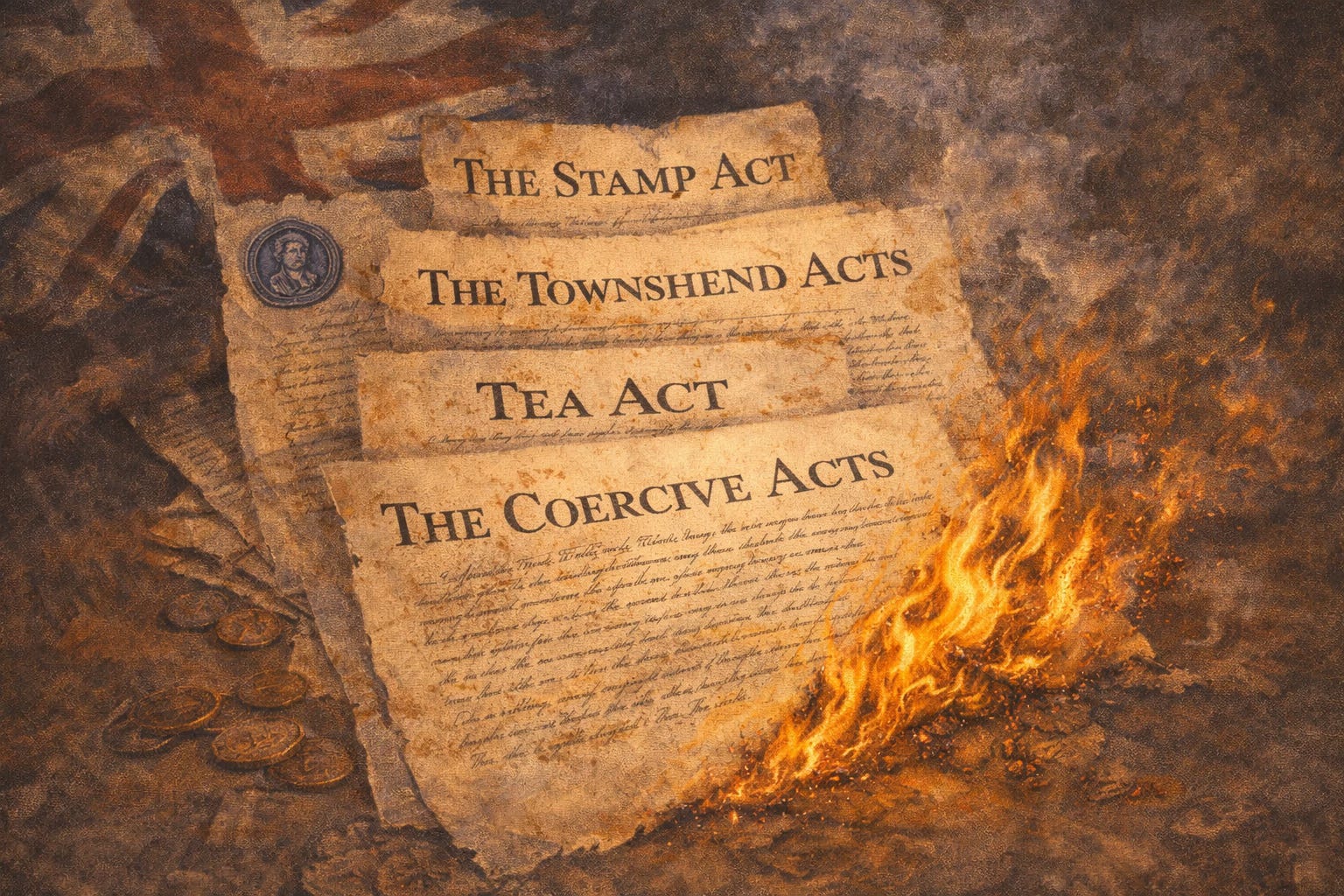
The Stamp Act.
The Townshend Acts.
The Tea Act.
The Coercive Acts.
And the deeper insult: the claim that representation was optional.
The crisis forced theory into practice.
And Thomas Jefferson did something brilliant: he distilled centuries of argument into a sentence structure that still makes tyrants nervous and created, for the first time in history, a rights based government:
Rights come from our Creator.
Government exists to secure them.
Government derives power from the consent of the governed.
When government becomes destructive of those ends, the people can alter or abolish it.
That isn’t a mere “value.” It’s a claim about reality and how the world must work.
Which brings us to a modern trap: the attempt to shift the conversation from founding transcendent principles to founding values.
Values are changeable. They float. They can be voted out of existence.
Principles are meant to be sturdier—like load-bearing walls.
A nation built on values alone becomes whatever the strongest institutions say it is at any given moment.
A nation built on transcendent principles can argue—fiercely—while still sharing a common standard because those principles are immutable.
And yes, the Founders contradicted themselves. Slavery sits there like a moral indictment that no honest American should minimize, though we should also be honest about that issue: our Founders set in motion the process by which slavery, a practice in every part of the world for millenia, would eventually be abolished.
But here’s the crucial point: hypocrisy does not invalidate the standard—sometimes it proves the standard was high enough to expose hypocrisy.
The Founding did not create perfection.
It created a framework capable of self-correction.
And that framework depended on something else Americans have always had in abundance:
Innovation.
From long rifles to inoculation to learning-by-doing and then correcting mistakes, the Revolution revealed a national trait: we started scrappy, then we get frighteningly good.
Which is why the Revolution doesn’t end with the Declaration. It moves toward architecture.
Because philosophy without structure becomes a slogan.
Which brings us to Philadelphia.
The inherent fault of democracy is on full display. The founders of our democratic system understood the inherent danger: factions can organize, capture institutions, and use the machinery of government for their own benefit rather than the common good. We now need a restoration that reins in zealotry and extremism of factions and re‑anchors democracy in a balance between individual liberty and the health of the whole society.
What’s being revealed in sharp relief these days is that when one branch of government fails in its checks and balances duties the whole system lies in jeopardy. We have almost the entire third branch of government, the Judicial, going completely rogue, and the Congress, the only branch with the actual power to do anything about it, doing nothing.
And Congress itself is responsible for the creation and overwhelming growth of the leviathan that is the administrative state, by delegating their ordered Constitutional duties over to it instead of doing their job.
We are in the mess that we are because no one has called a halt to the long march away from the boundaries set up by the Constitution specifically designed to prevent such chaos and lawlessness. The most vivid example of this is our Congress is the only branch with the power to rein in the judiciary which has gone almost completely rogue and borderline megalomaniacal, impeding the Executive branch from fulfilling its lawful efforts and responsibilities.
It should be at the very least be required of anyone who wants to hold any government office, no matter how seemingly insignificant must first have to pass with an A+, an exhaustive course on the Constitution and exactly where the lines are that cannot be crossed, and will result in immediate dismissal if caught doing so.
But then that would mean executing consequences, and clearly those don’t happen to anyone these days, no matter how egregious the crime they’re guilty of perpetrating.