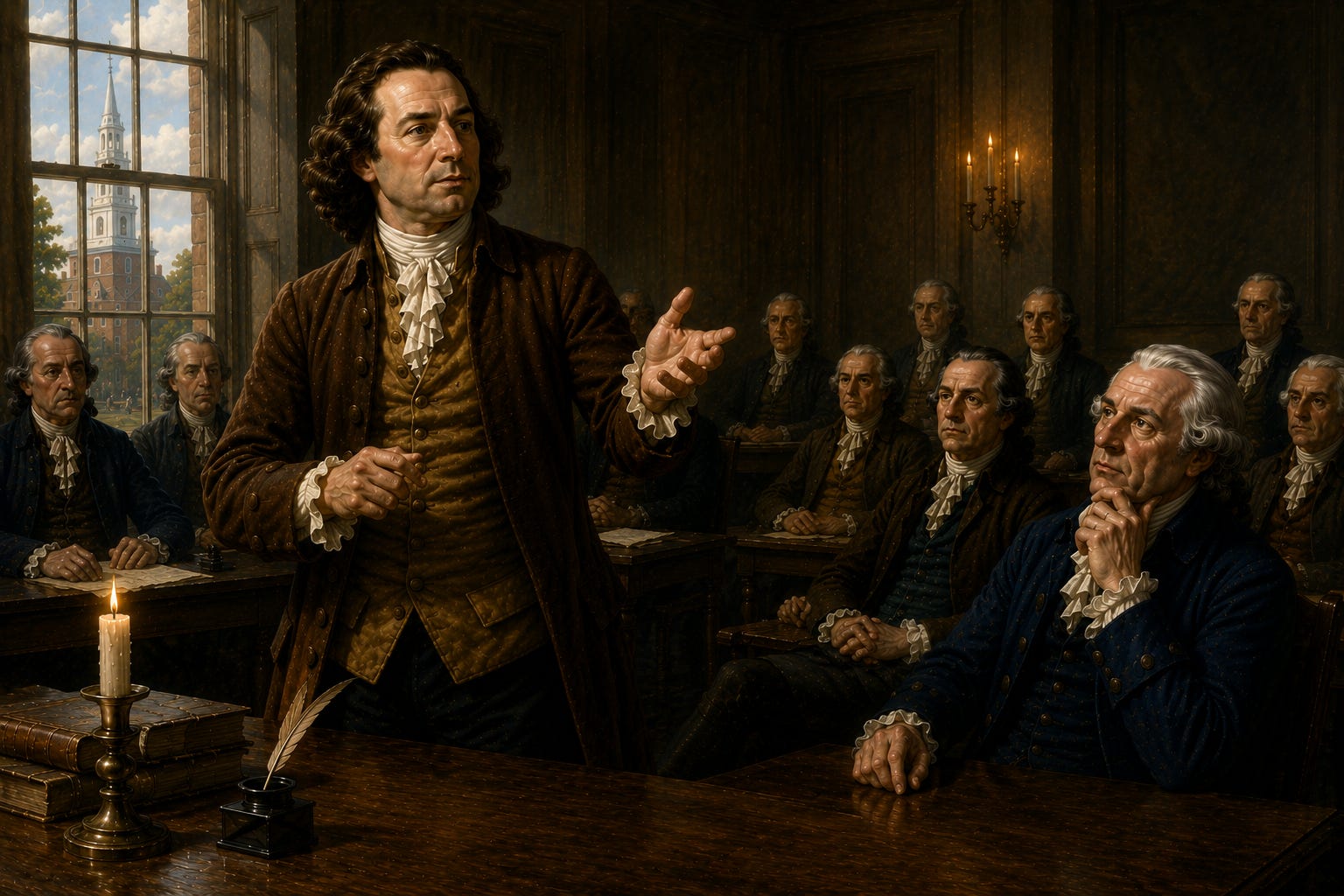
The Rights Document That Shaped America
George Mason and the Virginia Declaration of Rights
June 12, 1776
Before the Declaration of Independence announced liberty to the world, Virginia defined what liberty actually meant.
On June 12, 1776, Virginia adopted the Virginia Declaration of Rights, primarily written by George Mason.
Most Americans have never read it, which is unfortunate because this document helped shape nearly every major rights tradition that followed in American constitutional history.
The Declaration of Independence. The Constitution. The Bill of Rights; all of them carry Mason’s fingerprints.
The Virginia Declaration asserted several revolutionary principles:
That all men are by nature equally free. That rights are inherent rather than granted by government. That power derives from the people. That freedom of religion and the press matters. That excessive punishment and general warrants are dangerous.
These ideas now sound familiar precisely because the American founding would eventually enurame and institutionalize them during the process of writing and raitfying the Constitution.
But in 1776, they represented a direct challenge to old-world assumptions about authority.
The European model treated rights largely as privileges granted by rulers. Attempts had been made throughout history to rein in the power of rulers via the Magna Carta and the English Petition of Right in 1628 and later the English Bill of Rights in 1689.
But what the American model increasingly did was treat rights as pre-political—existing prior to government itself. Yes, there were inherited rights as Englishmen. But more importantly, there were inherent rights given by a Creator standing outside of governments or kings or parliaments
That distinction changes everything, from where rights come from to the purpose of government.
If rights come from government, government can change or redefine them. If rights exist independently of government, then government itself becomes limited.
That is the real significance of the founding.
America did not merely replace one ruling class with another. It attempted something radically different: A constitutional system where political power itself remained constrained by higher principles. What no earthly power gave, no earthly power could take away.
George Mason understood the danger of unconstrained authority. This is why he would later refuse to sign the Constitution without a Bill of Rights as he feared centralized power even after independence had been achieved.
That concern remains deeply relevant.
The administrative state consistently expands by treating rights as permissions managed by society or government or experts rather than as sacrosanct rights that limit government.
The founders viewed the relationship in reverse: government existed to secure liberty. Not redefine it.
The Virginia Declaration of Rights helped establish that principle before the United States formally existed.
And because it did, America developed into something historically unusual: a republic built on the idea that rights belong to citizens and never to the state.

