
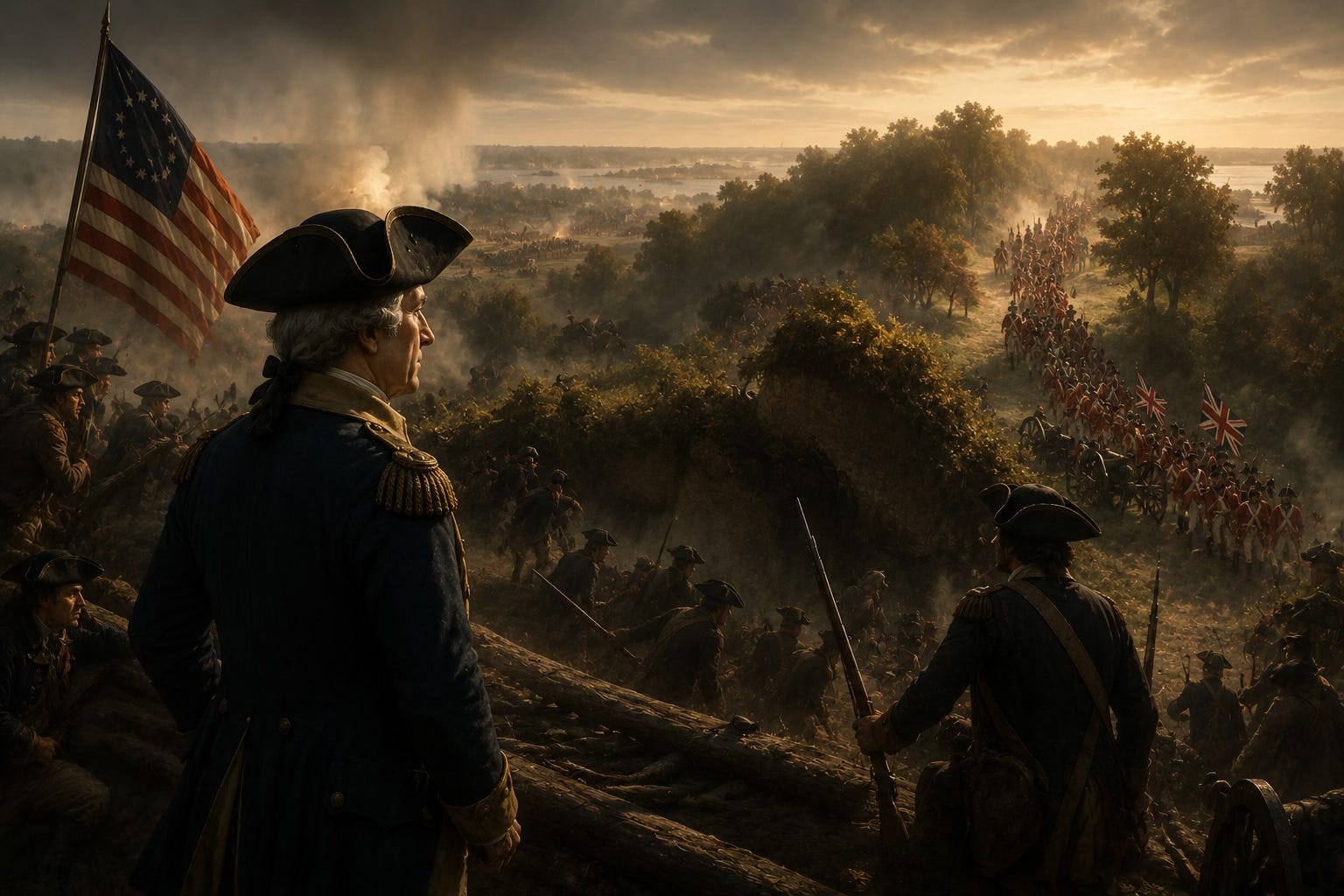
There were four ways through the Heights of Guan on Long Island.
The ridge ran across the island east to west — wooded, one hundred to a hundred and fifty feet tall, steep enough to be a real obstacle and cut by exactly four passes. From west to east: the Gowanus Road along the shore, Flatbush Pass, Bedford Pass, and, far out on the American left, Jamaica Pass.
Washington’s army guarded three of them.
The fourth, Jamaica Pass, was half-heartedly covered by five young militia officers on horseback.
Five men. For one of the most vulnerable parts in the American defensive lines.
Some context for how the Americans ended up in this position.
Howe had begun landing on Long Island on August 22 at Gravesend Bay, putting some twenty thousand men ashore in a few hours with the Royal Navy running the operation. It was a textbook amphibious landing, unopposed.
Washington had made a decision that military historians have criticized ever since: he divided his army between Manhattan and Long Island, because he could not determine where the main blow would fall and could not afford to be wrong either way. The result was that he was weaker than the enemy in both places.
Command on Long Island was muddled. Nathanael Greene, who knew the ground better than anyone, had fallen seriously ill. Israel Putnam took over days before the battle. John Sullivan held the center. William Alexander, who styled himself Lord Stirling, held the right along the Gowanus Road.
Roughly nine thousand raw American troops faced roughly twenty thousand professionals.
On the night of August 26, Howe did the thing that good generals do and mediocre ones talk about afterward. After he and the other British generals received word from Loyalist spies that the Jamaica Pass was lightly guarded, he and General Henry Clinton came up with a plan.
Howe left a force in front of the American center to make noise and hold attention. Then he personally led ten thousand men — with Clinton, Lords Cornwallis and Percy — on a night march east, around the American left flank, through the dark, dragging artillery, to Jamaica Pass.
In the early morning hours they took the five militia officers without a shot being fired.
By dawn the British army was through the pass and behind the American line. Two cannon shots signaled the trap closed.
The Americans in the center were still facing forward, fighting the diversion in front of them, when the muskets started behind them.
What followed was not a battle so much as a collapse. Sullivan’s line disintegrated. Men ran for the fortified lines at Brooklyn Heights through woods full of British and Hessian troops. Sullivan was captured. Stirling was captured. Casualty estimates run to about three hundred Americans killed and a thousand taken prisoner, against light British losses.
It was the largest battle of the entire war by the number of men engaged. It was also the most complete defeat the Continental Army would ever suffer.
Except for one thing, and it is the only thing worth remembering from that morning.
Stirling, on the right, understood before almost anyone else that the army was cut off and that the road to the Brooklyn lines — across the Gowanus Creek and its marsh — would be closed within the hour if somebody did not hold Cornwallis in place.
He had with him the 1st Maryland Regiment under Mordecai Gist. Roughly four hundred men, many of them from Baltimore’s better families, uniformed and drilled and new to combat.
Stirling ordered the rest of his command to save itself across the creek. Then he took the Marylanders and attacked.
Uphill. Into a fortified stone house held by Cornwallis’s grenadiers and artillery. Not once. By most accounts they came on five or six separate times into a force that outnumbered them five to one, re-forming after each repulse and going in again.
They could not take the position. They would never take the position. That was not what they were doing.
They were buying minutes, and they paid for them at the going rate. Somewhere around two hundred and fifty of them were killed or wounded in that field. The survivors were mostly captured. Stirling, refusing to surrender to Cornwallis, walked over and surrendered to a Hessian officer instead.
Washington watched it from a redoubt on the heights. The words attributed to him have echoed for two hundred and fifty years:
“Good God, what brave fellows I must this day lose.”
The men who got across the creek because of them went on to hold the Brooklyn lines that afternoon — and to be part of the army that survived the next three days, and the next seven years.
Two lessons, and they cut in different directions.
The first is about attention. An army with three passes covered and one unwatched is not an army with seventy-five percent security. It has none. A defense is only as strong as the gap nobody is looking at, and the enemy’s entire profession consists of finding that gap.
The second is about what a small number of committed men can purchase with their lives when the situation is hopeless and they act anyway.
Howe had the American army trapped on the night of August 27 — pinned against the East River with the Royal Navy positioned to seal the escape. He declined to storm the Brooklyn works, remembering Bunker Hill, and settled in for a siege.
It was the best decision available to a careful professional soldier.
It was also the mistake that lost Britain the war, because two nights later something happened on that river that the Americans would spend the rest of their lives calling providential.
If you enjoyed this article, you’ll love the documentary.
Thread of Liberty follows the entire thread of the American experiment — from ancient Rome and the Puritans, through the Revolution and the Constitution, to Tocqueville, Lincoln, Calvin Coolidge, and the modern Administrative State.
Watch the full feature documentary at ThreadofLiberty.com
this battle offers two timeless strategic insights:
Non-linear Risk (The Weakest Link): Systemic security is defined by its blind spots rather than its overall coverage. Leaving one pass unguarded did not leave the army 75% secure; it reduced the entire defense to zero. In modern strategy, whether in cyber defense or supply chains, a single unmonitored node invalidates the whole network.
Over-optimising on Past Failures: Howe’s decision to halt his advance and initiate a siege was a rational choice designed to avoid repeating the heavy casualties of Bunker Hill. By playing it safe against past risks, he created the exact operational pause that allowed a low-probability event (the overnight river evacuation) to completely rewrite the outcome of the war.