
Scotland in the eighteenth century had roughly a million and a half people, terrible weather, and no political power to speak of.
But it also had Edinburgh and Glasgow and inside those two cities a generation of thinkers — Francis Hutcheson, David Hume, Adam Smith, Thomas Reid, Adam Ferguson — who between them reinvented moral philosophy, economics, sociology, and the theory of how human beings actually behave.
Not how they ought to behave. How they do.
That distinction is the whole Scottish contribution, the Scottish Enlightenment, and it is in many ways the reason the American Constitution reads the way it does.
The French Enlightenment tended to begin with a theory of man and then design institutions to fit it. Perfect the man, perfect the state. The Scots ran the opposite direction. They started with man as he is — self-interested, tribal, easily flattered, prone to faction, occasionally capable of remarkable virtue but usually not — and asked what kind of institutions could produce decent outcomes anyway.
Adam Smith did it with markets. The butcher does not feed you out of love.
Thomas Reid did it with epistemology, answering Hume’s skepticism with what became known as Common Sense Realism: ordinary people can actually know things, and a philosophy that concludes otherwise has refuted itself, not the world.
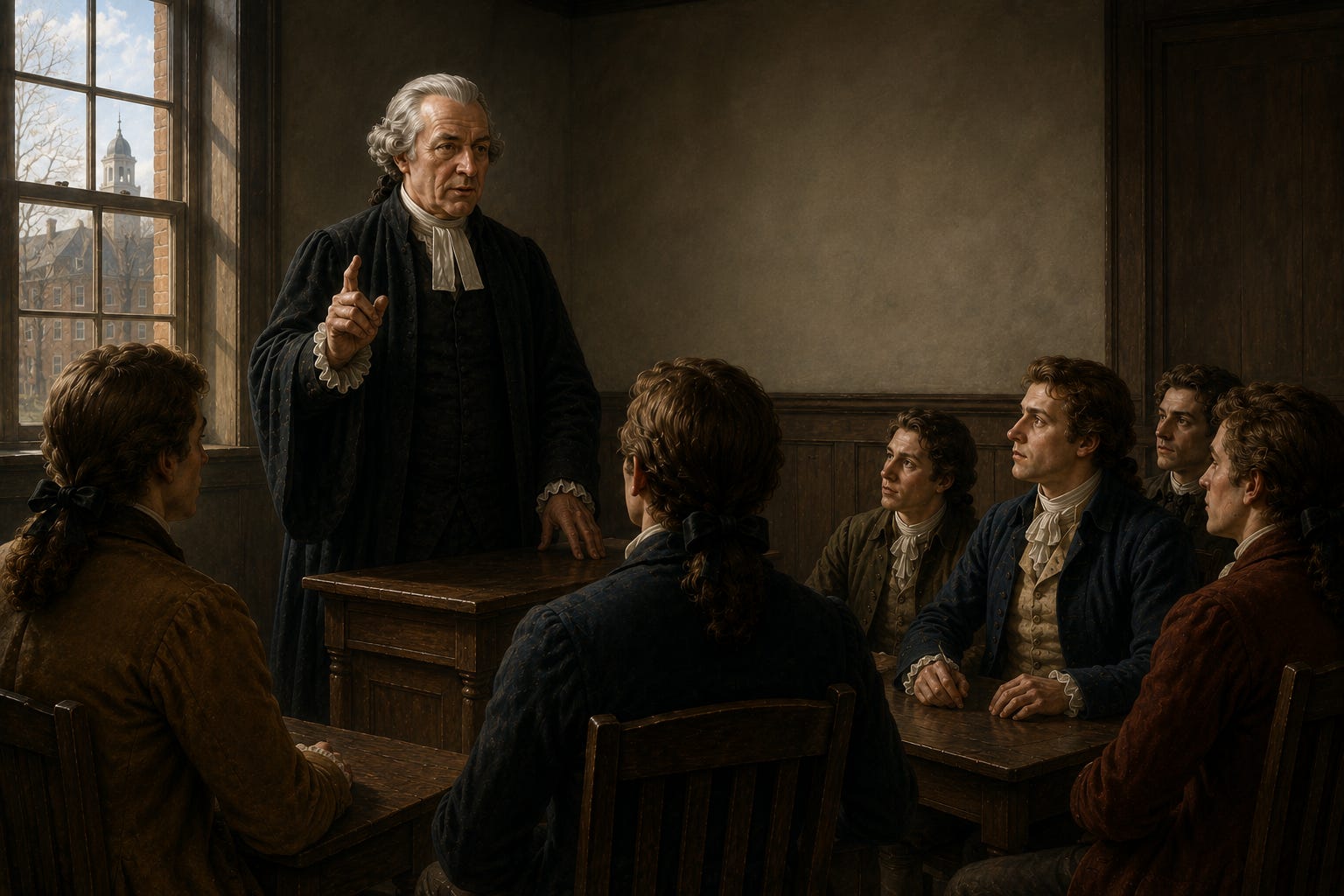
A Presbyterian minister named John Witherspoon carried the entire apparatus of thought across the Atlantic and installed it in a small college in New Jersey.
Witherspoon arrived in 1768 to become president of the College of New Jersey — the school we now call Princeton. He had been recruited out of Paisley, Scotland, and he had to be asked twice because his wife did not want to cross the ocean.
Witherspoon should be more famous than he is: he was the only active clergyman to sign the Declaration of Independence. He served in the Continental Congress through most of the war. But the signature is the least of it.
Look instead at the roll of students who passed through his classrooms: a President of the United States, a Vice President, dozens of Congressmen and Senators, a dozen governors, cabinet secretaries, Supreme Court justices, and a substantial bloc of the men who would sit in Philadelphia in 1787: James Madison, Gunning Bedford Jr., William Richardson Davie, Jonathan Dayton, Oliver Ellsworth, William Paterson, and Luther Martin.
Witherspoon did not simply preside over these men. He taught them personally. Moral philosophy was the capstone course at the college and the president taught it himself, lecturing on natural law, on the origins of civil society, on the rights of conscience, on the necessity of dividing power because power concentrated will be power abused.
The lectures were Scottish philosophy in American clothes.
His most consequential student stayed an extra year.
James Madison finished the standard course early — he compressed three years into two, wrecked his health doing it, and then remained at the College of New Jersey for further study with Witherspoon, working through Hebrew and ethics and, one assumes, a great deal of conversation.
Madison was small, quiet, and physically unimpressive. He was also the most systematic political mind of his generation, and when the moment came he did what a Witherspoon student would do: he read.
In the months before the Constitutional Convention, Madison worked through crate after crate of books Jefferson had shipped him from Paris, and he produced a memorandum on the ancient and modern confederacies — a catalog of every republic he could find and precisely how each one had died.
The diagnosis was always the same. Faction. One interest gathering enough strength to crush the rest.
The Scottish answer was not to abolish faction, because you cannot abolish human nature. The Scottish answer was to arrange things so that faction checks faction.
Madison wrote it up in Federalist 10. The remedy for the dangers of faction is not a smaller, purer republic where everyone agrees, which is what political theory had assumed since Aristotle. It is a larger one — extend the sphere, multiply the interests, and no single faction can assemble a majority to oppress the others.
He wrote the deeper premise in Federalist 51, and it is the single most Scottish sentence in American literature:
If men were angels, no government would be necessary.
Read the rest of that passage. If angels governed men, no controls on government would be necessary either. The difficulty is that you must first enable the government to control the governed, and then oblige it to control itself.
That is Witherspoon’s classroom, restated as constitutional architecture.
Which brings us to the uncomfortable part.
The entire American system was designed by men who assumed that whoever holds power will misuse it, and who therefore built a machine of competing ambitions to make misuse difficult.
The modern administrative state is built on the opposite assumption. It assumes a class of credentialed experts whose judgment is disinterested, whose expertise substitutes for consent, and who therefore do not require the same checks as ordinary politicians — because they are not really exercising political power at all, merely applying neutral technique.
That is not a Scottish idea. It is the French one, arriving late.
Madison had a phrase for what happens when the same hands write the rules, enforce the rules, and judge the disputes under the rules.
He called it the very definition of tyranny. He was quoting a Frenchman when he said it — but that is the next essay.
If you enjoyed this article, you’ll love the documentary.
Thread of Liberty follows the entire thread of the American experiment — from ancient Rome and the Puritans, through the Revolution and the Constitution, to Tocqueville, Lincoln, Calvin Coolidge, and the modern Administrative State.
Watch the full feature documentary at ThreadofLiberty.com
George Whitefield of England, itinerate Methodist Minister out of Cambridge, was also highly influential with revolutionizing the American Mindset of the day towards the acceptance of ideology behind the Declaration of Independence and American Revolution. His work even ended in early death...So strenuously did he travel, teach and preach.
While it's certain the Freemasons, Illuminati and other secret societies existed...Christianity was much more influential. The Secret Societies have INFILTRATED U.S institutions almost to saturation after almost 120 yrs. to 1920.
Now, treason is the norm and it is as common as air among the arrogant infiltrating U.S Govt. and all other institutions since the sell-out of Wilson bringing forth 'The Fed' and legal Income Tax still NOT supported by a majority of states to change the Constitution.
Those faithful to Jesus Christ are rising and the end of this time Psy-Ops; this
'Age of Darkness' via Cultural Warfare is yet to have a victor.