
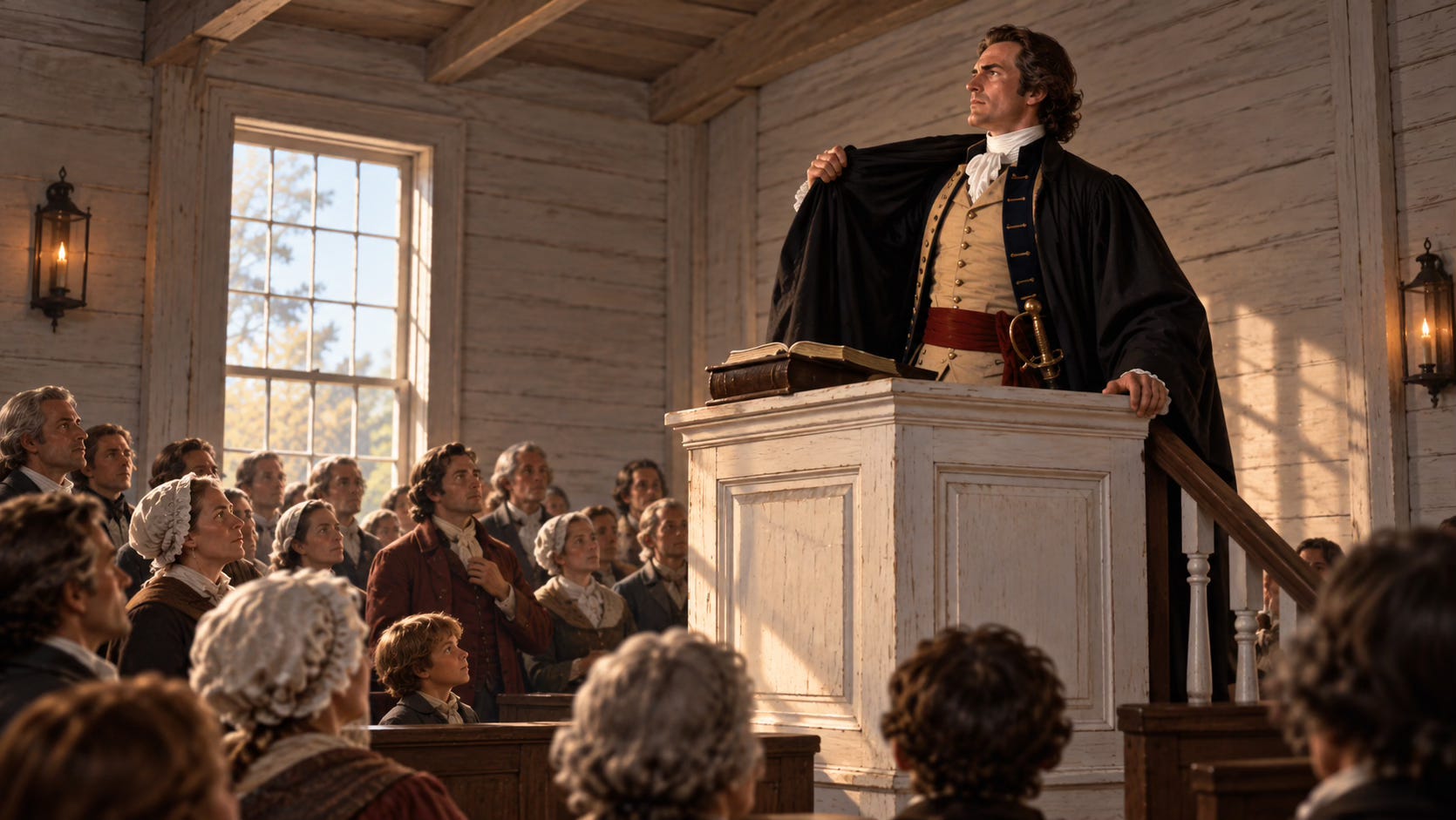
Peter Muhlenberg was twenty-nine years old in January 1776, the Lutheran pastor of Woodstock, a small German settlement in Virginia’s Shenandoah Valley. His father, Henry Melchior Muhlenberg, had come over from Germany a generation earlier and built the Lutheran church in America nearly from nothing. The son was supposed to carry that work forward. He had the training. He had the congregation. He had the name.
That winter day his people filled the church not knowing it would be his last sermon.
He took his text from Ecclesiastes 3: To everything there is a season, and a time to every purpose under heaven. A time to plant, and a time to pluck up. A time to keep silence, and a time to speak. A time of peace.
Then, as the account has it, he paused, looked out at the families he had baptized and married and buried, and according to accounts, firmly said: and now is the time for war!
He pulled off his clerical robe. Beneath it was the uniform of a Continental Army colonel.
Understand that Muhlenberg did not stumble into the Revolution. He walked in with his eyes open.Virginia had an established church, and it was not his. To serve his Lutheran congregation with full legal standing, he had to sail to England in 1772 and take orders from the Church of England. A Lutheran pastor had to ask the Crown’s church for permission to minister to Lutherans. He did it. Then he came home and went to work on the resistance.
He sat in the House of Burgesses. He chaired his county’s committee of safety. He knew Patrick Henry and George Washington. By the time he climbed into that pulpit, he understood what it meant to live under a power that decided who could preach and on what terms.
He raised and commanded the 8th Virginia, known as the German Regiment, filled largely with men from the Valley. He was the youngest of the Colonels in the Virginia Line in the Continental Army. Many of the men in his regiment came out of his own congregation. They’d followed their pastor in peace. And now they followed him in war.
In 1777 Congress made him a brigadier general. He fought at Brandywine and Germantown. He wintered with Washington at Valley Forge, where the army nearly starved and did not quit. He fought at Monmouth. He was legendarily ferocious in battle. When the Hessians saw him coming at Brandywine on his large white horse, according to legend they began calling out to each other, “Hier kommt Teufel Piet!”: Here comes Devil Pete!
Muhlenberg became one of Washington’s most trusted generals. He was at Yorktown when it ended; you can see him today in the Capitol Rotunda in John Trumbull’s famous painting, sitting on his horse among Washington’s other generals. At the close of the war he was brevetted a major general.
Afterward he served Pennsylvania in its executive council and the new nation in the House of Representatives, and was elected to the Senate. His brother Frederick became the first Speaker of the House. Peter’s statue stands today in the United States Capitol, still caught in the moment of casting off the robe.
Modern readers tend to see a tension in the story. The man of peace picks up a sword. The shepherd becomes a soldier. Surely something had to give.
Muhlenberg did not see it that way. Neither did most of his generation. The Declaration said men were endowed by their Creator with unalienable rights. If that was true, then liberty was not a policy. It was a gift. And a gift from God was worth defending with everything a man had, including his life.
For Muhlenberg, the pulpit and the regiment served the same end. It was that simple and that complete.
The lesson here is that where rights come from decides who can take them away.
A right that comes from God sits above the state. The state can violate it, but it cannot revoke it. A right that comes from the state is something else. It is a permit. And permits can be amended, conditioned, suspended, and reinterpreted by whoever holds the pen.
As a reminder for today, the administrative state runs on permits. Licenses, waivers, guidance documents, compliance regimes. None of it asks where your rights come from. It simply assumes they come from the agency, and it waits for you to assume the same.
Muhlenberg had already asked the Crown for permission once, just to preach. He did not ask again. Muhlenberg took up the thread and took off his robes to do it. It is one thread in a much longer story, the story of how a free people grasped an idea and refused to let it go.
That story is one of the subjects in our book, The Thread of Liberty: Keeping Our Republic, which is the companion book to the documentary of the same name. If this stirred something in you, watch the film and buy your copy of the book. The republic was kept by people who understood what they had been given. Be one of them.
Another history lesson learned and passed on.
Why do you choose to disable Pangram AI scanning on your pieces?