
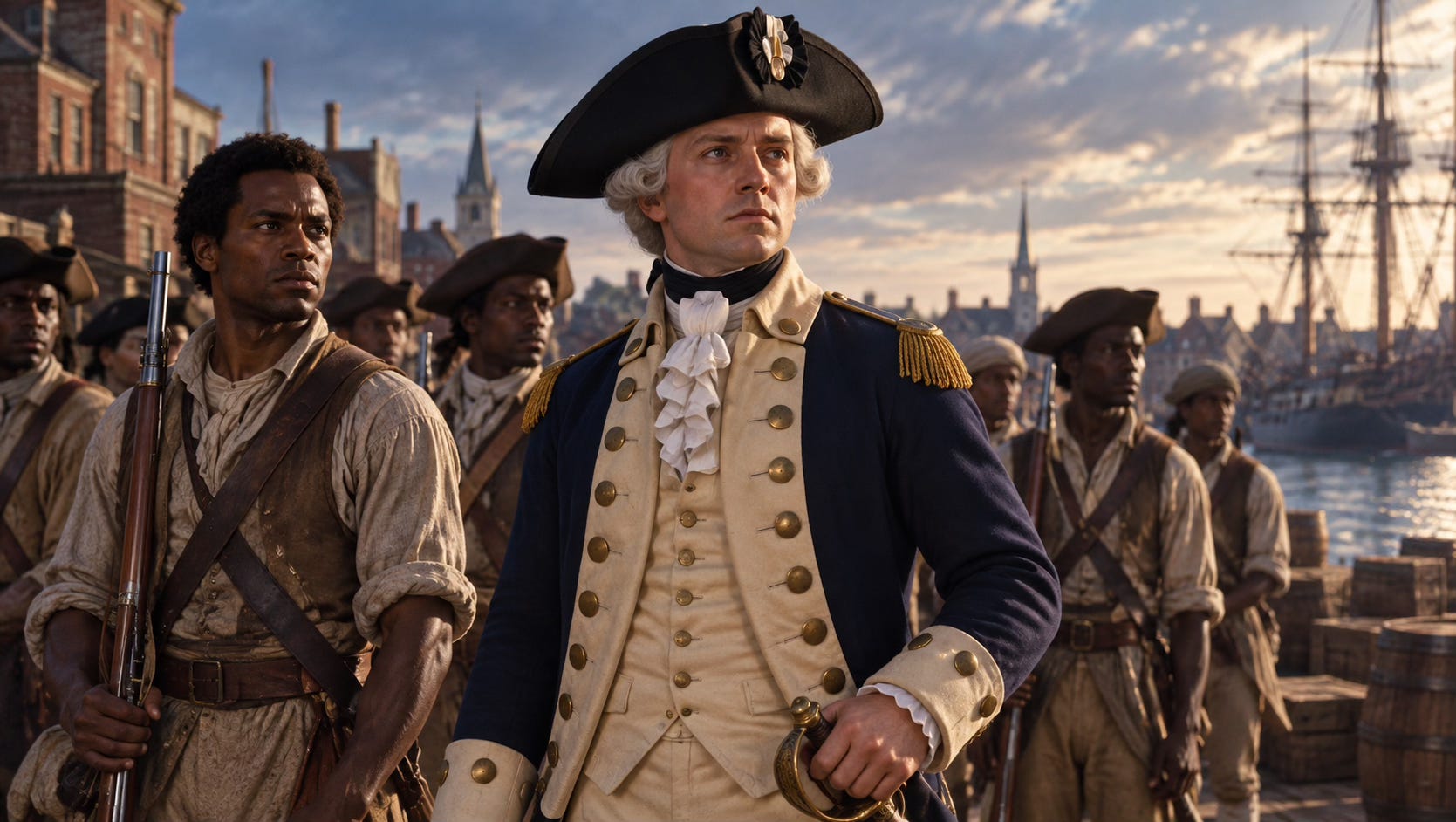
His father was Henry Laurens of Charleston: president of the Continental Congress, American commissioner to the Netherlands, and for a period of time, the largest slave trader in North America.
The firm of Austin and Laurens handled the sale of thousands of human beings through Charleston harbor. Henry Laurens later expressed misgivings, in the manner of many men of his class and generation, yet continued to sell and hold people in bondage.
His son concluded that the whole thing was indefensible and said so out loud, repeatedly, in public, during a war.
John Laurens was educated in Geneva, Switzerland and then read law in London, which meant he spent his formative years outside the American South in circles where the moral case against slavery was being argued seriously. He came home in 1777 with a wife left behind in England, along a small child he would barely know, and a determination to get into the war.
He joined Washington’s military family as an aide-de-camp, unpaid and as a volunteer.
The staff he joined included Alexander Hamilton, and the two became extraordinarily close. Their correspondence is famous and the modern argument about how to characterize it is not one this publication needs to settle. What is beyond dispute is that Hamilton wrote to him with an intimacy he showed almost no one else, and that when Laurens died Hamilton wrote that he felt the loss of a friend he had truly and most tenderly loved, and that he would never again allow himself to feel that way about anyone.
Laurens was reckless in combat to a degree that alarmed everyone around him. He was wounded at Germantown carrying a torch toward the fortified Chew House, a moment in the battle that proved to be the undoing of the Americans that day. With the Americans unable to take the house, Laurens took it upon himself to try and burn the British out, managing to open the front door while under heavy fire before throwing in a burning brand. He was shot in the shoulder for his troubles.
He was in the thick of Monmouth. He fought a duel with General Charles Lee over Lee’s public abuse of Washington. With Hamilton acting as his second, Laurens narrowly missed killing Lee, who was in fact a skilled duelist: Lee missed but Laurens put a shot into Lee’s right side, a wound that would prove to be non-fatal.
But the thing Laurens really cared about was his idea of a freed regiment.
By the winter of 1778 the southern states were badly short of troops and the British were about to move south in force. Laurens proposed a solution that was, in his mind, both military and moral: raise three thousand men from among the enslaved population of South Carolina and Georgia, arm them, pay their owners compensation, and grant every man his freedom at the end of his service.
He argued it to his father, who was initially appalled and then partially persuaded. He argued it to Washington, who was skeptical about the consequences but did not block it. Hamilton wrote to Congress supporting it and made an argument that is worth remembering: that the objection people would raise — that these men lacked the capacity to be soldiers — was an excuse dressed up as an observation, and that their natural faculties were probably as good as anyone else’s.
In March of 1779, the Continental Congress recommended the plan to South Carolina and Georgia.
South Carolina rejected it overwhelmingly. Laurens brought it back to the legislature after Charleston fell and the state was under occupation, when the military argument was as strong as it could possibly be. It was rejected again by a crushing margin. One observer reported that the proposal was received with horror by persons who would sooner lose the war than arm the men they owned.
Laurens went to France instead, as a special envoy in 1781, and came back with money and supplies that materially helped the Yorktown campaign. He served at Yorktown and was one of the two officers who negotiated the articles of Cornwallis’s surrender.
And then, on August 27, 1782, ten months after Yorktown, with peace negotiations already underway in Paris and the war effectively decided, he rode out with a small detachment against a British foraging party on the Combahee River in South Carolina.
He rode into an ambush and was shot dead almost immediately. He was twenty-seven. The engagement had no strategic purpose whatsoever. It is one of the last actions of the war, and it accomplished nothing.
Washington’s letters afterward carry more grief than he usually permitted himself. Greene wrote that Laurens had too much of what he called the spirit of enterprise, which is a general’s way of saying he could not be kept out of danger.
Two things are worth holding onto.
The first is that Laurens is the counterargument to the claim that nobody at the founding could have known better. He was from the deepest part of the slaveholding South, from the family that had profited most directly, and he knew it was wrong and he said so. He tried to do something concrete about it in the middle of a war when it was actively dangerous to his position and his family’s.
The moral knowledge was available in 1779. James Otis had it in 1764. Some men acted on it. Most did not.
The second is what South Carolina’s refusal actually reveals. Offered a plan that might have saved the state militarily, the legislature chose the risk of losing the war over the risk of the precedent. That decision tells you something exact about the strength of the interest the founding generation left in place, and about why it eventually took nearly seven hundred thousand dead to remove it.
If you enjoyed this article, you’ll love the documentary.
Thread of Liberty follows the entire thread of the American experiment — from ancient Rome and the Puritans, through the Revolution and the Constitution, to Tocqueville, Lincoln, Calvin Coolidge, and the modern Administrative State.
Watch the full feature documentary at ThreadofLiberty.com