
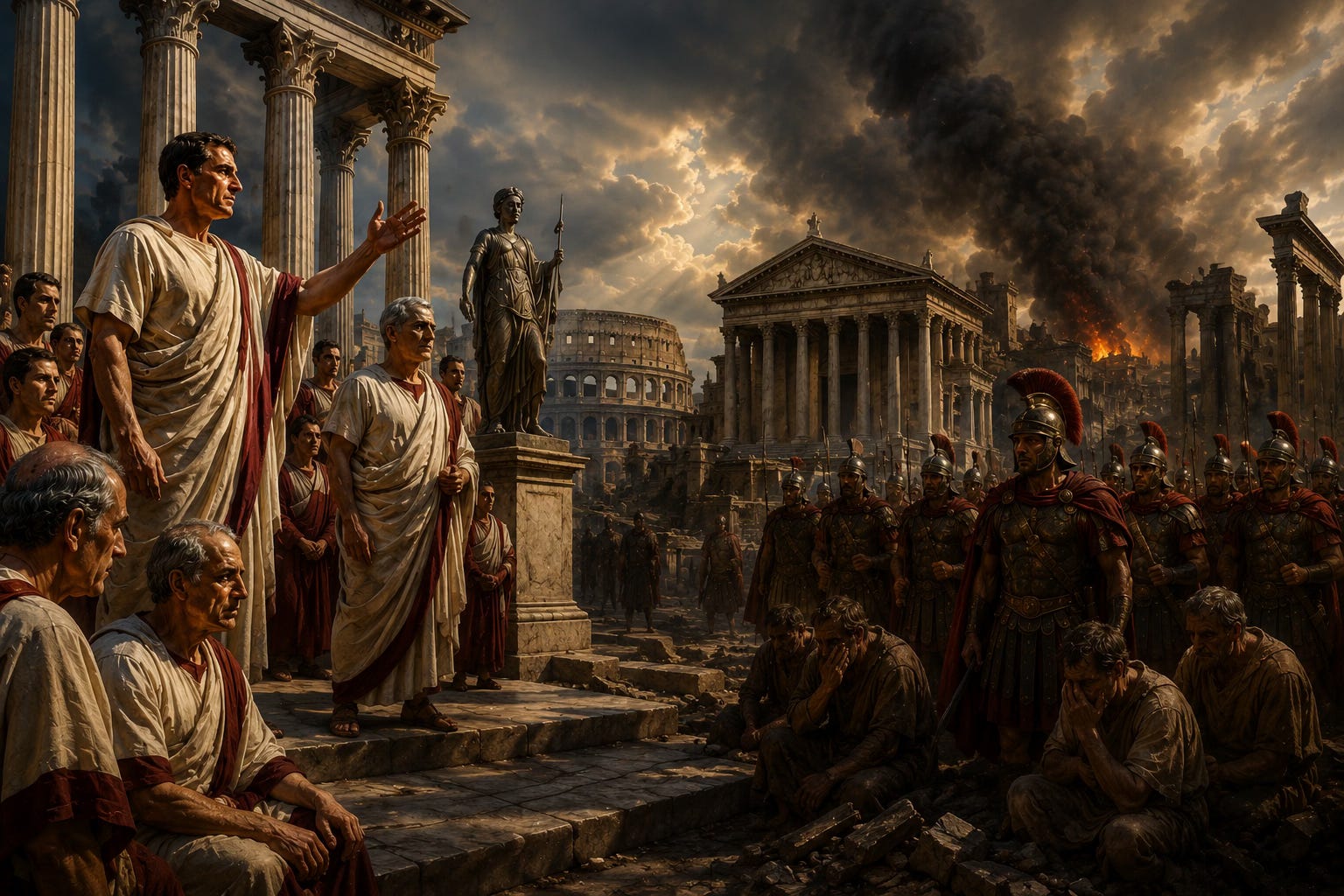
Rome had no Bill of Rights or written constitution or Supreme Court.
Yet the Roman Republic endured nearly five centuries.
How?
The Romans had something they called the mos maiorum, which means, “The ways and traditions of the ancestors.”
It wasn’t law. It wasn’t legislation. It wasn’t enforced by courts. It was more like the British Common Law: unwritten, understood and with expectations.
Citizens behaved a certain way because that was what honorable Romans did.
One took a ten year interlude before running for consul again. Consuls served one year and then surrendered power. Generals returned home. Senators placed the republic above themselves.
Until they didn’t.
That is the important part.
The republic did not collapse because someone ignored one law.
It collapsed because enough Romans stopped believing the unwritten rules still mattered. The forms survived but the spirit disappeared. The Senate still met, elections still occurred, titles remained.
But the civic trust had evaporated. It became clear that Rome’s gods and religion were not strong enough to enforce the mos maiorum and it became apparent that the ways and traditions of the ancestors was really just a gentlemen’s agreement and the gentlemen stopped agreeing.
Marius and Sulla eviscerated the norms and then Julius Caesar crossed the Rubicon.
By then, the Roman Republic was already dying. The Founders studied Rome obsessively because they feared precisely this sequence.
Not invasion, but Internal decay. Not foreign enemies, but citizens forgetting what citizenship requires.
Franklin understood it. Washington embodied it. Lincoln rescued it.
Tocqueville later recognized it.
Every republic depends upon habits that no constitution can manufacture.
The Constitution restrains government. But no amount of laws or traditions can restrain a people who have shrugged off virtue and individual self-governing.
In the end, if there is to be a virtuous republic the citizens must restrain themselves. There must be a virtue based on transcendent values with an understood enforcement mechanism of eternal rewards and punishments. The question still in the balance today is whether enough citizens of the American Republic will renew and restore the virtue necessary for the long-term survival of the republic.
If you enjoyed this article, you’ll love the documentary.
Thread of Liberty follows the entire thread of the American experiment—from ancient Rome and the Puritans, through the Revolution and the Constitution, to Tocqueville, Lincoln, Calvin Coolidge, and the modern Administrative State.
It is called Moral Authority the constraint on behavior that comes from a common understanding of moral purposes. Exactly what we have lost in the US and Western Civilization that can never be restored by laws. And what is possessed in Iran that cannot be destroyed with bombs. The people themselves must evolve, fully accept and incorporate into daily living. It is the antithesis of unrestrained individualism currently at the core of our society and the reason our society will go the way of the Romans. It is only a question of how and when.
What did Lincoln rescue? He destroyed the original Constitution and invaded illegally sovereign states which felt there was no place for them in the Yankee dominated republic. The war was not about freeing the slaves(see his support for the Corwin Amendment )but an attempt to incite slave revoltswhich did work. It was the Confederate States which wished to retain the original compact, namely, a Republic of Republics