
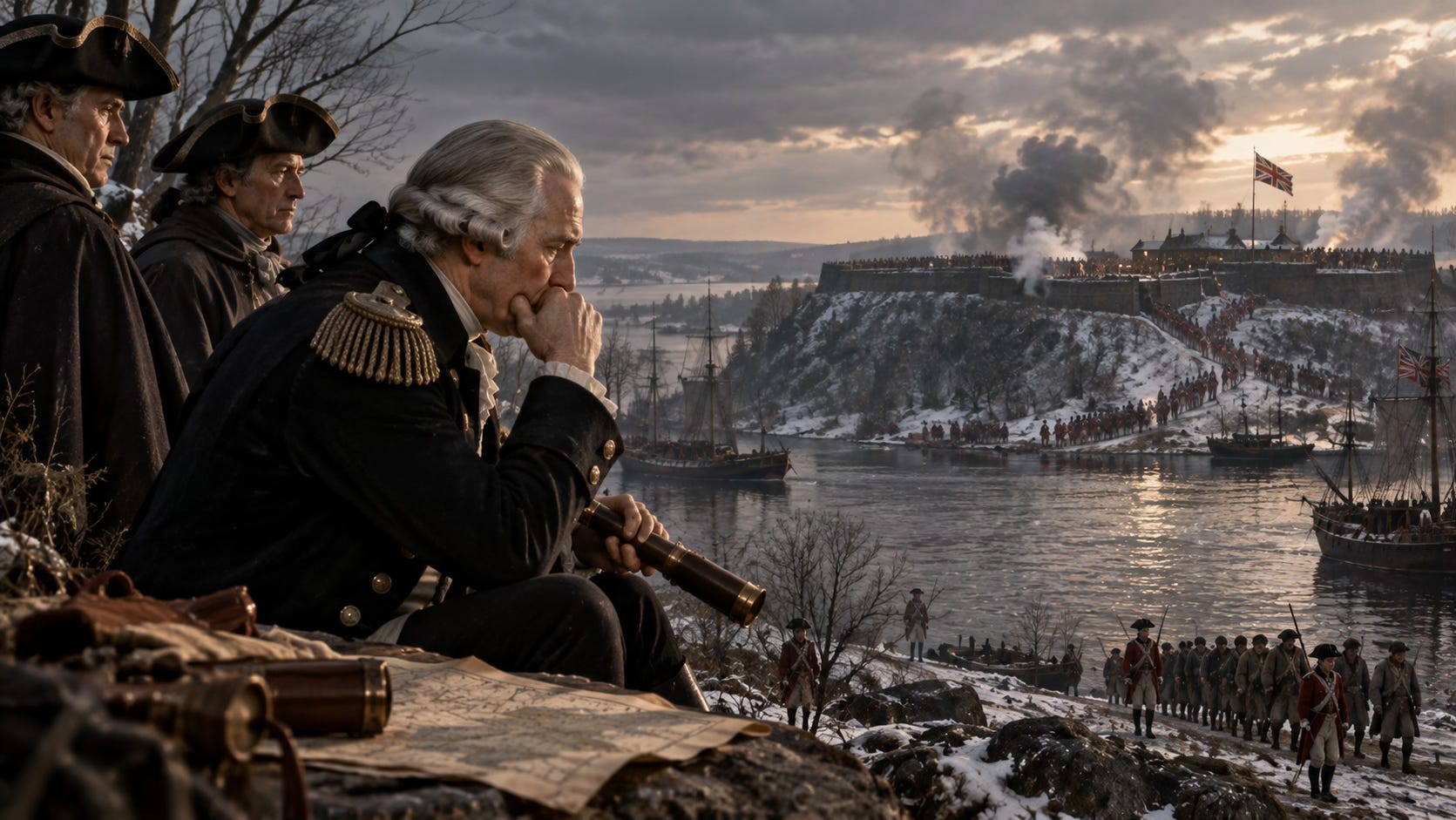
Fort Washington sat on the highest ground on the northern end of Manhattan Island, looking down on the Hudson, and it was named after the man who would lose it.
By November of 1776 it was the last American position on the island. The army had been driven north through Harlem Heights and White Plains. The rest of New York was gone. What remained was a garrison of roughly three thousand men in an earthwork fort with no interior water supply, no bombproof shelter, and no realistic means of retreat if the position were surrounded.
Washington was uneasy about it and had been for weeks. Nathanael Greene, who commanded in the area and whose judgment Washington trusted more than his own, urged that the fort could be held and evacuated by boat if it came to that. Congress had passed a resolution urging that the Hudson be obstructed and the position maintained.
Washington deferred. It is the clearest instance in the entire war of a commander overriding his own instinct because the people around him were confident and he was not.
There was a further problem, which nobody knew about.
Two weeks earlier, an adjutant named William Demont deserted and went over to the British, carrying the plans of the fort and details of the defenses. Howe went into the assault knowing where the weak points were.
On the morning of November 16 he attacked from three directions with roughly eight thousand men, British and Hessian.
The outer lines held longer than anyone expected. On the north, Hessian troops under General Knyphausen fought their way up steep, wooded ground under heavy fire and took serious casualties doing it. Margaret Corbin, whose husband was killed serving a cannon, took his place at the gun and kept firing until she was badly wounded — she would later become the first woman in American history to receive a military pension.
None of it mattered. The defenders were driven inside the fort, and inside the fort there was no room, no water, nowhere to go.
Colonel Robert Magaw surrendered that afternoon. Something close to twenty-eight hundred Americans marched out and into captivity.
Washington watched it from across the river at Fort Lee, through a spyglass, with Greene and Putnam beside him. Officers who were present said Washington wept.
He had reason to. This was the single largest loss of men in the war, and it was self-inflicted — a garrison placed in an indefensible position and left there past the moment when it could be withdrawn.
What happened to those prisoners is the part of the Revolution that Americans do not tell their children.
They were marched into New York and confined in churches, sugar houses, and eventually in the rotting hulks of prison ships moored in Wallabout Bay. Conditions on those ships were beyond anything a modern reader easily imagines: overcrowding, starvation rations, no sanitation, disease running unchecked through holds packed with men in the dark.
More Americans died in British captivity during the Revolution than died in combat in it. The best estimates run to something over ten thousand, and a great many of them came from the men who walked out of Fort Washington.
Four days later Cornwallis crossed the Hudson and Fort Lee was abandoned so hastily that the garrison left tents standing, cooking fires burning, and most of its cannon and supplies behind.
Then began the retreat across New Jersey — the long, humiliating, hundred-mile withdrawal through Hackensack and Newark and New Brunswick and Princeton to Trenton and across the Delaware, with the British close enough behind that on at least one occasion the rear guard was leaving a town as the advance guard entered it.
The army melted as it went.
Enlistments were expiring. Men went home. Militia did not turn out. New Jersey Loyalists came forward to take the oath of allegiance in numbers that shocked Congress. By the time Washington reached Pennsylvania in early December he had perhaps three thousand effective men left, and most of their enlistments ended on December 31.
Thomas Paine was with that column, and it was during this retreat that he began writing a new pamphlet, using a drum for a desk, describing summer soldiers and sunshine patriots. He knew first hand about it all because he had watched them leave.
There is a reason to sit with this article rather than skip ahead to the crossing of the Delaware, which is coming.
The story of the founding is usually told as a sequence of vindications, because we read it backward from the ending. But the men living it did not have the ending. What they had, in November of 1776, was a commanding general who had just made a catastrophic error that he had privately suspected was an error, three thousand men on their way to death in a prison ship, and an army disappearing at the rate of a regiment a week.
Washington wrote to his brother around this time that if every other man in the army had his feelings, he thought the game was pretty near up. But he also made it very clear that whatever happened, he was never going to surrender, nor was his neck fit for a halter, ie a hangman’s noose.
Washington in November and early December 1776 is not the marble Washington. He was a man at the bottom, in deep despair.
And then out of those depths, just a few weeks later, he did the most audacious thing any American commander has ever done, and it worked precisely because everyone on both sides believed his army was finished.
William Demont was an ancestor of mine, which brings shame to the family name. I had not idea how profound his actions were until I read this article. 3,000 deaths on his head.
When they arrived from France, some changed the name to DeMent, which is my family name. I did find another ancestor, George Dement, who served with the 3rd Battalion from Ohio County (WV).